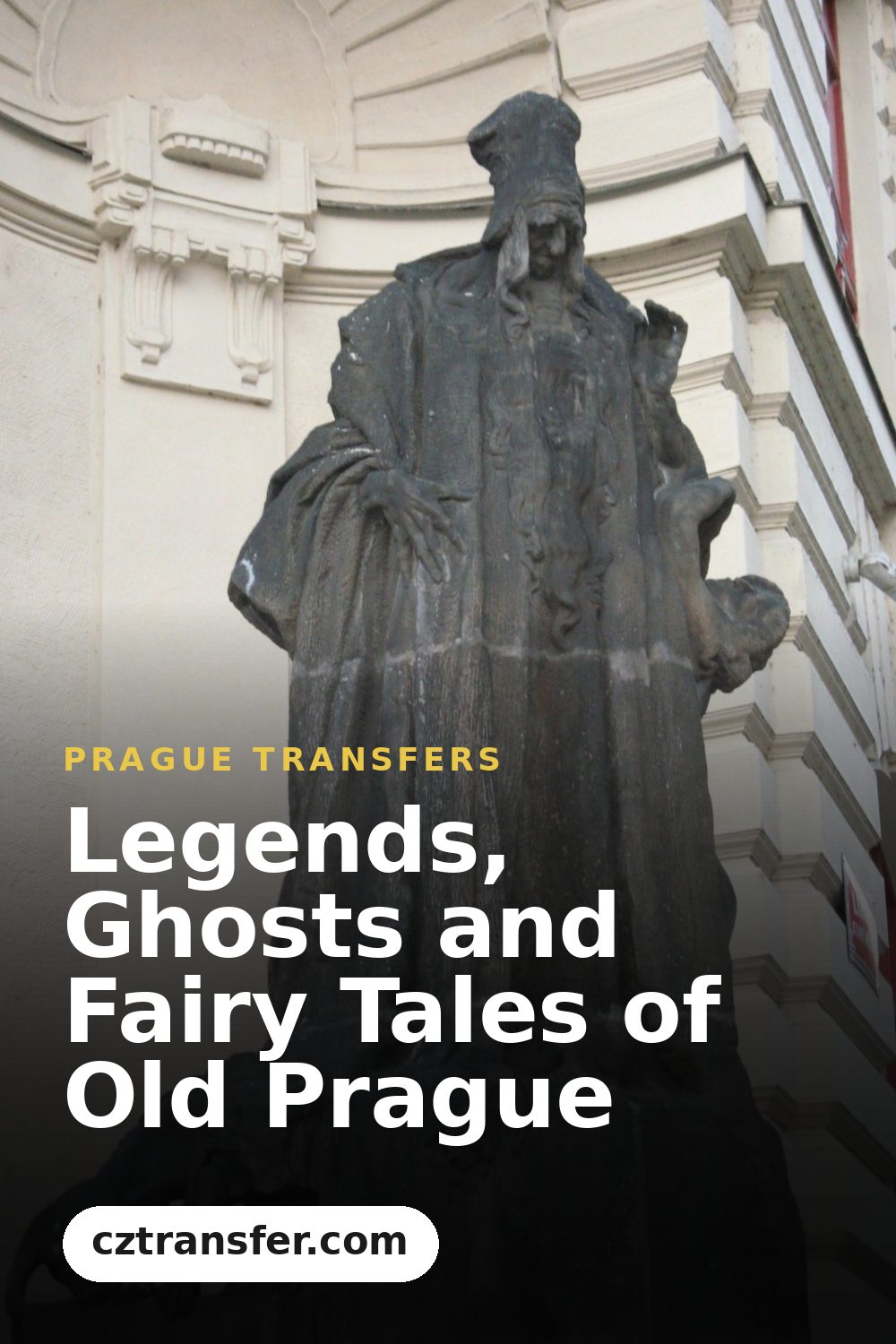
Legends, Ghosts and Fairy Tales of Old Prague
Prague has more ghosts per street than almost any city in Europe — and more legends cast in bronze and stone than most. Princess Libuše still points to the future from the Vyšehrad gardens, a knight with a golden sword stands in the river below Charles Bridge, and Rabbi Loew turns away from Death on the corner of the New Town Hall. Here are the legends, ghost stories and fairy tales of old Prague, grouped by district, with the monument you can see for each one — so you can stand on the spot yourself.
Weather in Prague
Updated 22 Nov, 11:39
Exchange rate
| 1 EUR (Euro) | 24.47 CZK |
| 1 USD (US dollar) | 22.26 CZK |
| 1 GBP (British pound) | 29.21 CZK |
ČNB rate, 20 Nov 2026
Walk them at night with a guide. Our evening walk «Legends and Ghosts of Old Prague» leads through the Old Town lanes where many of these stories are set: daily at 20:00, about two hours, starting in the city centre. €15 for adults, €9.50 for children under 12. Ask us about the language of the guide on your date. Vyšehrad is a short drive from the centre — we can take you there and back by car.
On this page:
- Vyšehrad: Libuše, Šárka, Šemík and the Devil’s Column
- Charles Bridge and the Vltava: Bruncvík, the Turk, St John of Nepomuk
- Old Town Square: the clock, the Kinský Palace, the Turk of Ungelt
- Josefov and Mariánské náměstí: the Golem, Rabbi Loew, the Iron Knight, Terezka
- New Town: the Faust House and St Wenceslas
- Where to find them
Vyšehrad: where Prague’s legends begin
The old fortress on its rock above the Vltava is where the Czech founding myths are set. In the gardens by the basilica of Sts Peter and Paul stand four large sculpture groups by Josef Václav Myslbek, made between 1889 and 1897 to decorate the Palacký Bridge. They were damaged when the bridge was hit in the bombing of February 1945, and since 1977 all four have stood together at Vyšehrad.
Libuše and Přemysl: the prophecy of Prague
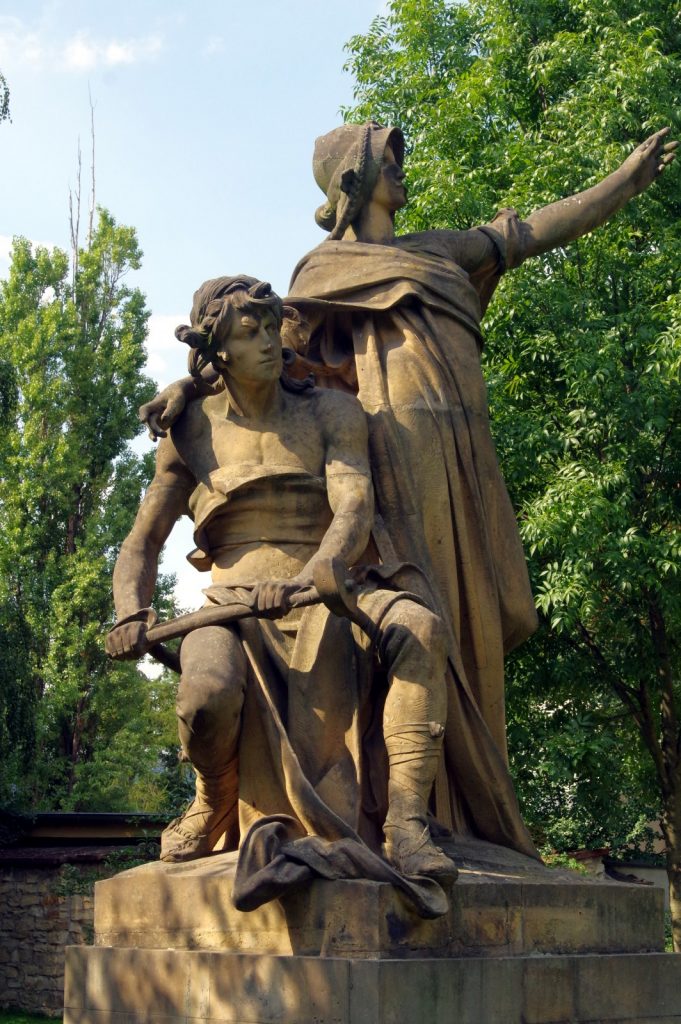
Myslbek’s Přemysl and Libuše in the Vyšehrad gardens. Photo: Donald Judge / CC BY 2.0
Libuše, the wise daughter of Duke Krok, ruled the Czechs from Vyšehrad. When the men of the tribe grumbled at being judged by a woman, she sent her white horse into the countryside to find her a husband. It stopped at a ploughman named Přemysl in the village of Stadice; he left his plough and his oxen, came to Vyšehrad, and founded the Přemyslid dynasty that ruled Bohemia for four centuries. Standing on the rock above the river, Libuše is said to have had a vision of a great city whose glory would reach the stars — and told her people to build it where they found a man shaping the threshold of a house. The Czech word for threshold is práh, and that, the legend says, is where Praha got its name.
See it: Myslbek’s group «Přemysl and Libuše», Vyšehrad gardens near the basilica. Myslbek shows Libuše with her arm raised towards the future and Přemysl still holding his ploughshare.
Šárka and Ctirad: the Maidens’ War
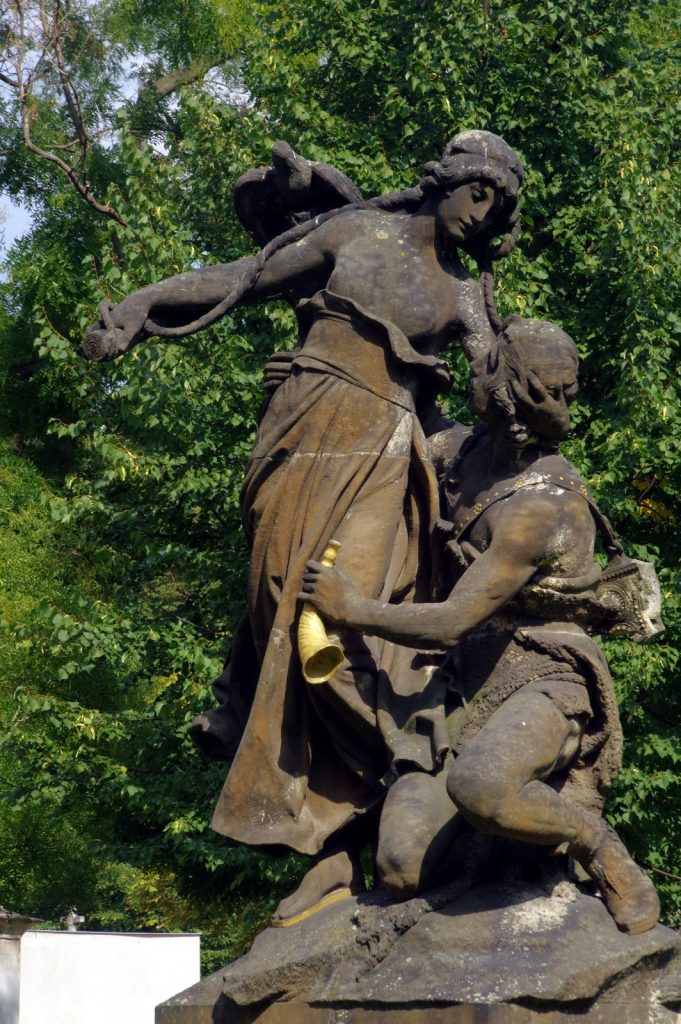
Myslbek’s Ctirad and Šárka at Vyšehrad. Photo: Donald Judge / CC BY 2.0
After Libuše died, the women of her court refused to obey the men and built their own castle, Děvín, across the river. Their boldest warrior, Šárka, had herself tied to a tree in the valley where the knight Ctirad would pass, pretending to be a prisoner of her companions. Ctirad freed her, drank the mead she offered, and when he and his men were drowsy she blew her horn — the hidden maidens rushed out, killed his escort and carried Ctirad off. The wild valley north-west of Prague is still called Šárka.
See it: Myslbek’s group «Ctirad and Šárka», Vyšehrad gardens. The two other groups nearby, «Záboj and Slavoj» and «Lumír and Song», show heroes from the 19th-century manuscripts that were later proved to be forgeries.
Horymír and his horse Šemík
The knight Horymír was condemned to death at Vyšehrad for defending his people against greedy miners. As a last wish he asked to ride his horse Šemík round the castle courtyard once more. On the third lap Šemík leapt over the wall, down the cliff into the Vltava, and carried his master all the way home to Neumětely. The horse died of the effort, and Horymír buried him there. Look down from the Vyšehrad walls to the river and you will see how far Šemík jumped.
The Devil’s Column
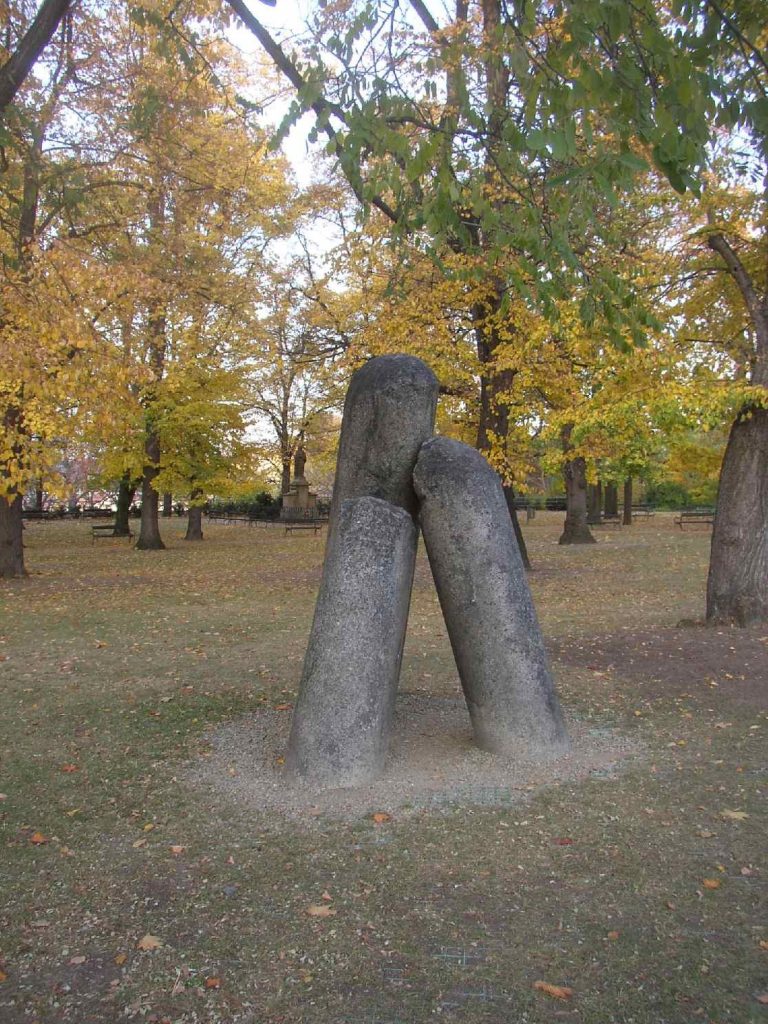
The Devil’s Column by the Vyšehrad basilica. Photo: public domain
Near the basilica lie three broken pieces of a stone pillar. A priest of Vyšehrad, the story goes, sold his soul to the devil for luck at cards — then repented and made one last bet: if the devil could bring him a column from St Peter’s in Rome before he finished saying Mass, his soul was forfeit. St Peter threw the devil into the sea three times on the way, the Mass ended before he arrived, and in his fury he hurled the column down onto the church, where it broke into three. Some versions add that the hole it made in the roof could never be mended.
See it: the Devil’s Column (Čertův sloup), in the park next to the basilica of Sts Peter and Paul, Vyšehrad.
Charles Bridge and the Vltava
Bruncvík and the sword in the bridge
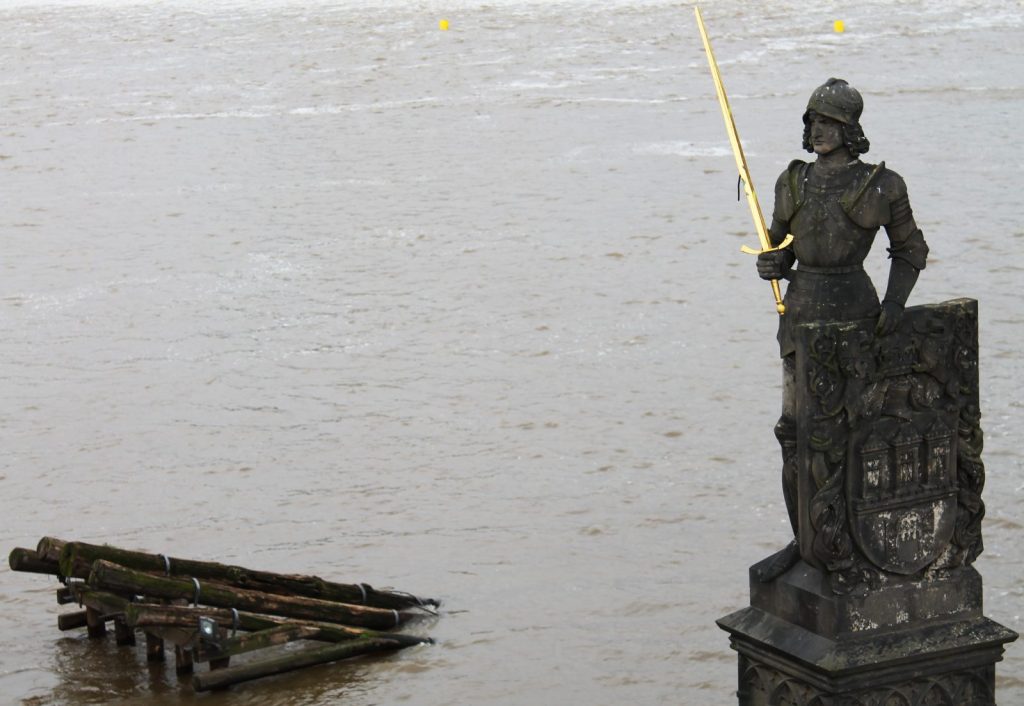
Bruncvík with his golden sword, below Charles Bridge. Photo: Sarah Stierch / CC BY 4.0
Look over the parapet of Charles Bridge on the Malá Strana side and you will see a knight with a golden sword standing on a column in the river. This is Bruncvík, a legendary Czech prince who travelled the world with a lion at his side and won a magic sword that would cut off any head on command. The sword, the legend says, is walled into Charles Bridge. When Bohemia is in its greatest danger, the knights of St Wenceslas will ride out of Blaník hill, the saint’s horse will stumble on the bridge and uncover the blade — and Wenceslas will use it to defeat the country’s enemies.
See it: the statue of Bruncvík by Ludvík Šimek (1880s), on a pillar on the south side of Charles Bridge, by Kampa island.
The Turk on Charles Bridge
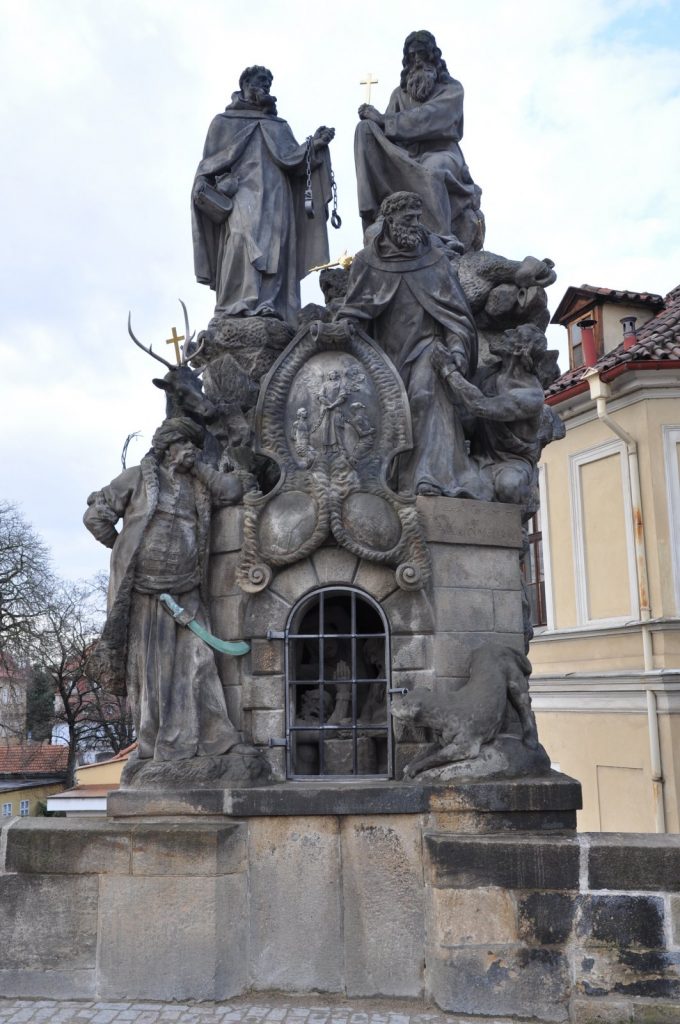
Brokoff’s group of Sts John of Matha and Felix with the Turk guarding the prisoners. Photo: Jorge Láscar / CC BY 2.0
The most dramatic statue group on the bridge, by Ferdinand Maximilian Brokoff (1714), shows the founders of the Trinitarian order, who ransomed Christian slaves. At its foot a moustached Turk with a whip guards the captives behind bars. The people of Malá Strana, the legend says, were furious to see a Turk among the saints and asked the monks to remove him. The abbot answered that he could not take the Turk away — but that he would pension him off. Nothing changed, so for years the townspeople took their anger out on the stone Turk: they stole his sabre, smeared his boots with mud, and sang mocking songs about him.
See it: the statue group of Sts John of Matha, Felix of Valois and Ivan, south side of Charles Bridge, towards Malá Strana.
St John of Nepomuk and the five stars
In 1393 John of Nepomuk, vicar-general of Prague, was thrown from the bridge into the Vltava on the orders of King Wenceslas IV. Legend says it was because he refused to reveal what the queen had told him in confession, and that five stars appeared on the water where he drowned. His bronze statue of 1683 is the oldest on the bridge; the five stars shine around his head. Visitors rub the bronze reliefs below for luck and for a return to Prague.
See it: the statue of St John of Nepomuk, north side of Charles Bridge, about halfway across. A small cross on the parapet nearby marks the place where he is said to have been thrown into the river.
The Vltava and her daughters
At the northern tip of Dětský ostrov (Children’s Island), by the Smíchov lock, a tall stone figure of the Vltava by Josef Pekárek (1916) stands over four women: her tributaries, the Otava, Lužnice, Sázava and Berounka. The river gives Prague its life, and it takes lives too: every year on All Souls’ Day boatmen and rescuers gather at the statue to remember those who drowned in the Vltava, and in spring the boating season is opened here. In Czech fairy tales the river also has its water goblin, the vodník, who lives under the mill on the Čertovka stream on Kampa and keeps the souls of the drowned under porcelain cups.
See it: the Vltava allegory, northern end of Dětský ostrov, reached from the Smíchov embankment; the old mill wheel on the Čertovka, Kampa island.
Old Town Square
Master Hanuš and the astronomical clock
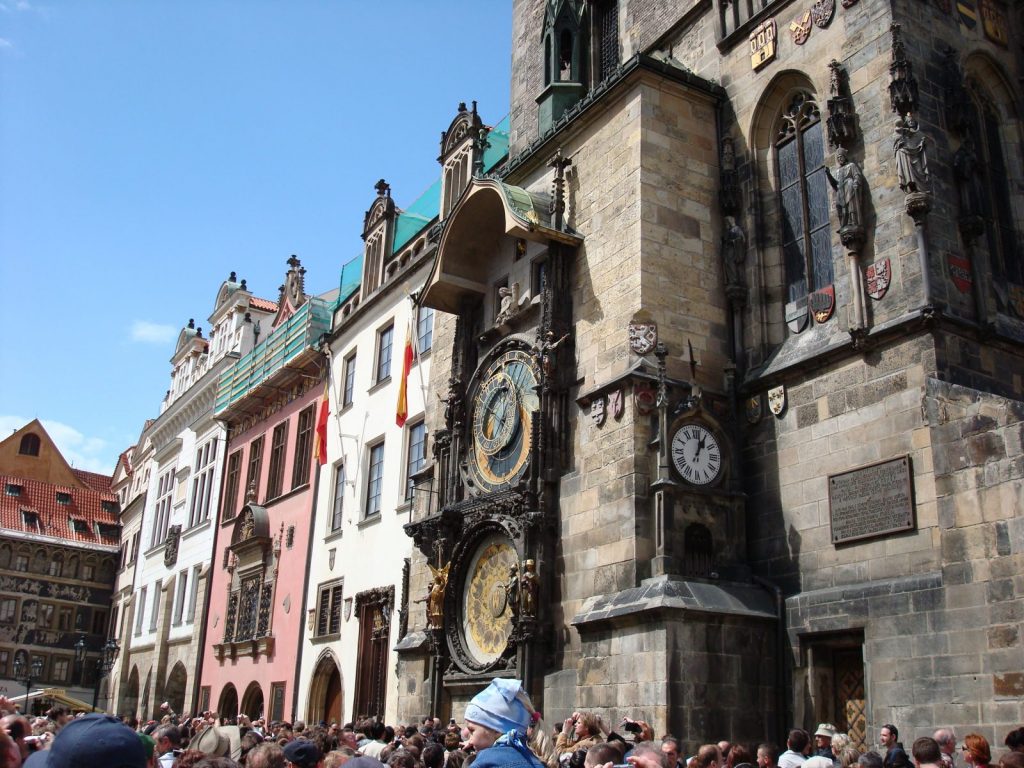
The astronomical clock on the Old Town Hall. Photo: Everythingandrobots / public domain
The astronomical clock on the Old Town Hall was made in 1410. Legend, though, gives it to a master named Hanuš — and says the city councillors had him blinded so he could never build a finer clock for anyone else. Before he died, the blind Hanuš asked to be led up to his clock one last time, reached into the mechanism and stopped it. For years nobody could make it run again. To this day people say that when the clock stops, misfortune comes to Prague.
Why the Kinský Palace stands forward
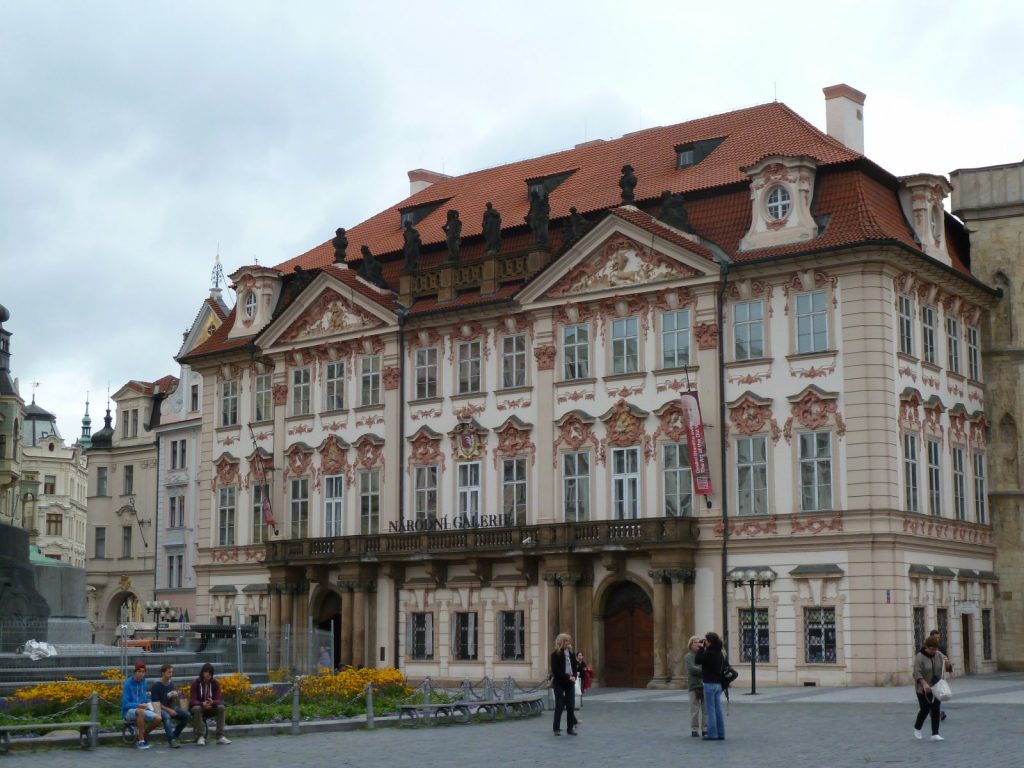
The Kinský Palace on Old Town Square. Photo: Fabio Visconti / CC0
Look along the east side of the square and you will notice that the pink-and-white rococo palace next to the Stone Bell House sticks out from the row. The legend explains why. The count who built it wanted the palace to catch the eye of everyone who looked towards Týn Church, and his architect proposed simply moving the façade out into the square. The city councillors refused — until three of them accepted a large bribe and signed the permit. When the rest of the council found out and ordered the walls pulled down, the count laid the signed permit on the table. The three bribed councillors were hanged, but their signatures still counted, and the palace was finished exactly as planned.
See it: the Kinský Palace (Palác Kinských), Old Town Square 12, today part of the National Gallery. Franz Kafka went to school in this building.
The 27 crosses
The 27 crosses set into the pavement by the Old Town Hall mark the execution of 27 leaders of the Bohemian uprising on 21 June 1621. On the anniversary, it is said, the executed walk the square at night and look up at the clock to see whether Bohemia is doing well.
The Turk of Ungelt
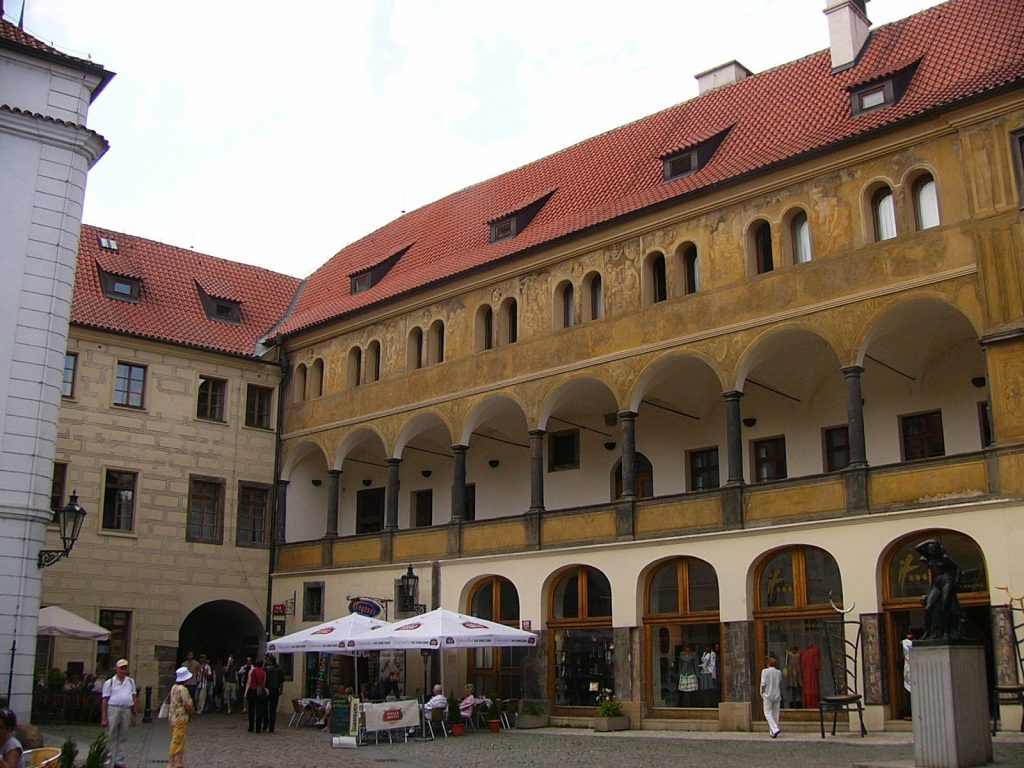
The Ungelt courtyard behind Týn Church. Photo: Jklamo / CC BY-SA 2.5
Behind the Týn Church lies Ungelt, the old courtyard where foreign merchants paid their customs. A young Turk who traded here fell in love with a Prague girl and promised to marry her when he came back from a journey home. He was away too long; when he returned and found her betrothed to another, he cut off her head and hid it. Ever since, the story goes, his ghost has wandered Ungelt at night carrying the head in a box, waiting for someone brave enough to set him free.
Josefov and Mariánské náměstí
The Golem of the Old-New Synagogue
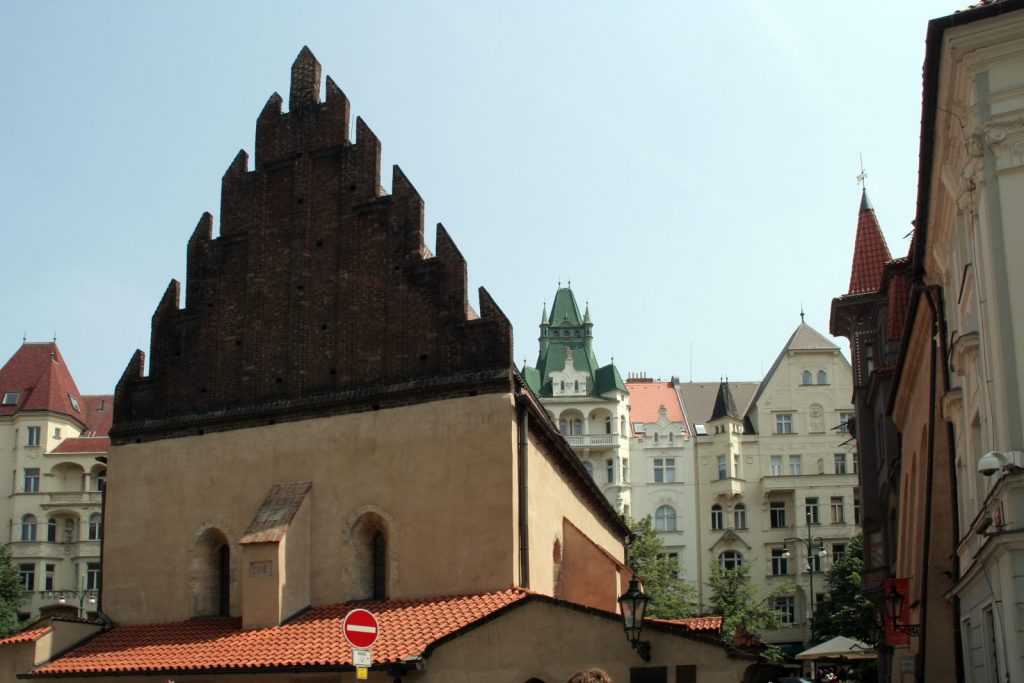
The Old-New Synagogue in Josefov. Photo: Tony Hisgett / CC BY 2.0
Prague’s most famous legend belongs to the Jewish Town. In the late 16th century the great Rabbi Judah Loew ben Bezalel shaped a man out of clay from the banks of the Vltava and brought him to life by placing a shem, a slip with the name of God, in his mouth. The Golem protected the ghetto and worked for the community — until one evening he ran wild and the rabbi pulled the shem from his mouth.
The clay body, the story says, was carried up to the attic of the Old-New Synagogue, built around 1270 and still the oldest working synagogue in Europe. The rabbi forbade anyone to go up. Years later a poor student who had read about the Golem crept into the attic and slipped a shem of his own under the clay tongue; the giant began to breathe, then to grow without end, until the terrified student tore the paper out and the clay collapsed on top of him. That, the legend says, was the last of the Golem. The attic is still closed to visitors.
Rabbi Loew and Death with a rose
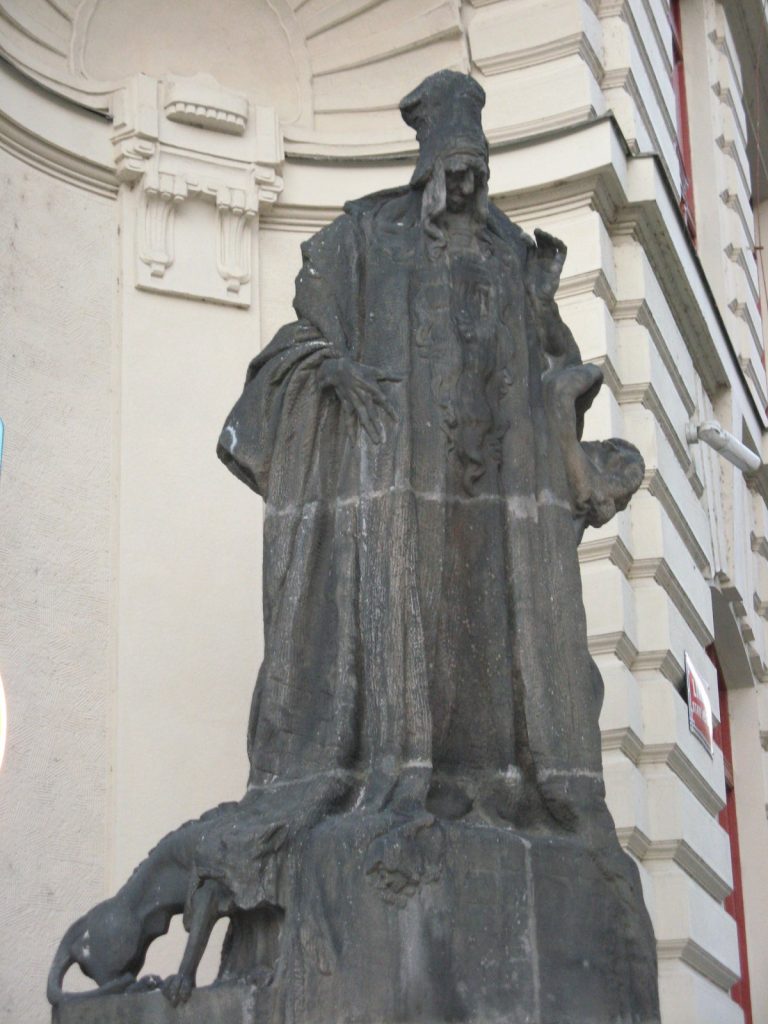
Ladislav Šaloun’s Rabbi Loew on the New Town Hall. Photo: public domain
Rabbi Loew lived to a great age, and the legend says Death could not reach him because he never stopped studying the holy books. At last Death hid inside a rose, and when the rabbi’s granddaughter handed him the flower and he bent to smell it, he died. On the corner of the New Town Hall, a few minutes’ walk from the Jewish Town, Ladislav Šaloun’s statue (1911–1913) shows the tall rabbi turning away from a young girl who holds out the rose.
See it: the statue of Rabbi Loew, corner of the New Town Hall at Mariánské náměstí and Linhartská street.
The Iron Knight of Platnéřská street
On the other corner of the same building stands Šaloun’s Iron Knight (1914). In old times the armourers of Platnéřská street hung an iron knight over one of their houses as a sign of their trade. Legend tied it to a foreign knight in black armour who fell in love with an armourer’s daughter, killed her in a fit of jealousy and was turned to iron as a punishment. Once every hundred years, it is said, he may come to life and look for someone to release him.
See it: the Iron Knight, corner of the New Town Hall at Mariánské náměstí and Platnéřská street.
Terezka, the Vltava fountain
Across the square, set into the garden wall of the Clam-Gallas Palace, a stone woman pours water from a jug. Václav Prachner carved her in 1812 as an allegory of the Vltava; one of her vessels releases a stream decorated with five stars, the emblem of St John of Nepomuk, who drowned in the river. Prague people call her Terezka, after a girl who, the story goes, used to come to the fountain for water.
See it: the Terezka fountain, Mariánské náměstí, in the wall of the Clam-Gallas Palace garden. The original sculpture was replaced by a copy in the 20th century.
More ghosts of the Old Town
The Headless Templar — near Liliová street, where the Knights Templar once had their house, a headless knight is said to ride out on a white horse on certain nights, looking for anyone who will take his sword and set him free.
The fiery carriage — after midnight a burning carriage drawn by goats is said to race out of the old Jewish Town towards the Goat Square; a frightening but harmless ghost.
New Town
The Faust House on Charles Square
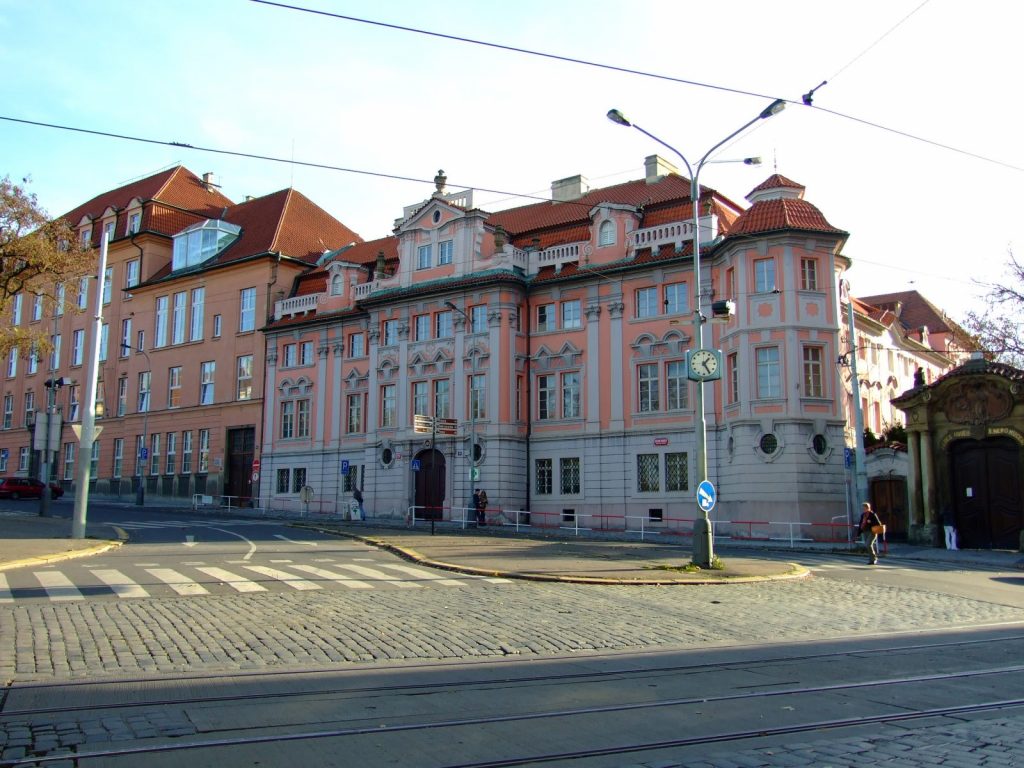
The Faust House on Charles Square. Photo: Wikimedia Commons contributor / CC BY-SA 3.0
The pink palace at the southern end of Charles Square is known as the Faust House. Alchemists really did work here — the English adventurer Edward Kelley, who served Rudolf II, is linked to the house. Legend went further: Doctor Faust himself is said to have lived here, signed his soul away and been carried off by the devil straight through the ceiling. The hole, they say, could never be plastered over — every time it was mended, it opened again by morning.
St Wenceslas and the knights of Blaník
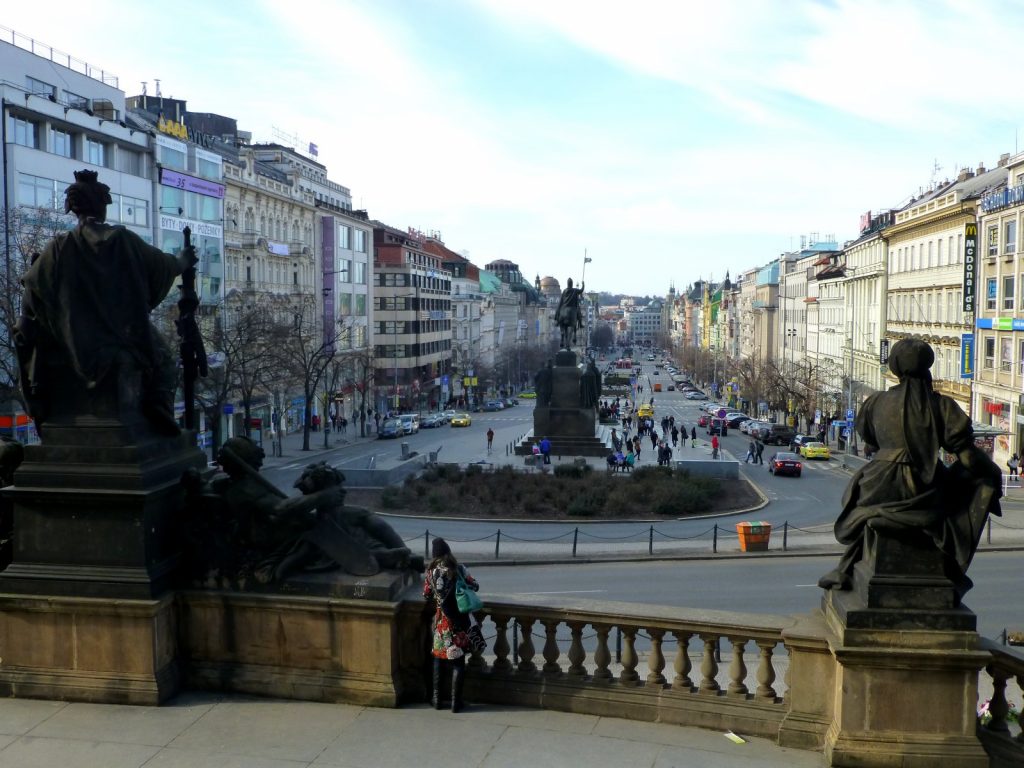
St Wenceslas on Wenceslas Square, seen from the National Museum. Photo: Edgar El / CC BY 3.0
Inside Blaník hill, south-east of Prague, the Czech patron saint Wenceslas sleeps with an army of knights. When the country is in its worst danger, the legend says, they will ride out, Wenceslas at their head; on Charles Bridge his horse will stumble on Bruncvík’s hidden sword, and with it the saint will drive the enemies away. Myslbek’s equestrian statue of Wenceslas, surrounded by four Czech patron saints, has stood at the top of Wenceslas Square since the early 20th century and was completed in 1924; it is the square’s meeting point to this day.
See it: the St Wenceslas monument, upper end of Wenceslas Square, in front of the National Museum.
Where to find them
- Vyšehrad (Myslbek’s groups, the Devil’s Column): about 15 minutes from the Old Town by car or tram; metro C to Vyšehrad.
- Charles Bridge and the river (Bruncvík, the Turk, St John of Nepomuk, the Kampa mill): ten minutes’ walk from Old Town Square. The Vltava allegory on Dětský ostrov is a short walk upstream on the Smíchov side.
- Old Town Square (the clock, the Kinský Palace, the 27 crosses) and Ungelt right behind Týn Church.
- Josefov and Mariánské náměstí (the Old-New Synagogue, Rabbi Loew, the Iron Knight, Terezka): five minutes from Old Town Square.
- New Town: the St Wenceslas monument at the top of Wenceslas Square, the Faust House on Charles Square.
Everything except Vyšehrad fits into one walk of two to three hours. Open the walking route in Google Maps.
Book the evening walk or a car
Send us the date and how many of you there are for the guided legends walk (€15 adults, €9.50 children under 12), or the pick-up address if you want a car to Vyšehrad, to the start of the walk and back to your hotel — from €30 per car within Prague. We confirm the same day.
Order
How you can pay
- Cash to the driver — euros, Czech crowns, US dollars or pounds sterling
- Card to the driver, contactless — Visa, Mastercard, Maestro, American Express, or pay by phone
- Card or PayPal online, before the trip — Visa, Mastercard, American Express; the payment processor adds a 6% fee
- Crypto, before the trip — USDT (TRC-20) or Bitcoin
Payment details · no deposit, pay at the end of the trip if you like
Frequently asked questions
What is the most famous legend of Prague?
The Golem — the clay man brought to life by Rabbi Judah Loew in the 16th century, whose body is said to lie in the attic of the Old-New Synagogue in Josefov.
Where is the statue of Libuše in Prague?
At Vyšehrad. Josef Václav Myslbek’s group «Přemysl and Libuše» stands in the Vyšehrad gardens near the basilica of Sts Peter and Paul, together with his three other groups from Czech legend.
What is the Turk on Charles Bridge?
A figure in Ferdinand Maximilian Brokoff’s statue group of 1714 honouring the Trinitarian monks, who ransomed Christian captives. The Turk guards the prisoners; the people of Malá Strana disliked him so much that, the legend says, they kept stealing his sabre and smearing him with mud.
Why does the Kinský Palace stick out on Old Town Square?
Legend says the count bribed three city councillors for permission to move the façade forward. They were hanged when the bribe came out, but the permit they had signed was still valid, so the palace was built as planned.
What is the Devil’s Column at Vyšehrad?
Three broken pieces of a stone pillar near the basilica. Legend says the devil was sent to fetch a column from Rome for a priest who had sold him his soul, arrived too late and threw it down in anger.
Is there a ghost tour in Prague?
Yes. Our evening walk «Legends and Ghosts of Old Prague» runs daily at 20:00 for about two hours, from the city centre. It costs €15 for adults and €9.50 for children under 12.
Can you visit the attic where the Golem lies?
No. The attic of the Old-New Synagogue is closed to the public. The synagogue itself can be visited as part of the Jewish Museum tour.
Several of these stories are retold in our own words after Václav Cibula, Pražské pověsti (Prague Legends), first published in 1977.