Who Are the Slavs?
There are roughly 300 million Slavs — the largest ethnolinguistic group in Europe. Ask most people outside the region to name them, though, and the answer comes out wrong in the same two ways every time: Hungarians get counted in, and half the actual Slavic nations get left out.
The most common mistake in English is treating Slavic and Russian as near-synonyms. Russians are the largest Slavic nation, but they are one of thirteen, and the Czechs whose country you are visiting are just as Slavic as they are.
Three branches
| Branch | Peoples | Roughly |
|---|---|---|
| East | Russians, Ukrainians, Belarusians | ~190 m |
| West | Poles, Czechs, Slovaks, Sorbs, Kashubians | ~60 m |
| South | Serbs, Croats, Bosniaks, Montenegrins, Slovenes, Macedonians, Bulgarians | ~30 m |
The smallest Slavic nation is the one almost nobody has heard of: the Sorbs, about 60,000 people in Saxony and Brandenburg. They have lived inside Germany since the Middle Ages and kept their language. They are the westernmost Slavs in Europe, and the road from Prague to Dresden runs straight through their country.
Who is not Slavic, despite the neighbourhood
- Hungarians — Finno-Ugric. Their language is related to Finnish and Estonian. They are surrounded by Slavs on every side and are not Slavic at all.
- Romanians and Moldovans — Romance. Their language descends from Latin.
- Albanians — their own branch of Indo-European.
- Greeks — also their own branch, despite living in the Balkans alongside South Slavs.
- Lithuanians and Latvians — Balts. This is the subtle one.
The Baltic case is worth a moment. Baltic and Slavic languages descend from a common Balto-Slavic ancestor, which is why Lithuanian is startlingly archaic and why a Slavic speaker can sometimes half-follow it. The kinship is real — but the two split thousands of years ago, and Lithuanians are not Slavs.
The word you already use
This is the standard etymology in English dictionaries, and it says something blunt about the period Mucha was painting: for several centuries, being Slavic and being sold were connected closely enough in the European imagination to reshape a word.
Where they came from
Scholarship still argues about the homeland. The most widely accepted proposal places it between the Vistula and the Dnieper, around the Pripet marshes.
The first undisputed written references are Byzantine, from the sixth century. The Gothic historian Jordanes in 551 and Procopius of Caesarea both write about the Sclaveni and the Antes; Jordanes adds that they had earlier been called Venethi.
Archaeologically, early Slavs are associated with the Prague-Korchak culture of the fifth to seventh centuries: handmade pottery thrown without a wheel, sunken huts with a stone oven in the corner. The culture is named after Prague, where characteristic finds were made.
Then comes the part that is genuinely hard to picture. Within roughly a century and a half, in the sixth and seventh centuries, Slavic speech covers half of Europe: south across the Danube into Byzantine territory, west to the Elbe, east to the Dnieper and the upper Volga.
The alphabet was not the one you think
In 863 Prince Rastislav of Great Moravia asked Byzantium to send missionaries who could preach in a language his people understood. The brothers Cyril and Methodius arrived from Thessaloniki.
Old Church Slavonic became the fourth liturgical language of Christian Europe, after Hebrew, Greek and Latin. The idea was opposed by the so-called trilingual heresy — the doctrine that worship was permissible only in those three. For the ninth century this was close to unthinkable.
How Alphonse Mucha saw it
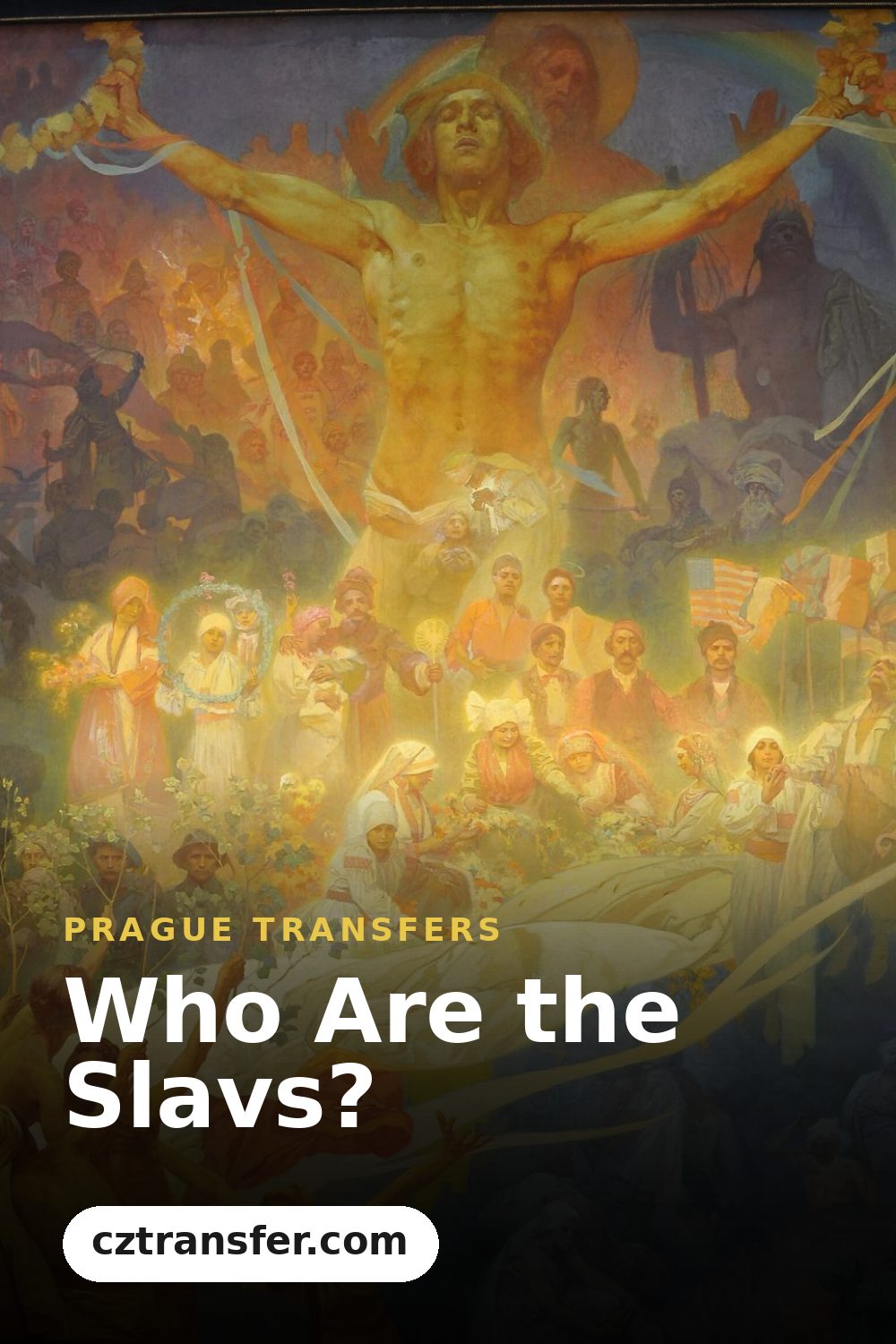
Mucha (1860–1939) is world-famous for Art Nouveau posters of Sarah Bernhardt. He considered his real life’s work to be something else entirely: The Slav Epic, twenty canvases roughly six by eight metres, painted between 1911 and 1926 and funded by the American industrialist Charles Crane. He effectively buried his commercial career to finish them.
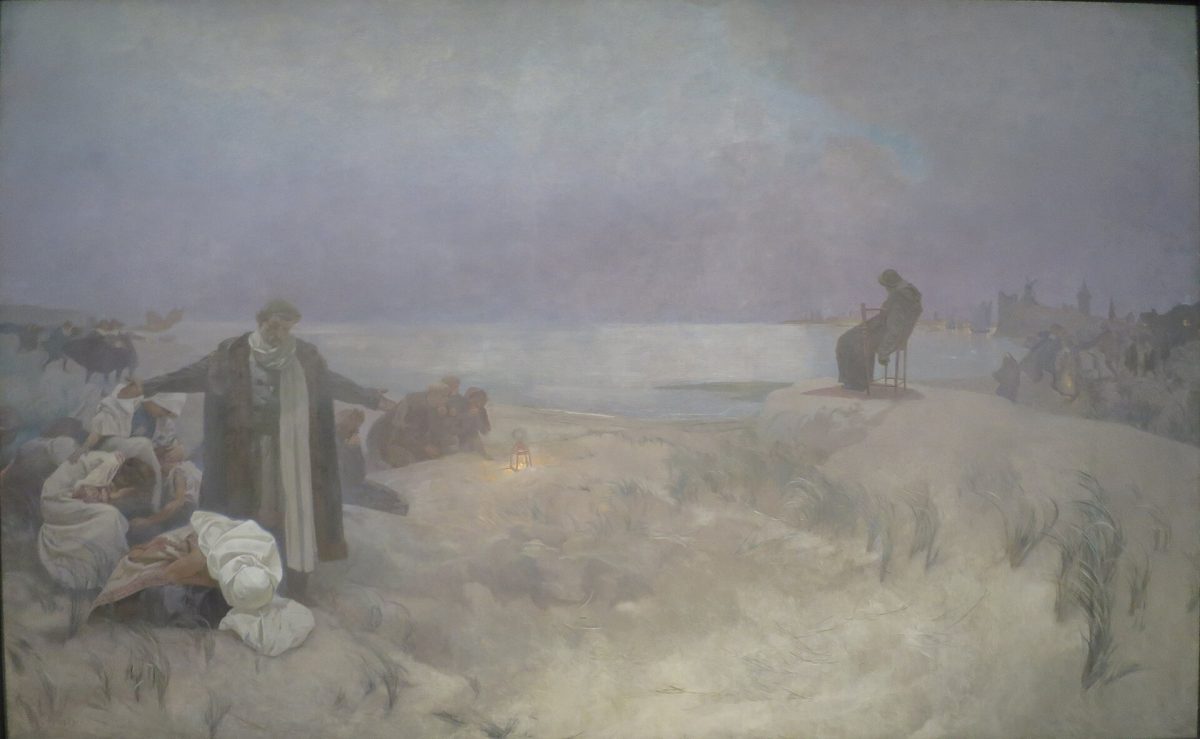
The first canvas answers the question this page asks. Its full title is a thesis in itself: The Slavs in Their Original Homeland — Between the Turanian Whip and the Sword of the Goths.
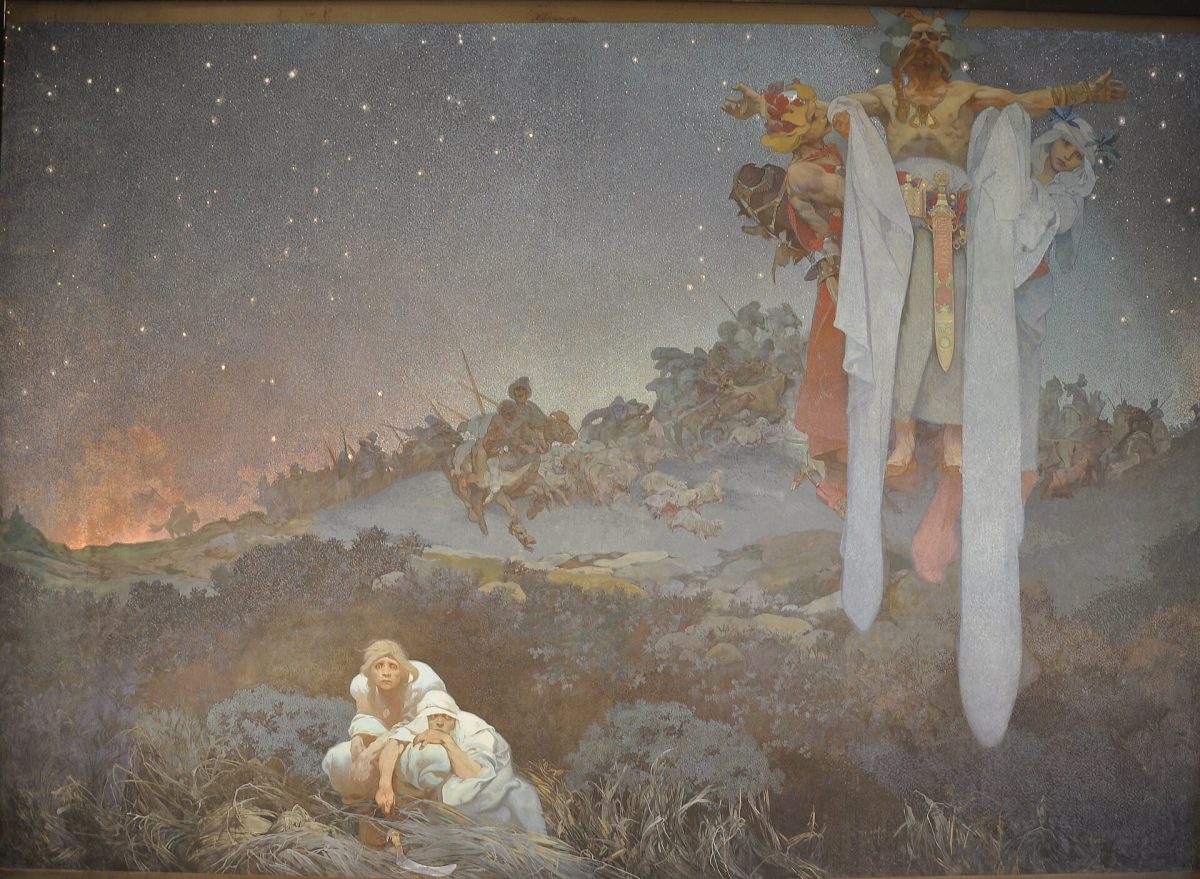
That subtitle contains his entire theory of history. The Turanian whip is the nomads from the east: Huns, Avars, later Tatars and Turks. The sword of the Goths is the Germanic west. His Slavs are caught in a vice between two forces, and geography becomes destiny.
They are farmers and herders in his telling, not conquerors: they plough, keep bees, settle disputes at the village assembly. Suffering in this worldview is not pointless — it earns the nation the right to carry a message of peace to everyone else.
An honest caveat
It should be said plainly: this is a nineteenth-century Romantic national myth, not history. Czechs even have a wry name for it — holubičí povaha, the dove-like nature.
The idea traces back to the German philosopher Johann Gottfried Herder, who in the 1780s described Slavs as peaceful, generous, freedom-loving and perpetually wronged. Ján Kollár and Pavel Jozef Šafárik developed it further in Slavic Antiquities (1837), and Mucha inherited it fully formed and translated it into paint.
What the sources actually say is less flattering and more ordinary: sixth-century Byzantine writers describe Slavic raids into the Balkans with sieges and captives, entirely in the manner of the age. No innate gentleness is on record — for the Slavs or for anyone else in Europe at the time. Czech intellectuals, Masaryk among them, were criticising the dove myth long ago.
None of which diminishes the Epic. It simply is not a reconstruction of the past; it is an argument about the future.
His pan-Slavism was not what it sounds like
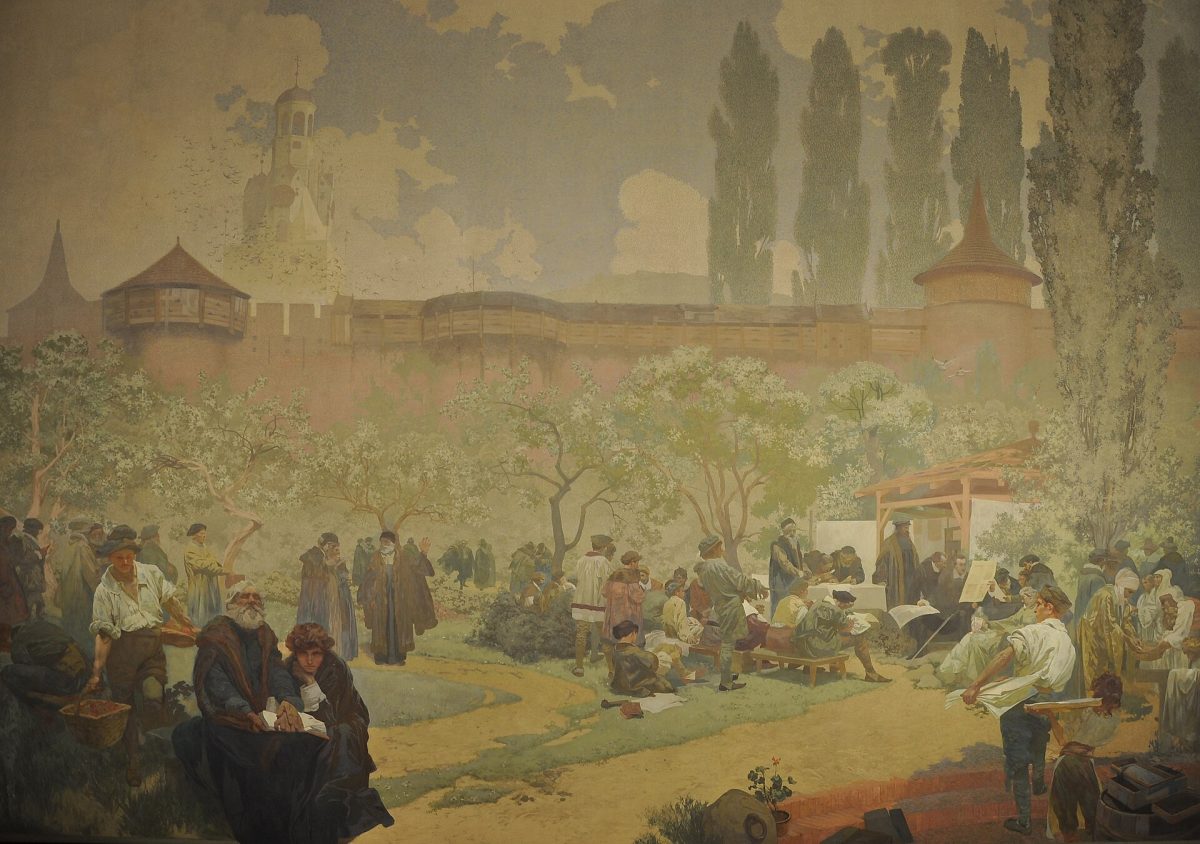
Here is the nuance usually missed. Mucha deliberately avoided militarism — look at what the cycle actually depicts. There is almost no battle painting. There is Jan Hus preaching, the printing of the Kralice Bible, a school, a book, a sermon.
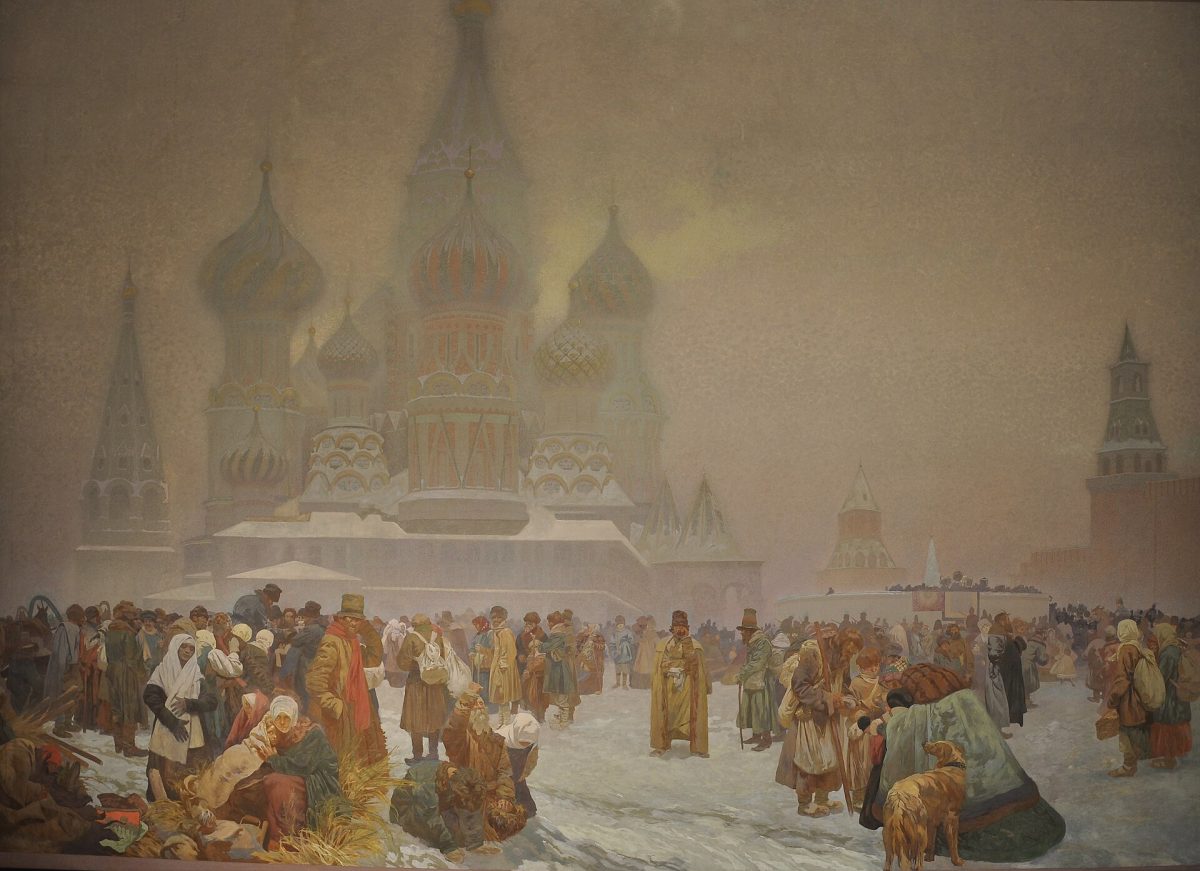
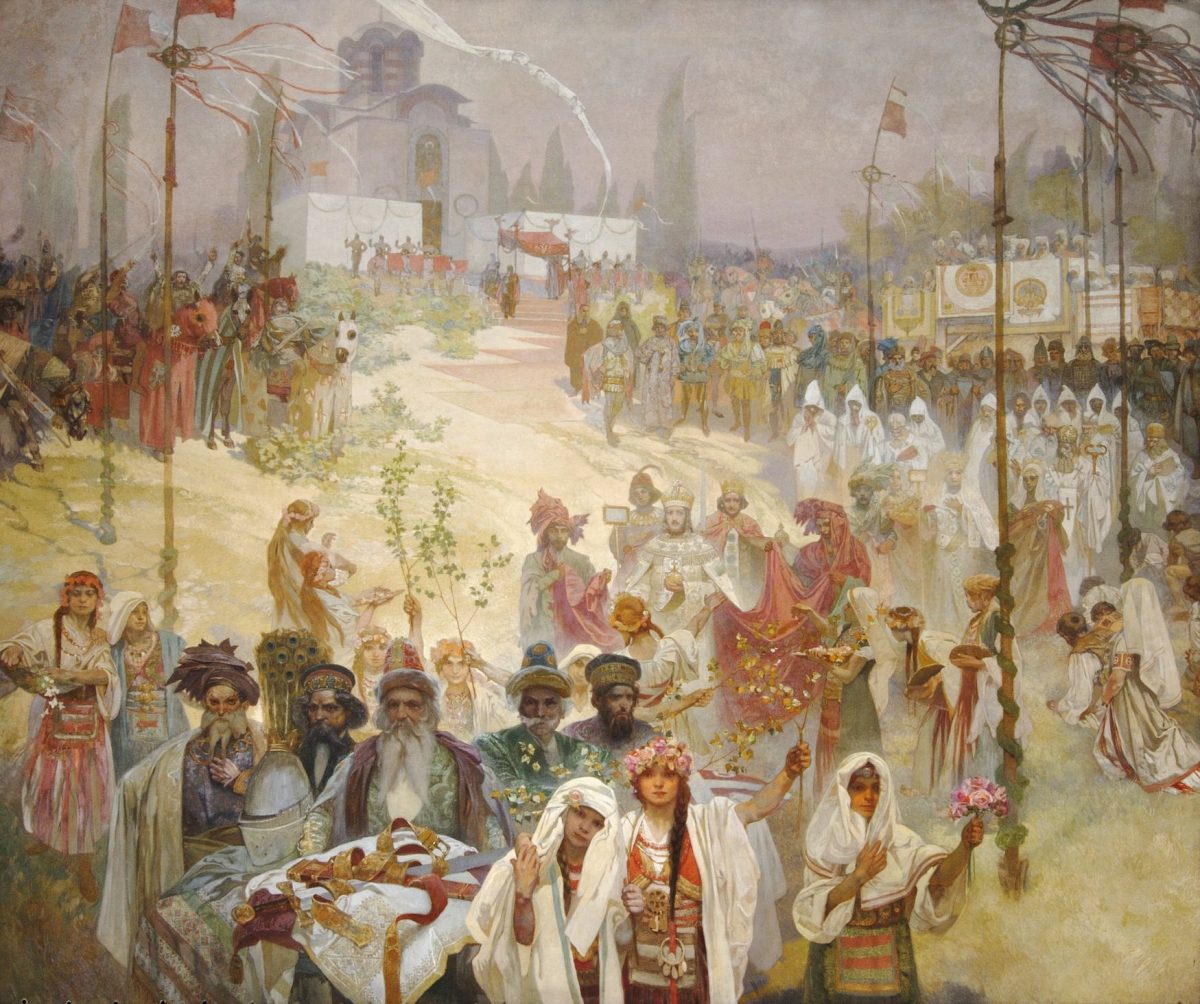
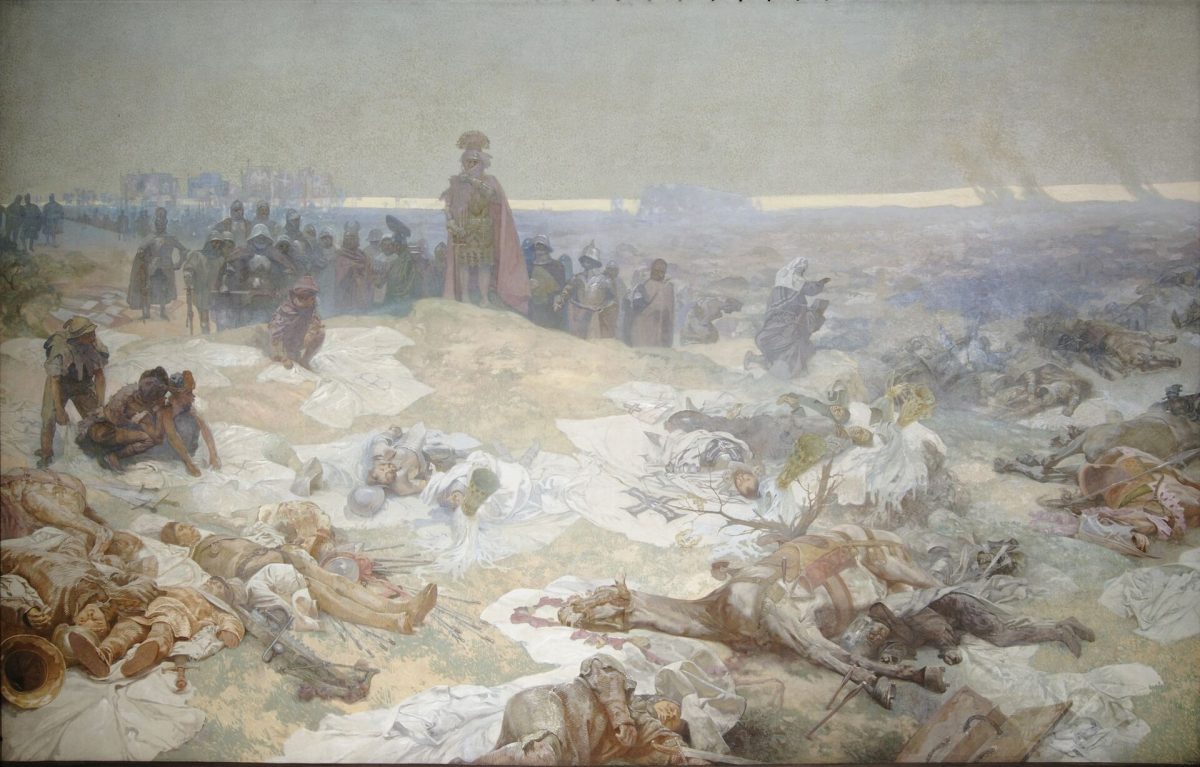
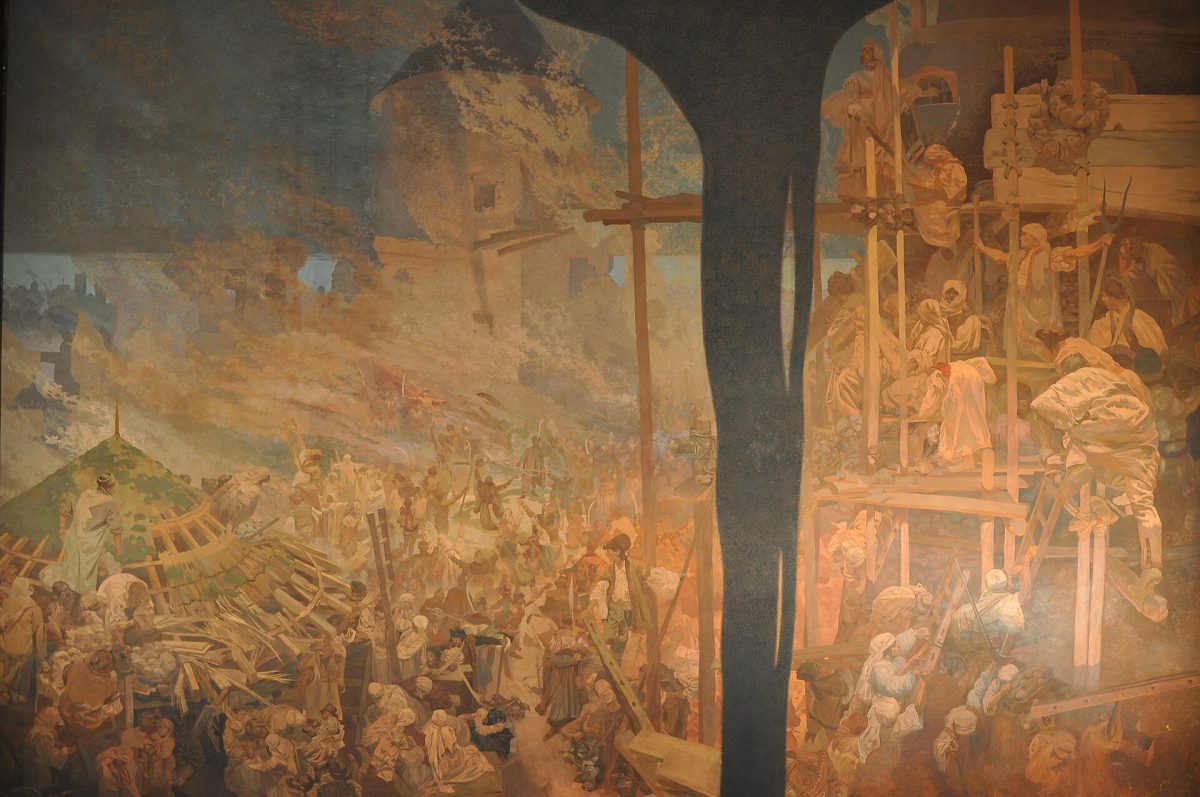
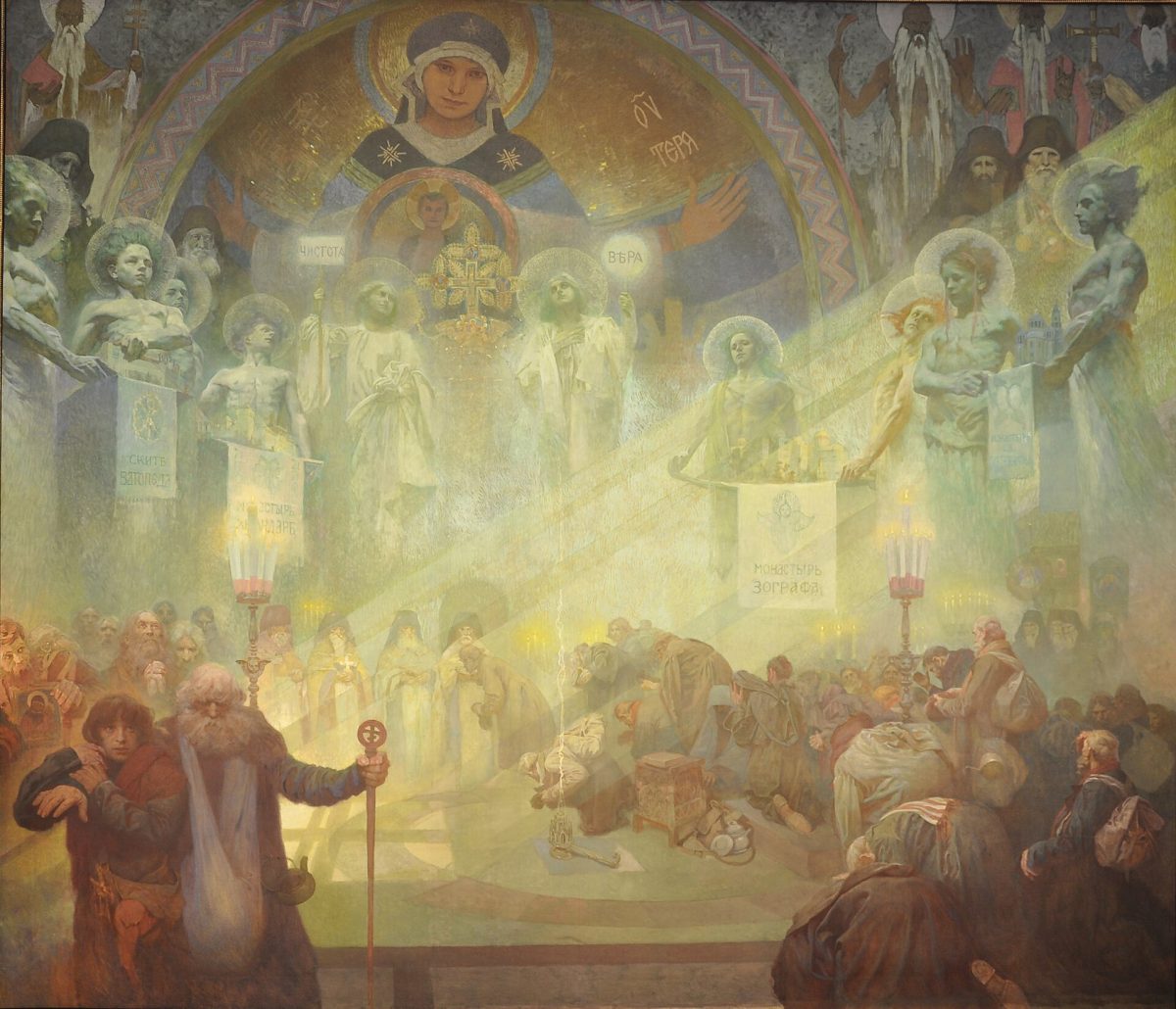
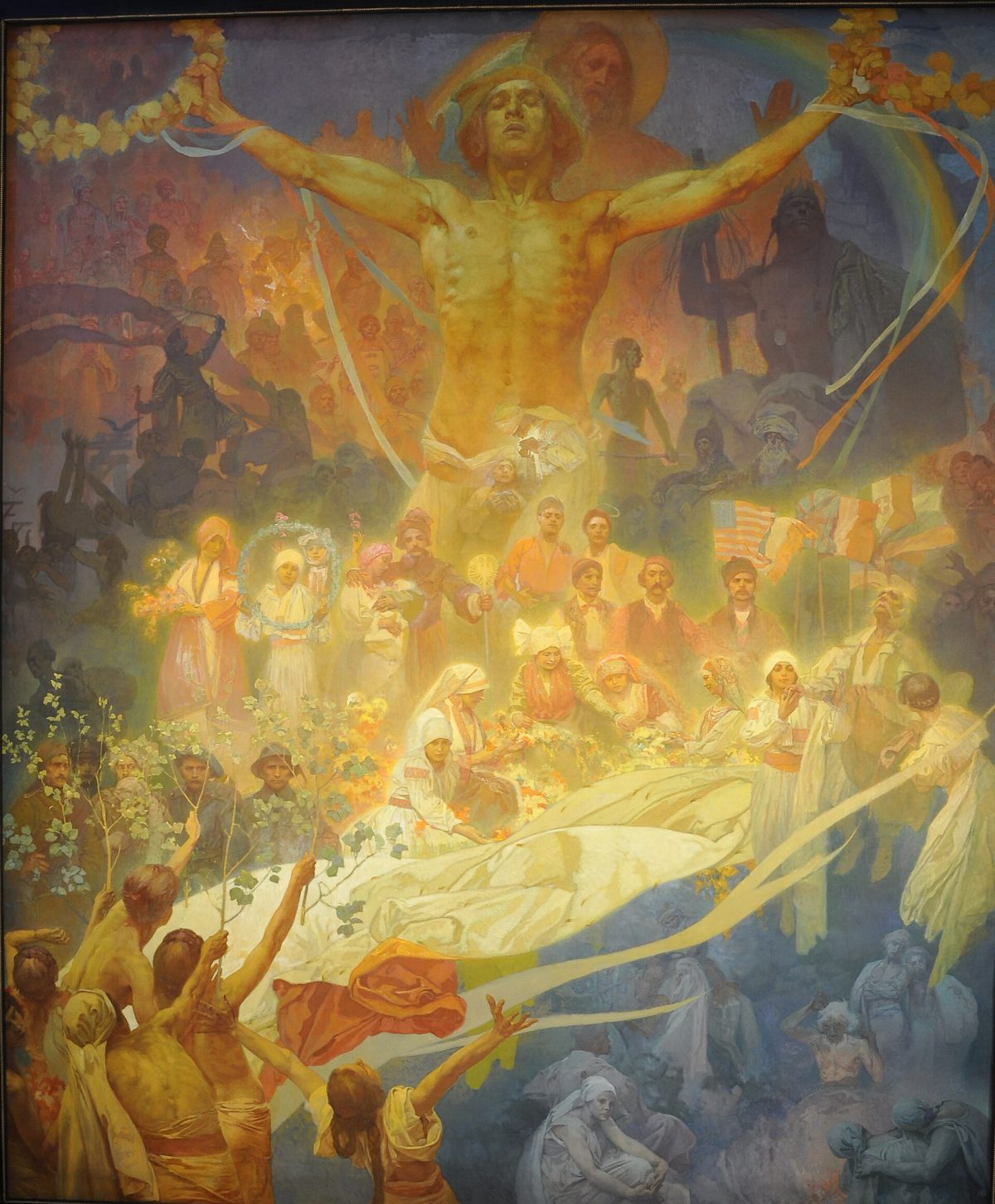
Mucha was a Freemason — initiated in Paris in 1898, and from 1923 Sovereign Grand Commander for Czechoslovakia. Hence the universalism: the goal is not Slavic supremacy over anyone but a Slavic contribution to a common human accord. Which is why the cycle ends not in victory but in an apotheosis.
How it ended
In March 1939, when German troops entered Prague, the 78-year-old Mucha was among the first people the Gestapo interrogated — precisely because of the Epic and his Freemasonry. He was released, never recovered, and died on 14 July that year. The vice he painted in 1912 closed on him personally.
Where to see the Slav Epic
All twenty canvases are on display at Moravský Krumlov castle and will stay there until 2031 — Prague has just extended the loan by another five years. Only after that does the cycle move to the capital, to the Savarin palace.
Prague itself has had an Alphonse Mucha museum in that same Savarin building on Na Příkopě since March 2025 — around a hundred works, including material on his Freemasonry. The Epic is not there yet.
Moravský Krumlov is about 200 km from Prague, roughly two and a quarter hours by car. Public transport is awkward: by train it means changing at Brno and over three hours each way. This is the kind of trip where a car saves you a day rather than money.