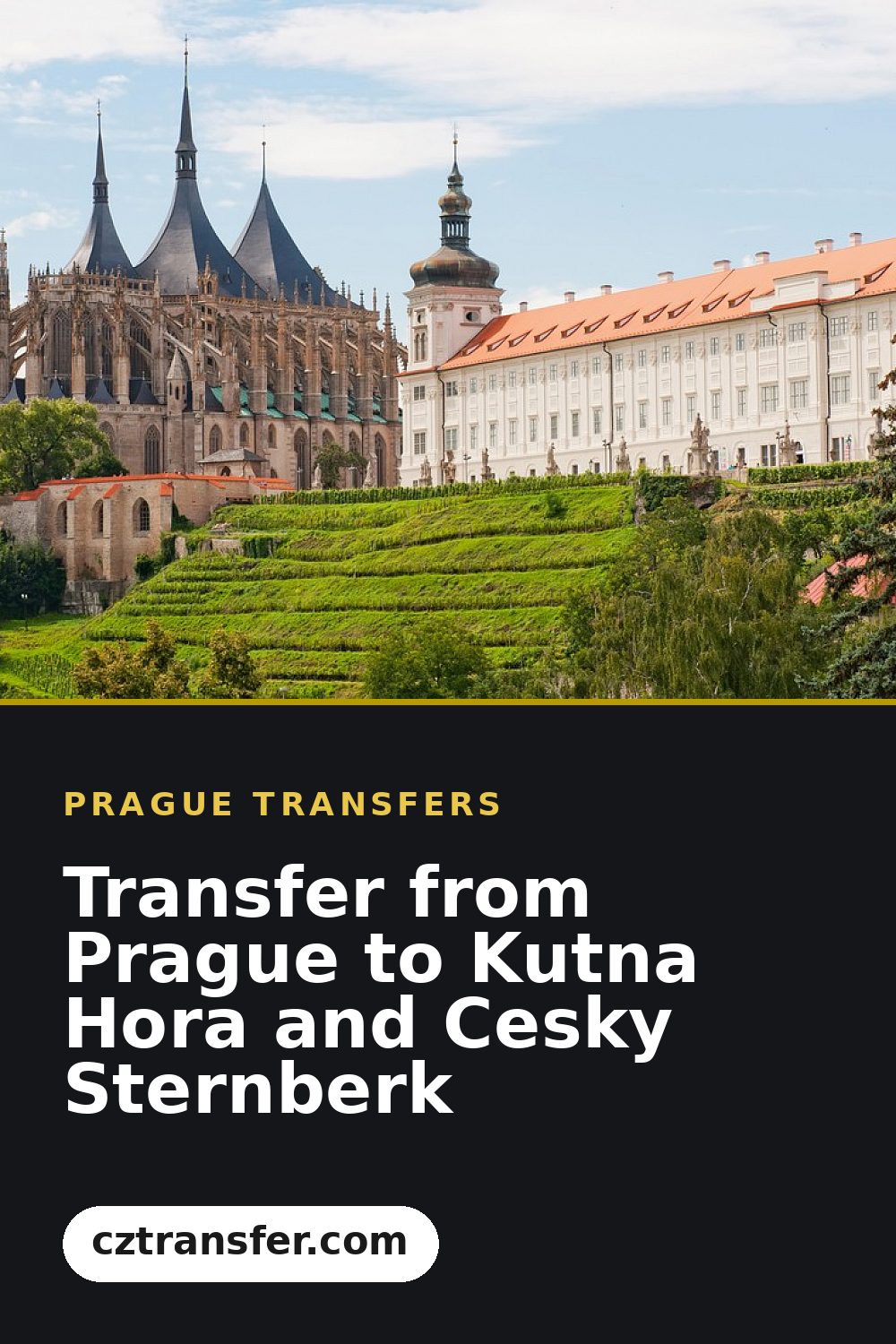
Transfer from Prague to Kutna Hora and Cesky Sternberk
Kutna Hora is an hour east of Prague and, for two centuries, it was the second city of the Bohemian kingdom — because the silver under it paid for everything above it. What that money built is still standing: a cathedral raised by miners, a mint that struck the coin of central Europe, and, on the edge of town, a chapel decorated entirely with human bones.
This is a full day: the ossuary at Sedlec, St Barbara’s Cathedral, a walk down into a medieval silver mine, and then the castle of Cesky Sternberk on the way home.
100 €per car, the whole day
- Pick-up at your hotel in Prague, at the time you choose
- Sedlec Ossuary, St Barbara’s Cathedral and the Czech Museum of Silver
- Cesky Sternberk castle above the Sazava on the way back
- The driver waits at every stop and brings you back to the same door
The price is for the whole car, not per person. Entry tickets are not included — see the note on booking them below.
The Sedlec Ossuary
The chapel at Sedlec holds the bones of somewhere between forty and seventy thousand people, and they are not stored — they are arranged. Chandeliers, garlands, pyramids in the corners, a coat of arms rendered in vertebrae and shoulder blades.
The story behind it is straightforward enough. In 1278 the abbot of Sedlec brought back a handful of earth from Golgotha and scattered it in the cemetery, which made it the most desirable burial ground in central Europe. Plague and the Hussite wars filled it many times over. By the nineteenth century the bones were simply there, in heaps, and in 1870 the Schwarzenberg family hired a woodcarver named Frantisek Rint to do something with them. He did.
It is not a horror attraction and it does not play as one — the effect in person is closer to sombre than macabre. Note that photography inside has been prohibited for ordinary visitors since 2020, and entry is by timed ticket.
St Barbara’s Cathedral
Barbara is the patron saint of miners, which is the whole explanation for this building. The men who went down the shafts paid for it themselves, beginning in 1388, and they wanted something that would rival the cathedral at Prague Castle. They very nearly got it.
Work stopped during the Hussite wars, restarted, stopped again when the silver ran out, and the west front was only finished in 1905 — which is why the church has a Gothic body and a tent-shaped roof of three peaks that looks like nothing else in the country. Inside, look for the frescoes of miners at work and of the minters striking coins: donor portraits, in effect, of the people who paid the bills.
Down the silver mine
The Czech Museum of Silver occupies the Hradek, a late-Gothic townhouse that belonged to a mine owner. The part worth coming for is underground.
You are given a white coat and a helmet with a lamp, and taken into a genuine medieval working — a narrow passage cut by hand through the rock, at points tight enough that you turn sideways. It is cold, low and completely silent, and it does more to explain the cathedral upstairs than any label could.
Practical points: the mine tour runs seasonally, roughly April to November, places on each tour are limited, and it is not suitable for anyone who dislikes confined spaces. Young children are not admitted to the underground section.
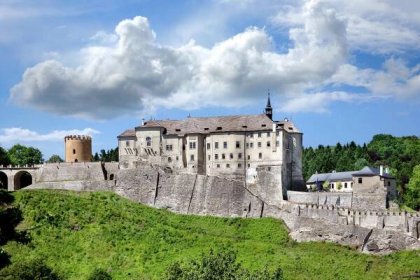
Cesky Sternberk
On the way back to Prague the road passes within a few kilometres of one of the oldest castles in Bohemia, and it is worth the detour.
Cesky Sternberk was founded in 1241 by Zdeslav of Divisov, who took his new name from the star on his coat of arms — Sternberg, star mountain. The same family holds it today, which after eight centuries and two confiscations in the twentieth century is remarkable in itself. It sits on a narrow rock spur above the Sazava river, and unlike most Czech castles it was never rebuilt into a comfortable chateau: it still reads as a fortress with baroque rooms fitted inside it.
How the day runs
| Time | Where |
|---|---|
| 08:00 | Pick-up at your hotel in Prague |
| 09:00 | Sedlec Ossuary — it sits on the Prague side of town, so it comes first |
| 10:00 | Into the historic centre: St Barbara’s Cathedral |
| 11:30 | The Czech Museum of Silver and the mine tour |
| 13:00 | Lunch in the old town, and the Italian Court if there is time |
| 14:30 | Drive to Cesky Sternberk, about 45 minutes |
| 15:15 | Castle tour |
| 17:00 | Back to your hotel in Prague |
This is a suggestion, not a schedule. Tell the driver what you want more or less of and the day moves around it — that is the point of having your own car rather than a coach seat.
Book the tickets yourself, in advance. The ossuary runs on timed entry, the silver mine has limited places and a season, and Cesky Sternberk admits visitors on guided tours at fixed times. All three sell out in summer.
We do not sell entry tickets and we do not mark them up — you book directly on each site, and we build the driving around the times you have.
What is included
A private car with an English-speaking driver for your group only, for the whole day. Pick-up from any hotel or address in Prague. Fuel, tolls and parking at every stop. Child seats on request at no charge. A fixed price agreed at booking — the day does not get more expensive because it ran long.
Not included: entry tickets and guided tours at the sites, and lunch.
Booking
Write to cz@cztransfer.com or message +420 773 477 799 (Viber, WhatsApp, Telegram) with your hotel, the date, and the entry times you have booked. We confirm the car and the price the same day.
Related: taxi from Prague to Cesky Sternberk · Prague to Cesky Krumlov day trip · Prague to Dresden day trip · private transfers across the Czech Republic and Europe