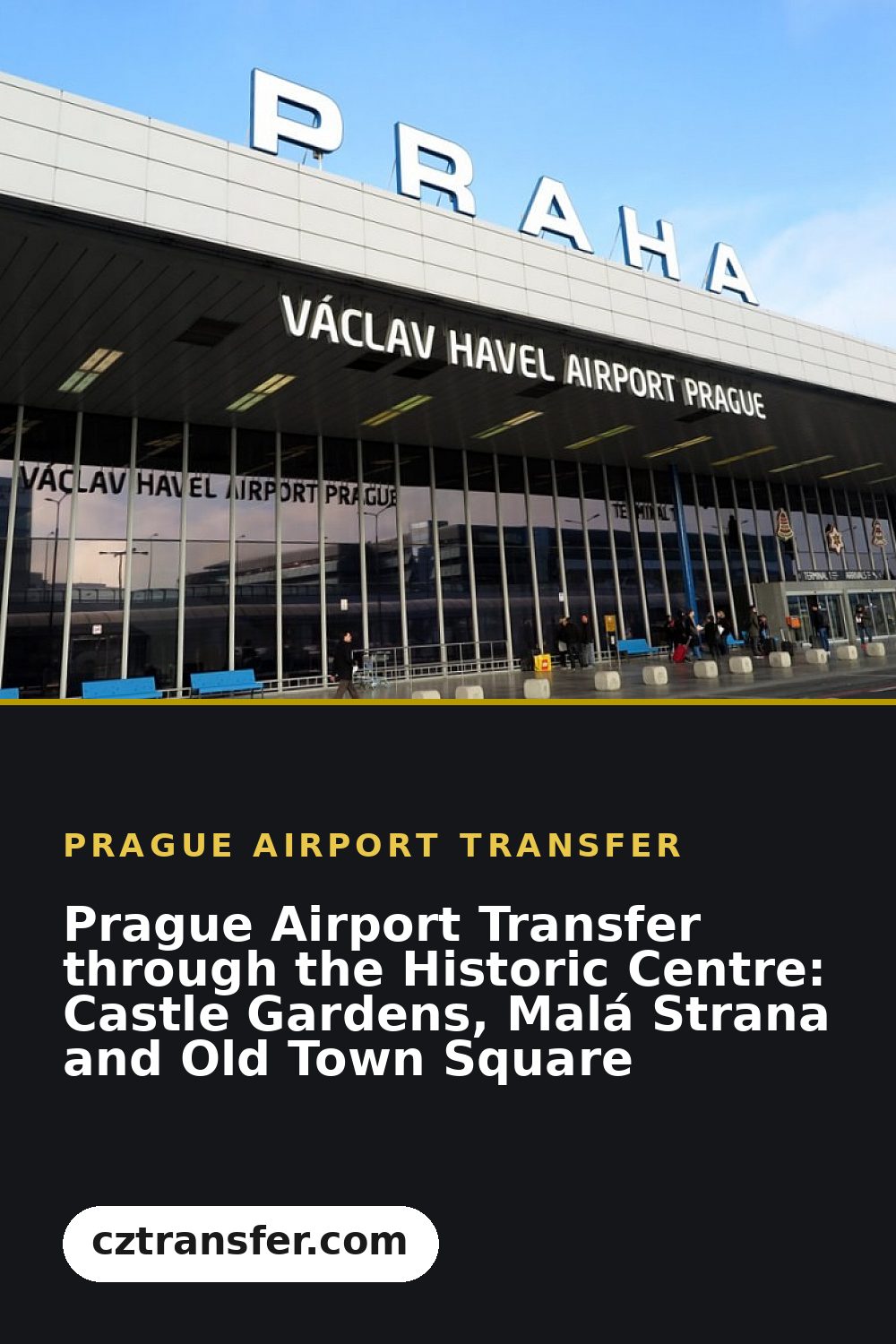
Prague Airport Transfer through the Historic Centre: Castle Gardens, Malá Strana and Old Town Square
This airport transfer crosses the whole historic centre of Prague on its way to your hotel. Your driver meets you in the arrivals hall at Václav Havel Airport, loads your luggage and drives in along Evropská avenue. From there the route runs past the gardens of Prague Castle, down the hill into Malá Strana, across the Vltava and through the Old Town, with stops wherever you want to get out: the Lion Court, the Belvedere and its Singing Fountain, the Chotek Gardens, the Senate in Wallenstein Palace, Malostranské Square, the Rudolfinum, Pařížská Street and, at the end, Old Town Square. Your suitcases stay locked in the car the whole time.
In effect, you ride the Royal Route in reverse. The coronation way of the Bohemian kings also linked Prague Castle, Malostranské Square and Old Town Square, although on foot it crosses Charles Bridge, which is closed to cars.
How the route works
From the airport the car follows Evropská, the long straight avenue into the city, through Vokovice and Dejvice. After about twenty minutes you reach the north side of Prague Castle. The first three stops — the Lion Court, the Belvedere with the Singing Fountain and the Chotek Gardens — are along the edge of the Royal Garden, a few minutes’ walk apart. The car then winds down the hairpins of Chotkova Street into Malá Strana, where the Senate, the Ministry of Finance and Malostranské Square are close together on foot. Finally it crosses the river by Mánes Bridge to the Rudolfinum, drives along Pařížská Street and drops you at Old Town Square, before taking you to your hotel.
How much time you spend is up to you. Seeing everything from close by, with a few short walks, takes about two hours; with longer walks in the gardens and a coffee on Old Town Square, allow three or four. Tell us what you have in mind when you book, and the price is fixed before you arrive.
Note on the seasons: the Royal Garden, with the Belvedere and the Singing Fountain, is closed from 1 November to the end of February and open from March; the Wallenstein Garden is open from April to October. In winter the driver shows you the Belvedere from the street and the route continues through the Chotek Gardens, which are open all year.
Stop 1: the Lion Court
The long ochre building by the Powder Bridge, at the entrance to the Royal Garden, was built for Emperor Rudolf II, who moved his court to Prague in 1583 and filled it with artists, astronomers and alchemists. Here he kept his menagerie of lions, tigers and bears. His favourite lion was called Mohammed, and the story goes that when the lion died, the emperor followed it to the grave within days, as an astrologer had predicted. Today the Lion Court is a restaurant.
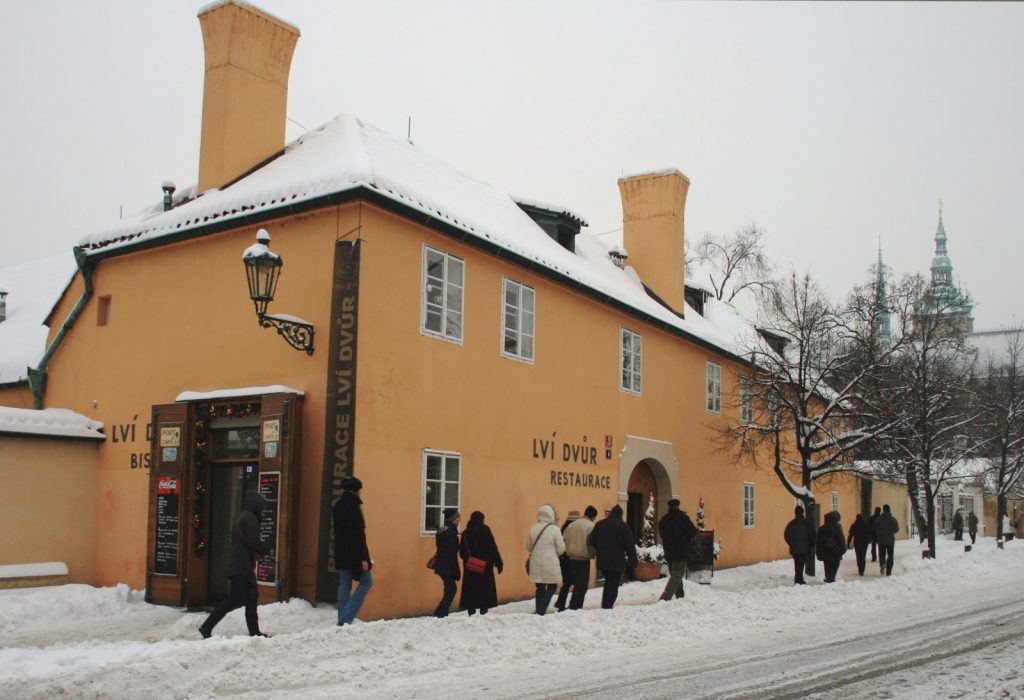
The Lion Court, with St Vitus Cathedral behind. Photo: Karelj, public domain
Stop 2: the Belvedere and the Singing Fountain
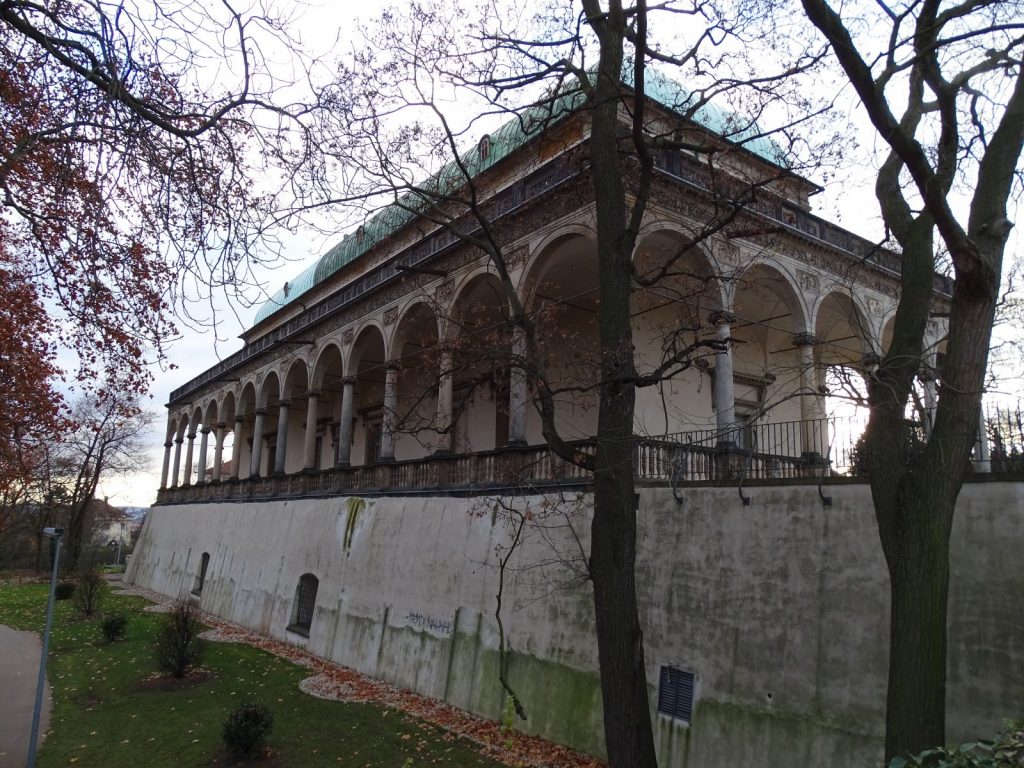
At the far end of the Royal Garden stands the Royal Summer Palace, which everyone calls the Belvedere or Queen Anne’s Summer Palace. King Ferdinand I built it in the 1530s–1560s for his wife Anne, and with its slender arcade and copper roof shaped like an upturned ship’s hull it is the finest Italian Renaissance building north of the Alps.
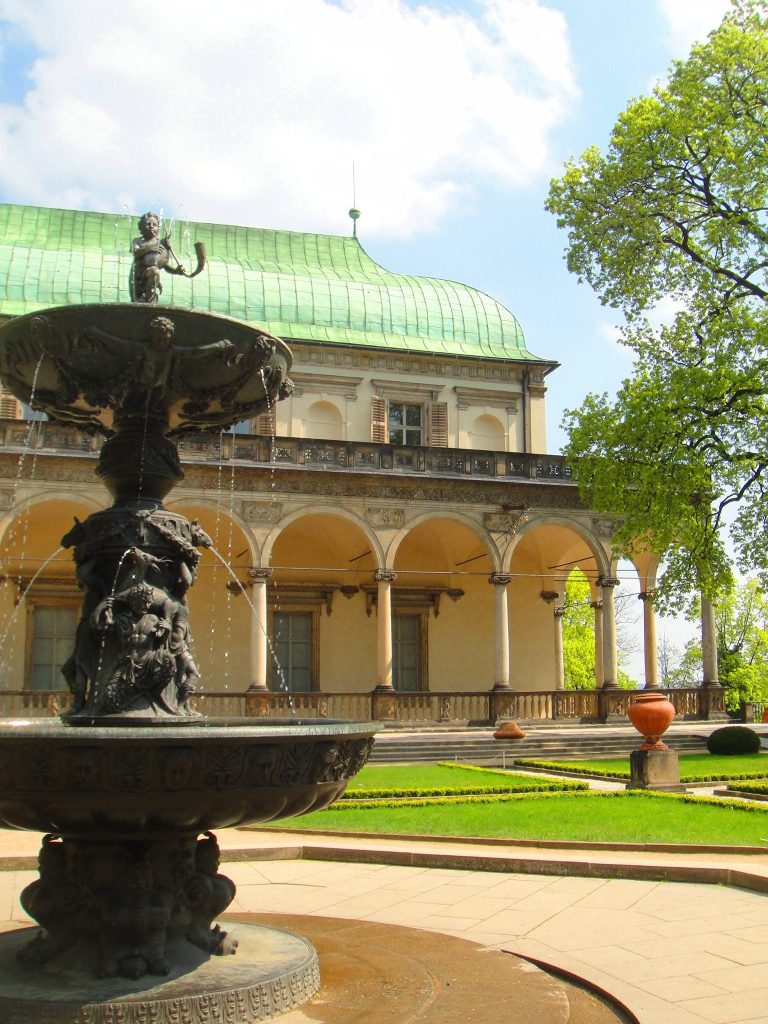
In front of it, in a small formal garden, is the Singing Fountain, cast in bronze in the 1560s. Water falls from the upper bowl into the lower one with a soft ringing sound. Crouch down beside the lower basin and listen: that is where the name comes from.
Stop 3: the Chotek Gardens
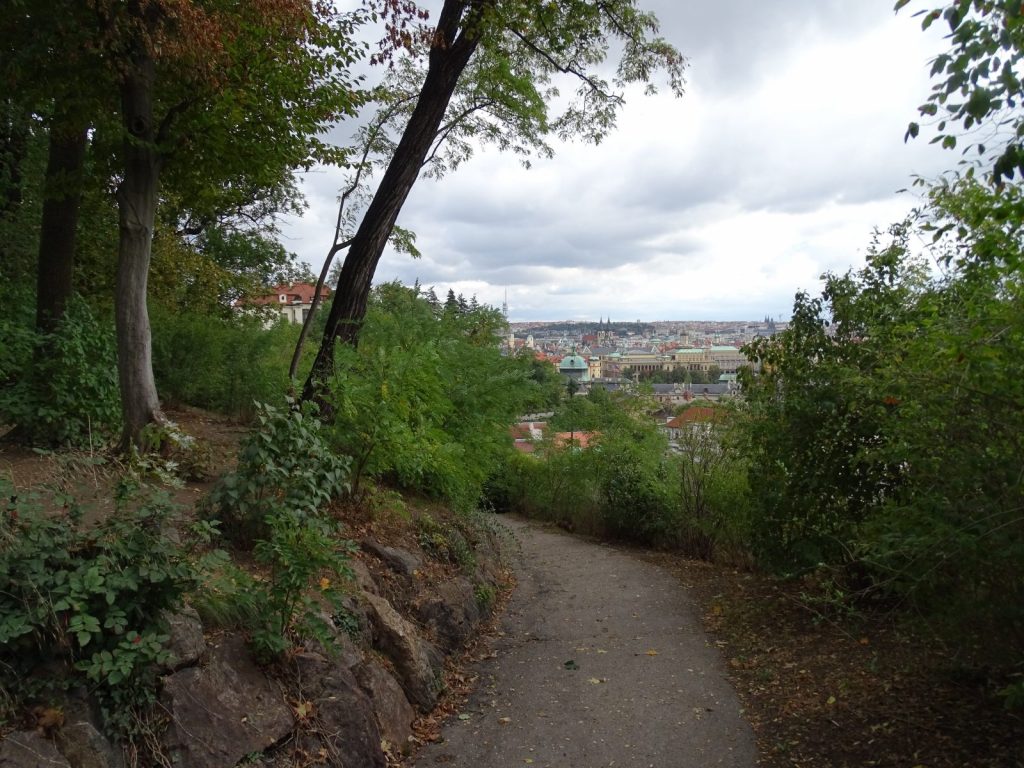
Across the road from the Belvedere lie the Chotek Gardens, the first public park in Prague, laid out in the 1830s by the governor of Bohemia, Count Karel Chotek, who also built the winding road below. It is a quiet place of old trees and lawns, and from its edge you look straight down over the roofs of Malá Strana and the bridges of the Vltava.
Stop 4: the Senate in Wallenstein Palace
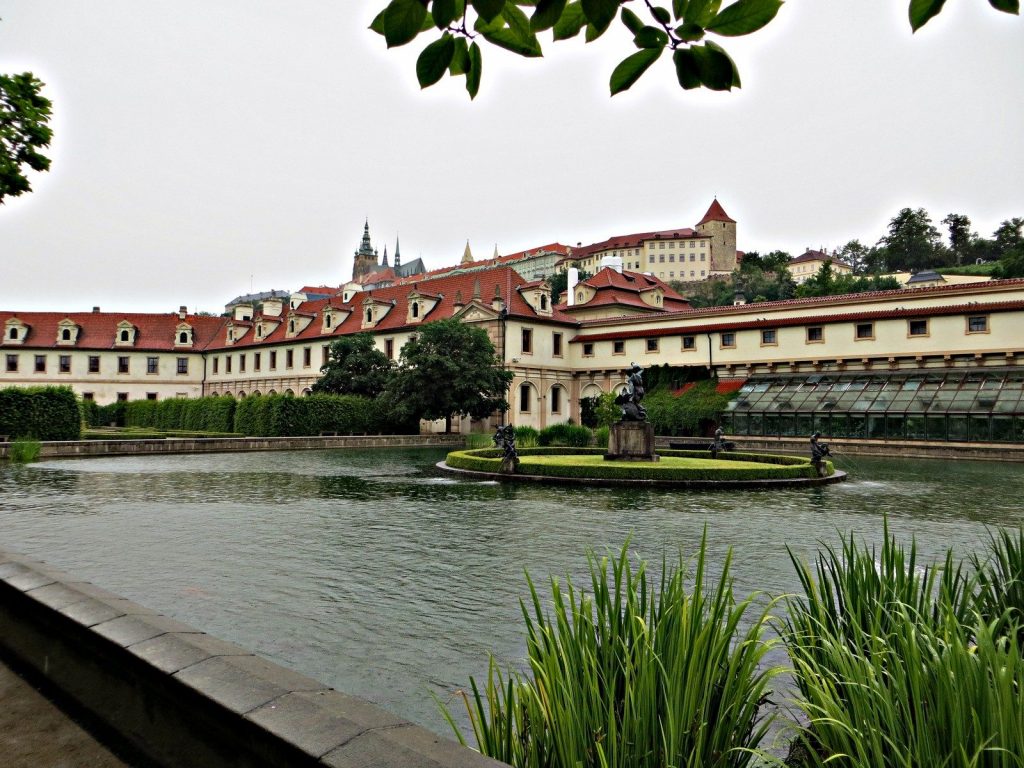
At the bottom of the hill is the first great baroque palace in Prague. Albrecht von Wallenstein, the most powerful general of the Thirty Years’ War, built it in the 1620s, pulling down more than twenty houses to make room. He enjoyed it only briefly: in 1634 he was murdered on the emperor’s orders in Cheb. Today the palace is the seat of the Senate of the Czech Republic. Its garden, with a huge open loggia, bronze statues, a pond and a strange grotto wall made to look like dripping stone, is open free of charge from April to October.
Stop 5: the Ministry of Finance and the Church of St Thomas
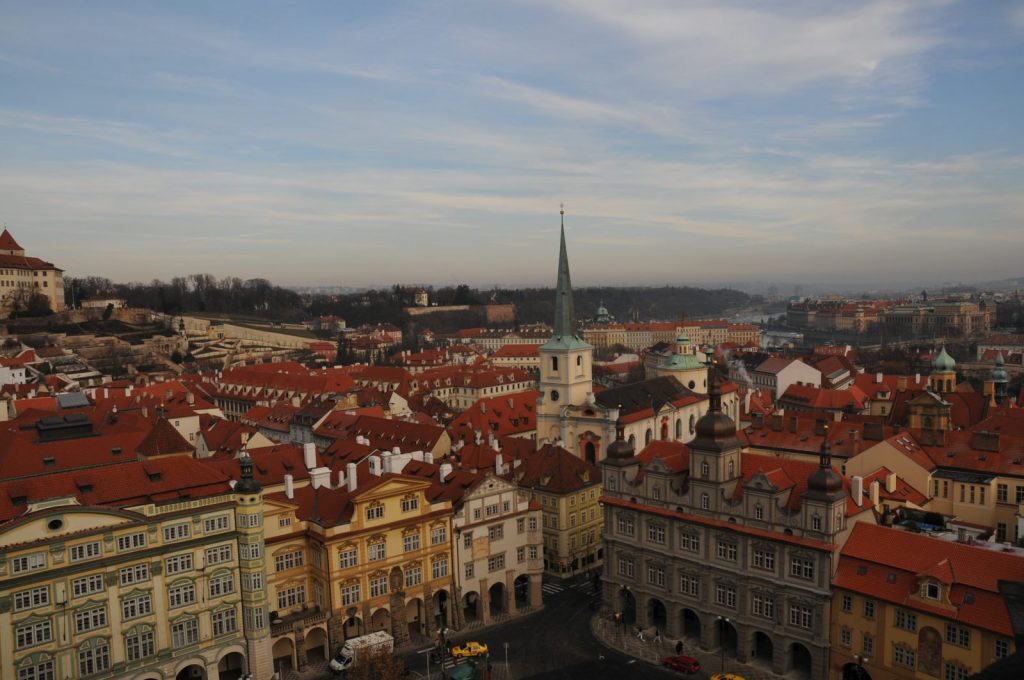
A short walk along Letenská Street brings you to the Ministry of Finance, a long block of government buildings next to the Church of St Thomas. The church, with its tall slender spire, was founded by Augustinian friars in the 13th century and rebuilt in baroque style by Kilian Ignaz Dientzenhofer in the 1720s. The ministry is a working government office and can only be seen from outside.
Stop 6: Malostranské Square
Letenská leads into Malostranské Square, the heart of Malá Strana. Its centre is the Church of St Nicholas, the most important baroque church in Prague, whose green dome and bell tower are visible from all over the city. Mozart played its organ in 1787. Around the square stand noble palaces that now house government offices and parliament.
Stop 7: the Rudolfinum
The car crosses the Vltava by Mánes Bridge, and on the far bank stands the Rudolfinum, a neo-Renaissance concert hall built in 1876–1885 and named after Crown Prince Rudolf. It is the home of the Czech Philharmonic, whose very first concert, in 1896, was conducted here by Antonín Dvořák, and its main hall bears his name. Between the wars the building served as the parliament of Czechoslovakia.
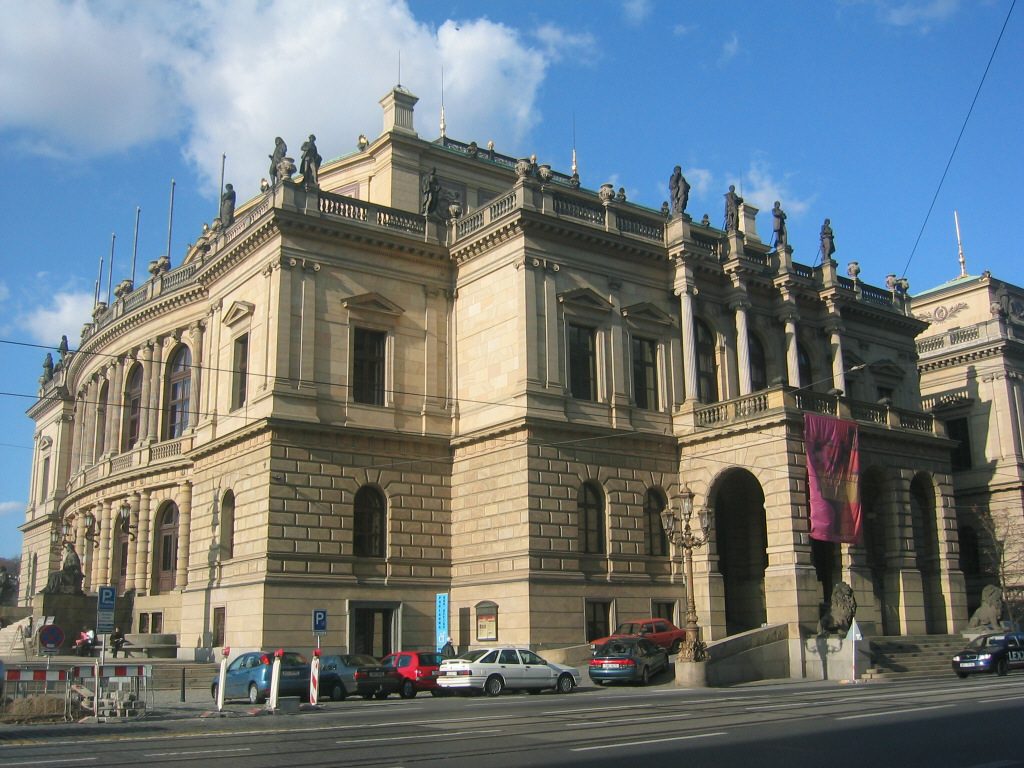
The Rudolfinum. Photo: Andreas Praefcke, CC BY 3.0
Stop 8: Pařížská Street
Pařížská — Paris Street — runs from the river to Old Town Square through the old Jewish Town. It was laid out around 1900, when the crowded ghetto was demolished, and is lined with Art Nouveau apartment houses full of turrets, mosaics and carved balconies, with luxury shops on the ground floors. Halfway along, just off the street, stands the Old-New Synagogue, built in the 13th century and the oldest synagogue in Europe still in use.
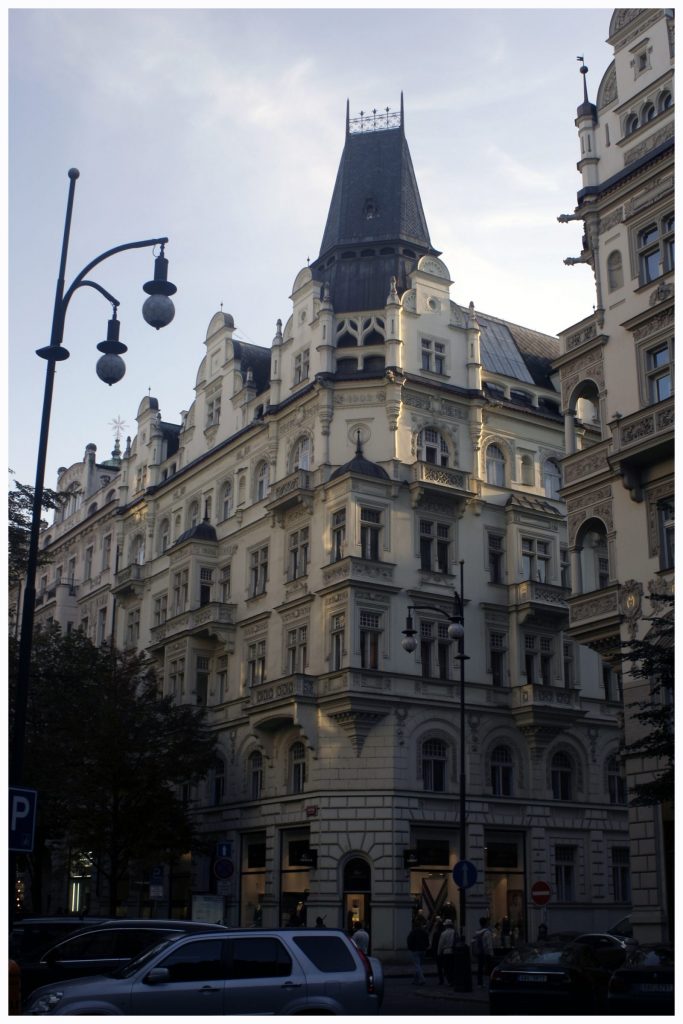
Stop 9: Old Town Square
Pařížská ends at Old Town Square, the place where most visitors’ Prague begins. On one side is the Old Town Hall with its Astronomical Clock, first set going in 1410, where the apostles appear in the little windows every hour; across the square rise the twin black spires of the Týn Church; in the middle stands the memorial to the reformer Jan Hus. The square is a pedestrian zone, so the driver sets you down at its edge and waits nearby while you walk around.
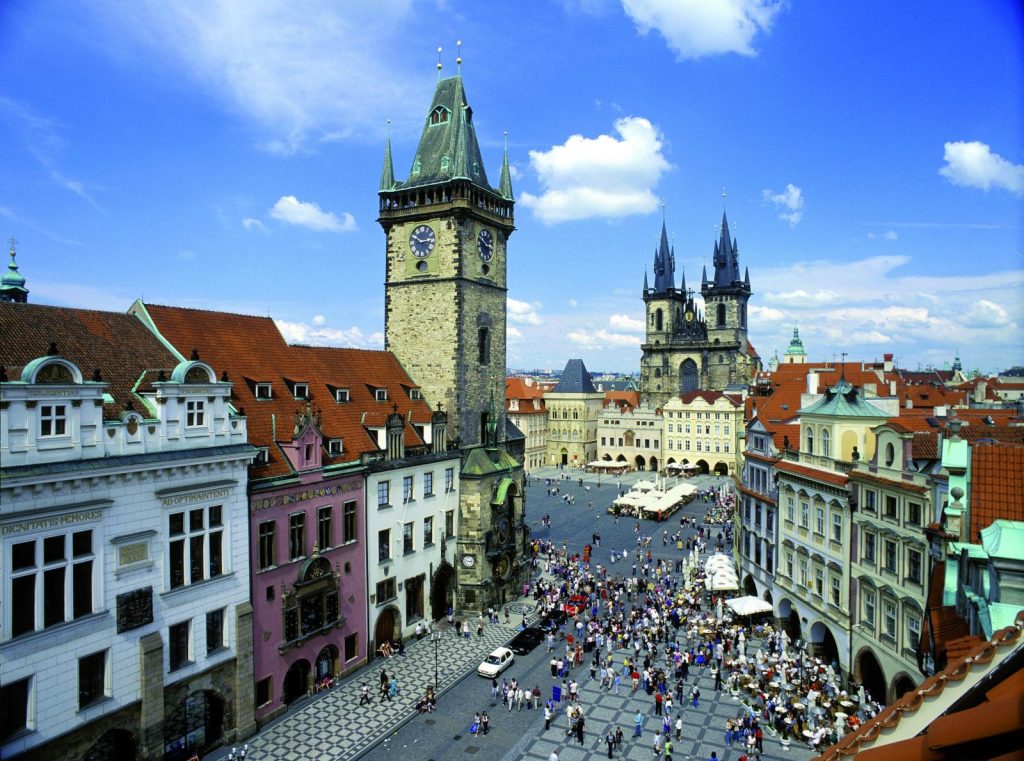
Old Town Square. Photo: Estec GmbH, CC BY 3.0
Then to your hotel
From Old Town Square the driver takes you to your hotel or apartment anywhere in Prague; most hotels in the centre are five to fifteen minutes away.
Booking and price
Airport transfer through the historic centre — €50 per car, fixed when you book. The driver meets you in the arrivals hall with a name board and follows your flight; waiting at the airport is free.
Another route: the Loreto, Hradčany Square, Strahov and the Infant Jesus of Prague · Straight to the hotel: airport transfer, €30
WhatsApp, Viber, Telegram: +420 773 477 799
Frequently asked questions
What happens to our luggage during the stops?
It stays locked in the car. The driver waits nearby at every stop, so you walk around with nothing more than a camera.
How long does the whole transfer take?
About two hours with short stops and walks; three to four hours if you spend longer in the gardens or sit down for a coffee on Old Town Square. You decide on the way.
Can we see the gardens in winter?
The Royal Garden with the Belvedere and the Singing Fountain is closed from November to February, and the Wallenstein Garden from November to March. The Chotek Gardens are open all year, and the Belvedere can be seen from the street.
Are any entrance fees included?
There is nothing to pay on this route: the streets, squares and gardens are free, and the price covers the car and the driver.
Can we skip some stops?
Yes. The nine places are a suggestion, not a fixed programme: you can stay in the car for some of them, get out at others, or go straight to the hotel at any point.