Prague Free Audio Guide and Walking Tour in 14 Stops
The best way to see the centre of Prague is downhill: start at the castle on top of the hill, walk down through the Lesser Town, cross Charles Bridge and finish in the Old and New Towns. This page is a free audio guide to that walk in English, written out and read aloud: fourteen stops from Prague Castle to Wenceslas Square, about 5 km and four to five hours with visits. Keep the page open on your phone and play or read each stop as you reach it. The walk itself costs nothing; you pay only for the buildings you go into.
Listen to the audio guide — each stop below has its own track, about a minute long. Start with the introduction:
Or download the whole tour as one MP3 (12 minutes, 5 MB) before you leave, so it plays without mobile data.
Fixed price car, up to 4 · minivan, up to 8 · confirmed in writing
Driver up to the castle, walk down, driver back to your hotel
- Pick-up at your hotel or apartment in Prague, at the time you choose
- The driver takes you up the hill and drops you at Hradčany, a few steps from Castle Square — the start of this walk, with no climb
- You walk down at your own pace: the castle, the Lesser Town, Charles Bridge, the Old Town
- The driver meets you at the top of Wenceslas Square, by the statue of St Wenceslas, and takes you back to your hotel
- Price for the whole car, not per person; child seats included
Tell us the date, your hotel, when you would like to start and how many of you there are — we confirm the car and the price in writing. +420 773 477 799 (WhatsApp, Viber, Telegram) · cz@cztransfer.com · private city tour by car
Order
How you can pay
- Cash to the driver — euros, Czech crowns, US dollars or pounds sterling
- Card to the driver, contactless — Visa, Mastercard, Maestro, American Express, or pay by phone
- Card or PayPal online, before the trip — Visa, Mastercard, American Express; the payment processor adds a 6% fee
- Crypto, before the trip — USDT (TRC-20) or Bitcoin
Payment details · no deposit, pay at the end of the trip if you like
Before you set off
- Distance: about 5 km, almost all of it downhill or flat. The only climb is the one to the castle, and the car or the tram does that for you
- Time: four to five hours with visits; about an hour and a quarter of walking alone
- Start early: the castle courtyards open early in the morning, long before the crowds. Its buildings are open from 9 am to 5 pm, and to 4 pm in winter
- Free: the castle courtyards, the front part of St Vitus Cathedral, the Old Castle Steps, the Lennon Wall, Kampa, Charles Bridge and all the squares
- Paid: one castle ticket covers the rest of the cathedral, the Old Royal Palace, St George’s Basilica and Golden Lane; the bridge towers and the Old Town Hall tower have their own tickets
- Security: there are bag checks at the castle entrances; leave large bags at the hotel
- In Advent: from the end of November until early January, the route passes three Christmas markets — at the castle, on Old Town Square, with Prague’s main Christmas tree, and on Wenceslas Square. They are busiest in the evenings and at weekends
- Without a car: tram 22 or 23 to the Pražský hrad or Pohořelec stop takes you up the hill
- Map: open the route in Google Maps
Walking it in this direction is not only easier on the legs. It also follows history: from the castle, where Bohemia was ruled for a thousand years, down to Wenceslas Square, where the Czechs won back their freedom in 1989.
Route map
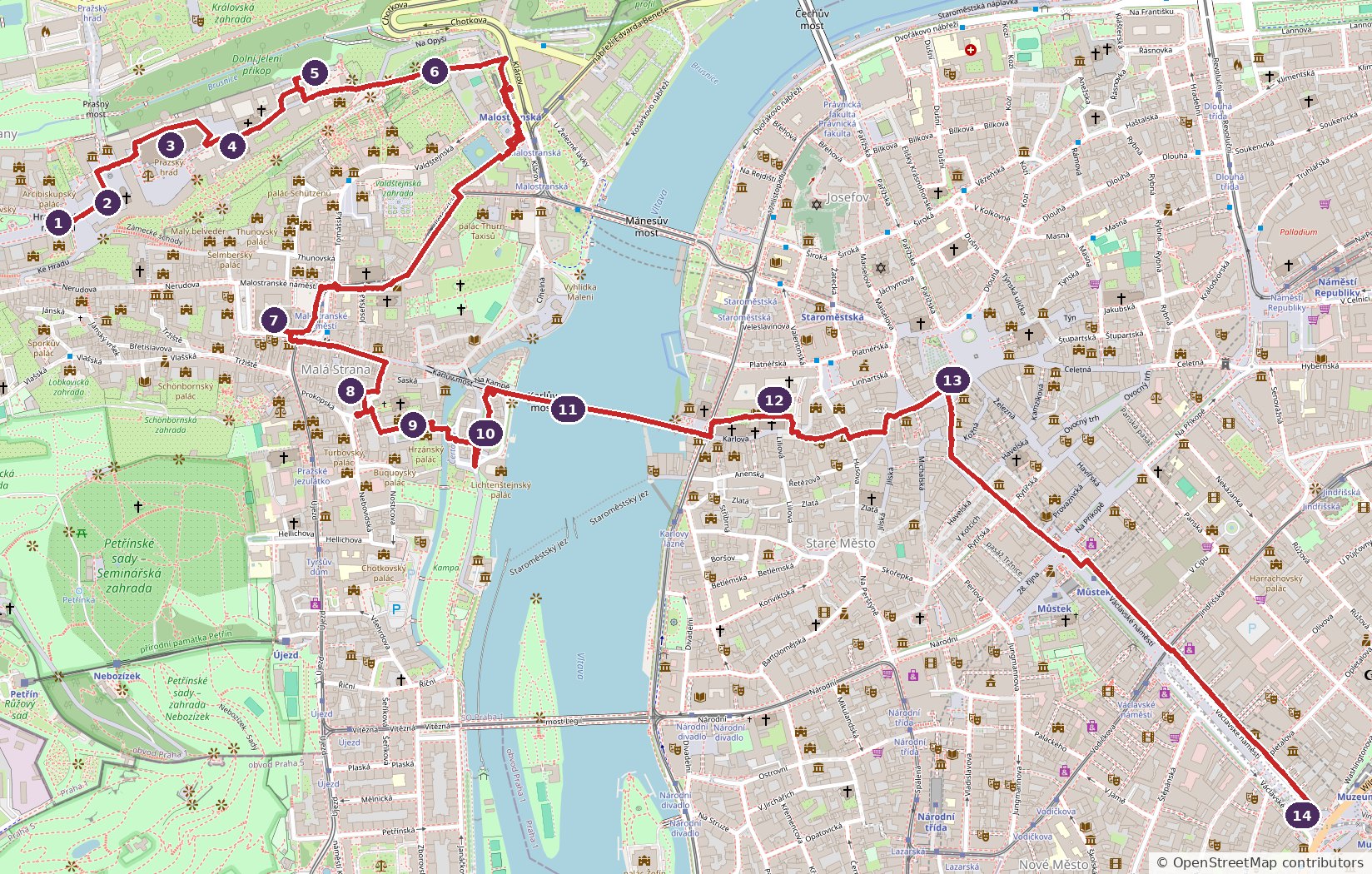
1 Castle Square · 2 the castle gates and the guard · 3 St Vitus Cathedral · 4 Old Royal Palace and St George’s Basilica · 5 Golden Lane · 6 Old Castle Steps · 7 Lesser Town Square and St Nicholas · 8 Mostecká street · 9 Lennon Wall · 10 Kampa · 11 Charles Bridge · 12 Karlova street and the Clementinum · 13 Old Town Square · 14 Wenceslas Square. Tap the map to open it full size. Map data © OpenStreetMap contributors.
1. Castle Square
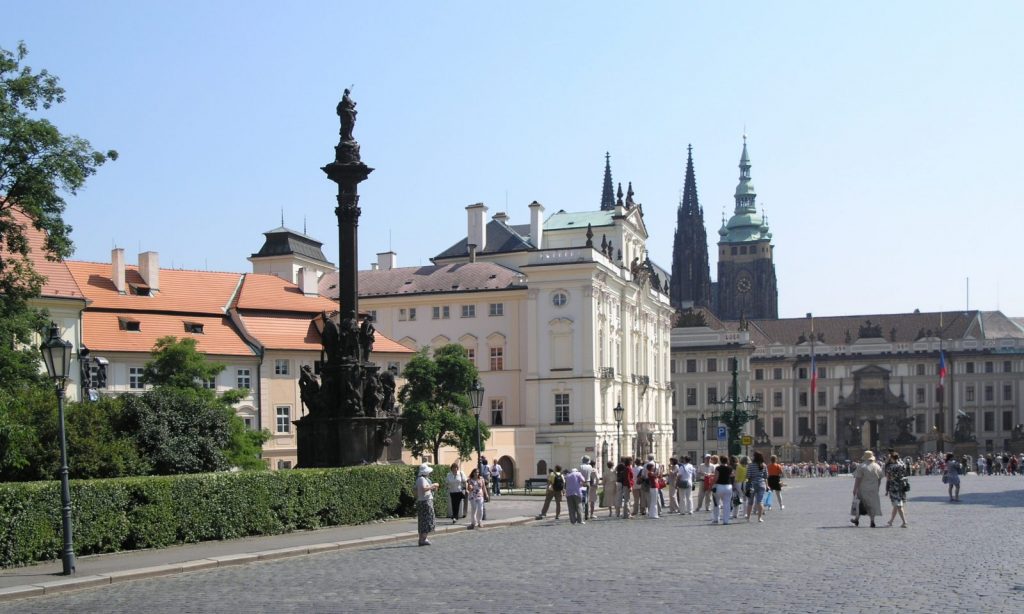
Castle Square, with the plague column and the cathedral spires behind the palace. Photo: Matěj Baťha / CC BY-SA 3.0
Welcome to Hradčany, the castle quarter on the hill above the river. You are standing on Castle Square, with the gates of Prague Castle on one side and the palaces of the nobles who wanted to live close to the king on the others.
Look for the white Archbishop’s Palace with its Rococo front, and for the Schwarzenberg Palace, whose walls are covered in sgraffito, a black-and-white pattern scratched into the plaster that looks like cut stone. Before you go in, walk to the edge of the square by the castle wall: the view over the red roofs of the Lesser Town and the towers of the Old Town is the whole of this walk laid out in front of you.
2. The castle gates and the guard
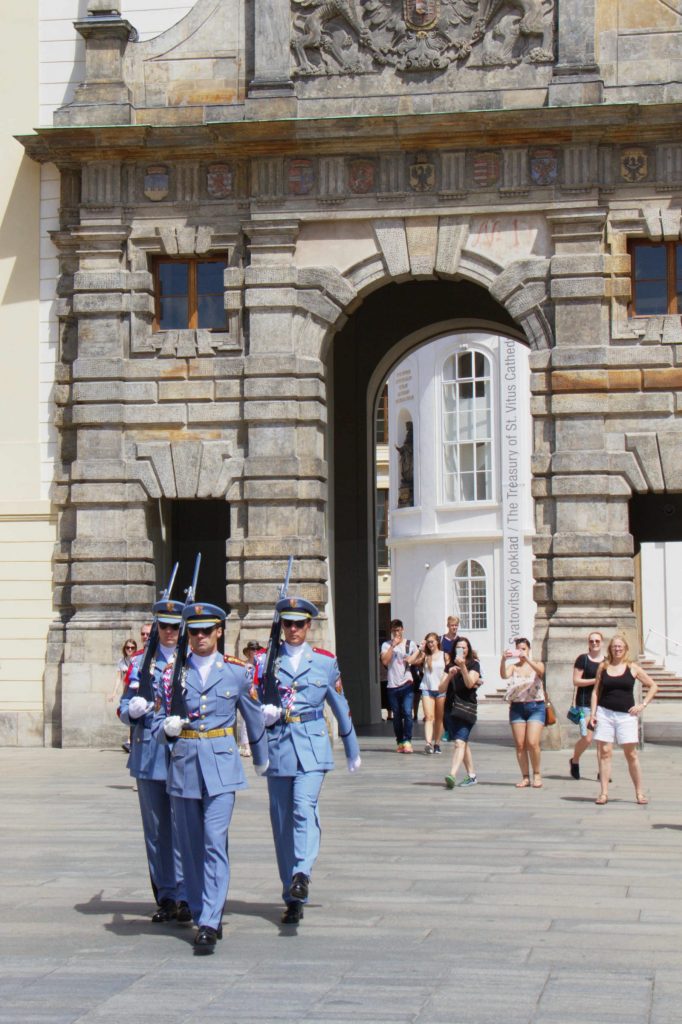
Castle guards at the Matthias Gate. Photo: Ronnie Macdonald from Chelmsford and Largs, United Kingdom / CC BY 2.0
Prague Castle was founded in the late 9th century and has been the seat of Czech rulers ever since — princes, kings, emperors and now the president. It is listed as the largest ancient castle complex in the world, so do not try to see it all.
The gate into the first courtyard is watched by two groups of fighting giants, and by the soldiers of the Castle Guard. Their blue uniforms were designed in 1990 by Theodor Pištěk, the costume designer who won an Oscar for the film Amadeus. The guard changes every hour on the hour during the day, and at noon there is a full ceremony with a fanfare in the first courtyard.
Walk on through the Matthias Gate, built in 1614 and one of the first Baroque buildings in the country, into the second courtyard. There are bag checks at the entrance.
3. St Vitus Cathedral
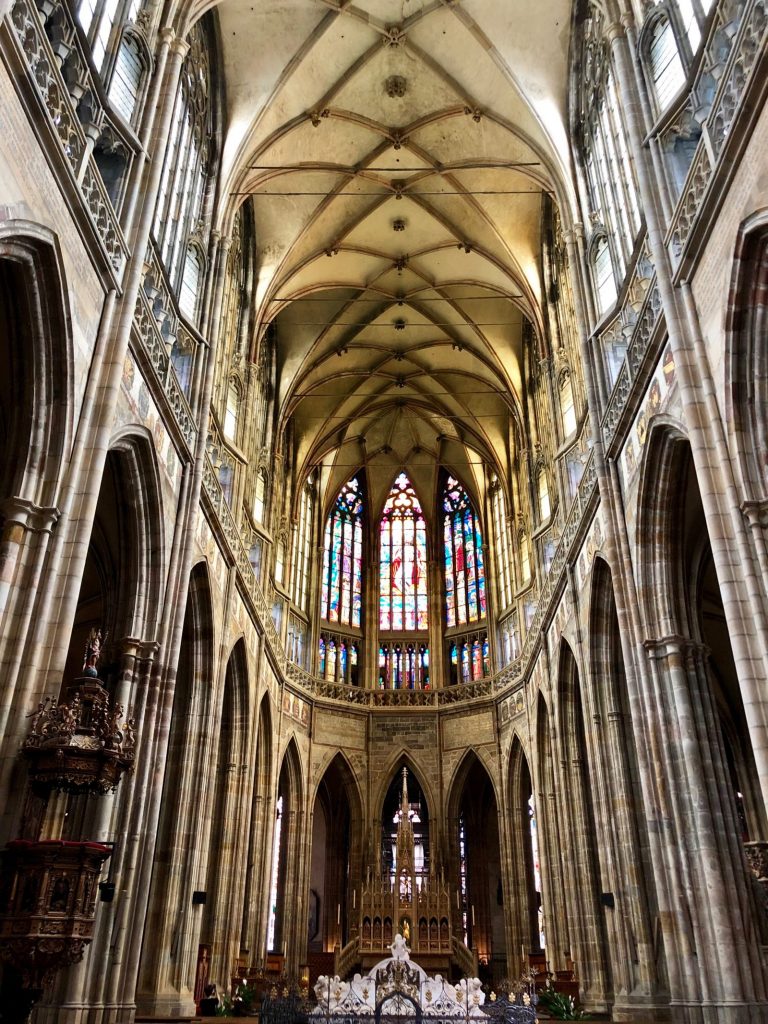
The nave of St Vitus Cathedral. Photo: Warren LeMay from Cullowhee, NC, United States / public domain
Pass through to the third courtyard, and the cathedral rises right in front of you, so close that it is hard to photograph. Its story is long: the work started in 1344, under the future Emperor Charles the Fourth, with the French architect Matthias of Arras and then the young genius Peter Parler. Wars and money stopped it many times, and the cathedral was finished only in 1929.
The front part of the nave is free to enter. Along the left-hand side, look for the stained-glass window designed by Alphonse Mucha, full of Slavic saints in Art Nouveau colours. With a castle ticket you can go further, to the silver tomb of St John of Nepomuk and to the St Wenceslas Chapel, its walls set with semi-precious stones. The Czech crown jewels are kept in a room above it, behind a door with seven locks.
4. The Old Royal Palace and St George’s Basilica
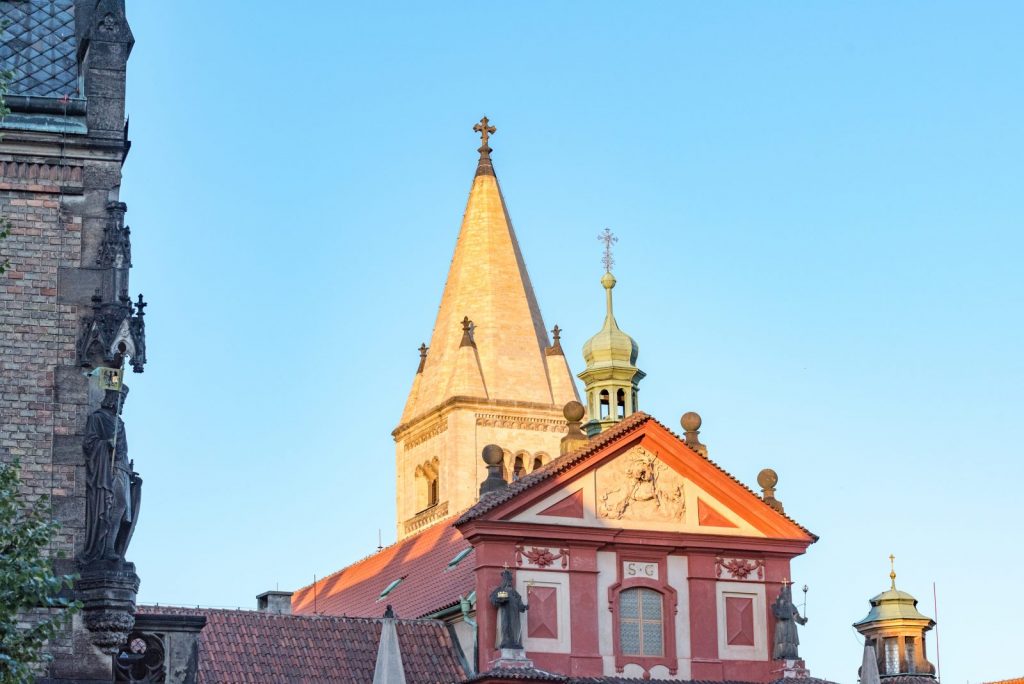
St George’s Basilica: a red Baroque front on a Romanesque church. Photo: Tilman2007 / CC BY-SA 4.0
Opposite the cathedral’s south side is the entrance to the Old Royal Palace. Its great Vladislav Hall, finished around 1500 by Benedikt Ried, was the largest hall in Prague, so big that knights rode their horses up the stairs to tournaments held indoors.
In a room of the palace in 1618, Protestant nobles threw two royal governors and their secretary out of a window. All three survived — the story says they landed on a dung heap — but this Defenestration of Prague started the Thirty Years’ War.
At the far end of the square stands St George’s Basilica, with its red Baroque front. Behind it is the oldest church in the castle that still stands, founded around 920, with a calm, bare Romanesque interior.
In Advent, the square in front of the basilica holds the castle’s small Christmas market, with stalls of crafts, mulled wine and hot food.
5. Golden Lane
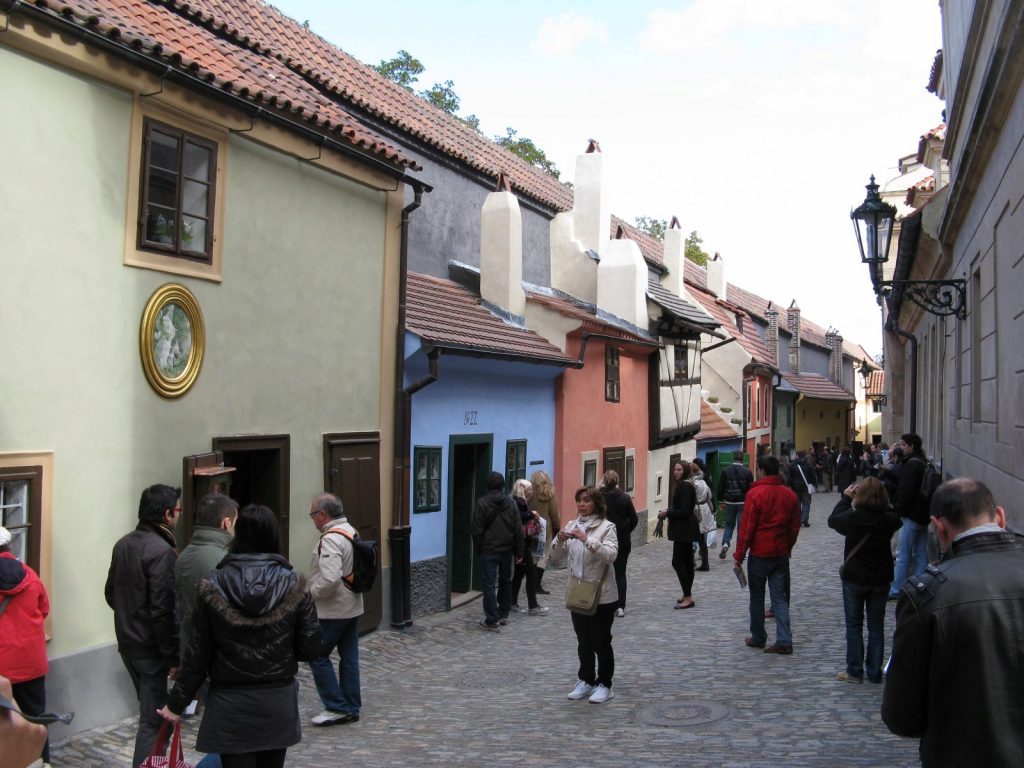
The little houses of Golden Lane. Photo: Yair Haklai / CC BY-SA 3.0
Walk down Jiřská street and turn left into Golden Lane, a row of tiny houses built into the castle wall at the end of the 16th century for the castle guards. Later, goldsmiths, craftsmen and poor families lived here, and a legend grew that the alchemists of Emperor Rudolf the Second made gold in these rooms.
The writer Franz Kafka worked for a few months in 1916 and 1917 in the blue house, number 22, which his sister had rented. Today the houses are little museums of how people lived here, and the lane is part of the castle ticket.
6. The Old Castle Steps
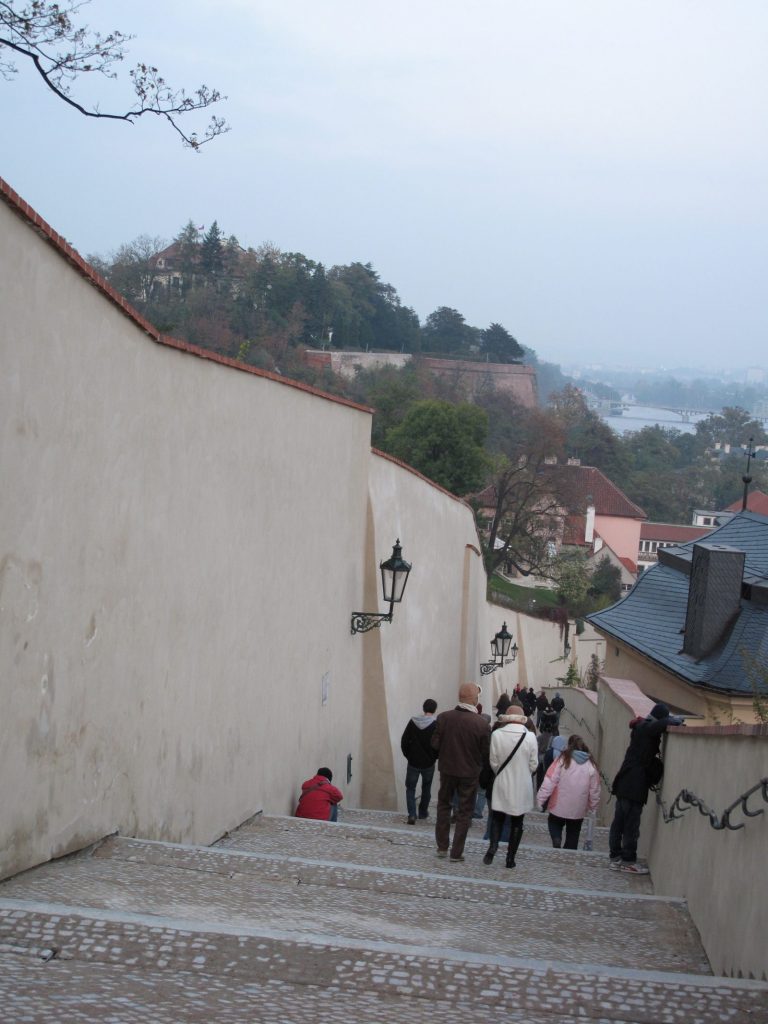
The Old Castle Steps on the way down to the Lesser Town. Photo: Juan de Vojníkov / CC BY-SA 3.0
Leave the castle through the east gate, under the Black Tower. Just outside, stop at the viewpoint above the steps: this is one of the best views of Prague, over the bridges and the river to the Old Town.
Then go down the Old Castle Steps, a long stone stairway that has linked the castle with the town below for centuries. At the bottom, near Malostranská metro station, turn left and follow the streets into the Lesser Town. If you need a break, the Wallenstein Garden, with its peacocks, is on the way and free to enter in the warmer months.
7. Lesser Town Square and St Nicholas Church
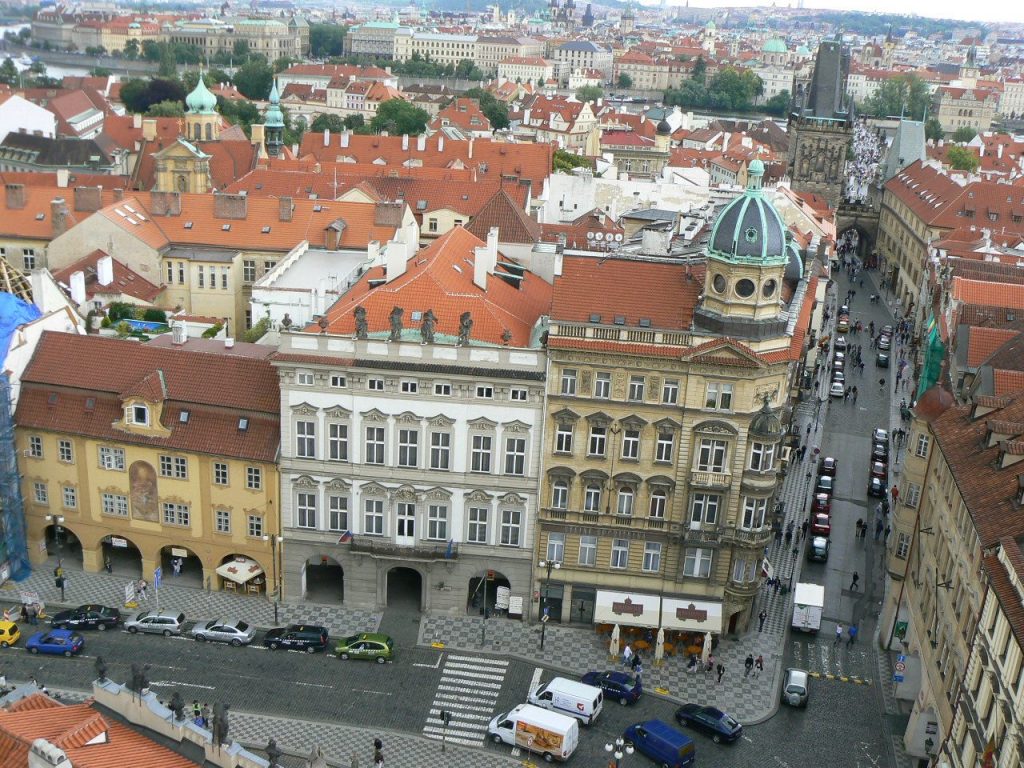
Lesser Town Square from above, with the green dome of St Nicholas. Photo: Joker Island / public domain
You are now in Malá Strana, the Lesser Town, a quarter of palaces, embassies and quiet courtyards at the foot of the castle. Its heart is Lesser Town Square, and in the middle of it stands St Nicholas Church, the finest Baroque church in Prague, with its green dome and tall bell tower.
It was built over half a century, from 1704 to the 1750s, by the Dientzenhofers, father and son. Inside it is all movement: painted ceilings, gold and marble, and statues that seem about to step down. Mozart played its organ in 1787. During the communist years the secret police used the bell tower to watch the Western embassies nearby. You need a ticket to go into the church, and another to climb the tower.
8. Mostecká street and the bridge towers
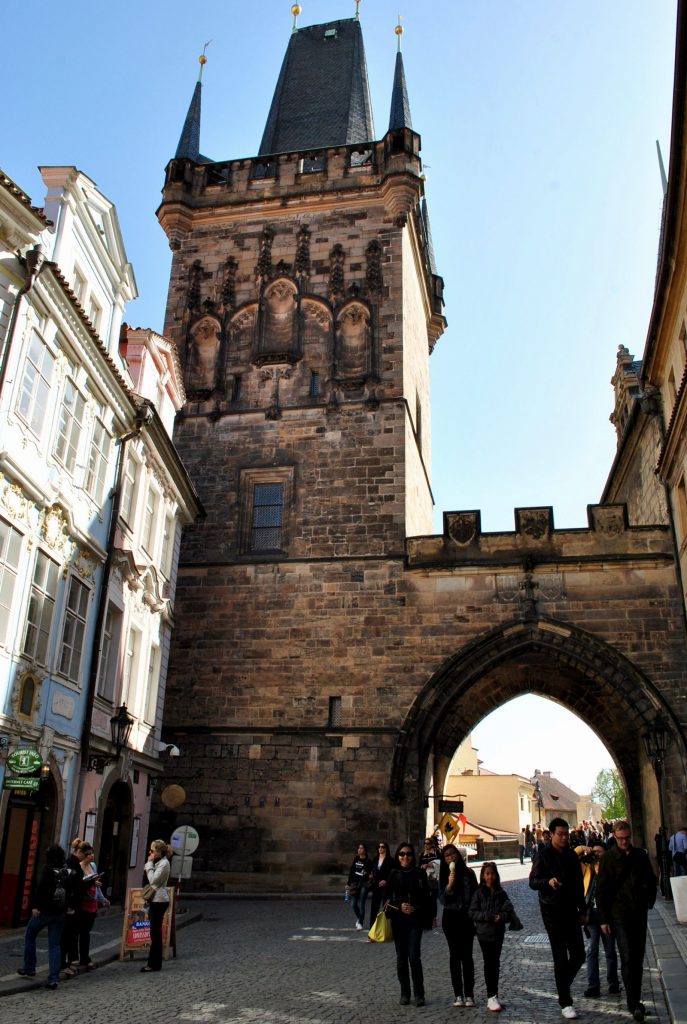
The Lesser Town bridge towers at the bottom of Mostecká. Photo: Ignaz Wiradi / CC BY-SA 3.0
From the square, take Mostecká, which simply means Bridge Street. For centuries this was part of the Royal Route, the path of the coronation processions from the Old Town up to the castle, and you are walking it in reverse.
At the end of the street stand the two Lesser Town bridge towers, joined by a gate. The lower one is older than Charles Bridge itself: it belonged to the Judith Bridge, the stone bridge that stood here before a flood destroyed it in 1342. Before you go through the gate, turn right.
9. The Lennon Wall
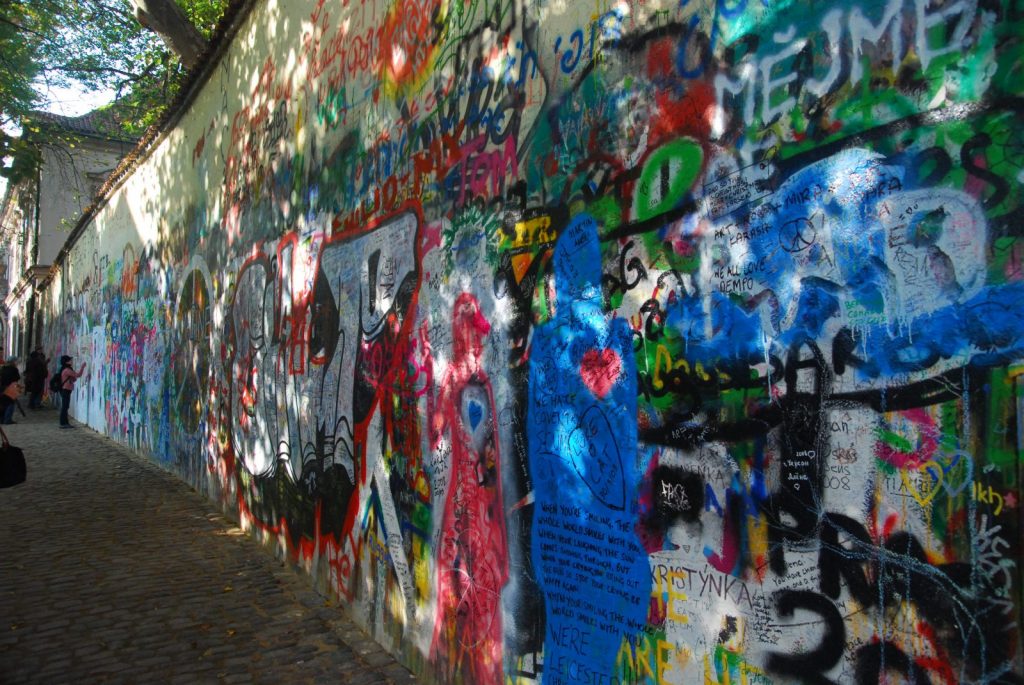
The Lennon Wall, repainted again and again. Photo: Adam Zivner / CC BY-SA 3.0
A short walk brings you to a quiet square and a wall covered from top to bottom in colourful graffiti. After John Lennon was killed in 1980, young Praguers painted his portrait here, and then lyrics and slogans of peace and freedom. The communist police painted over it again and again, and every time the paintings came back.
Today the wall belongs to the Knights of Malta, whose Grand Priory palace stands on the same square, and the paintings on it keep changing every week. You can read more on our Lennon Wall page.
10. Kampa
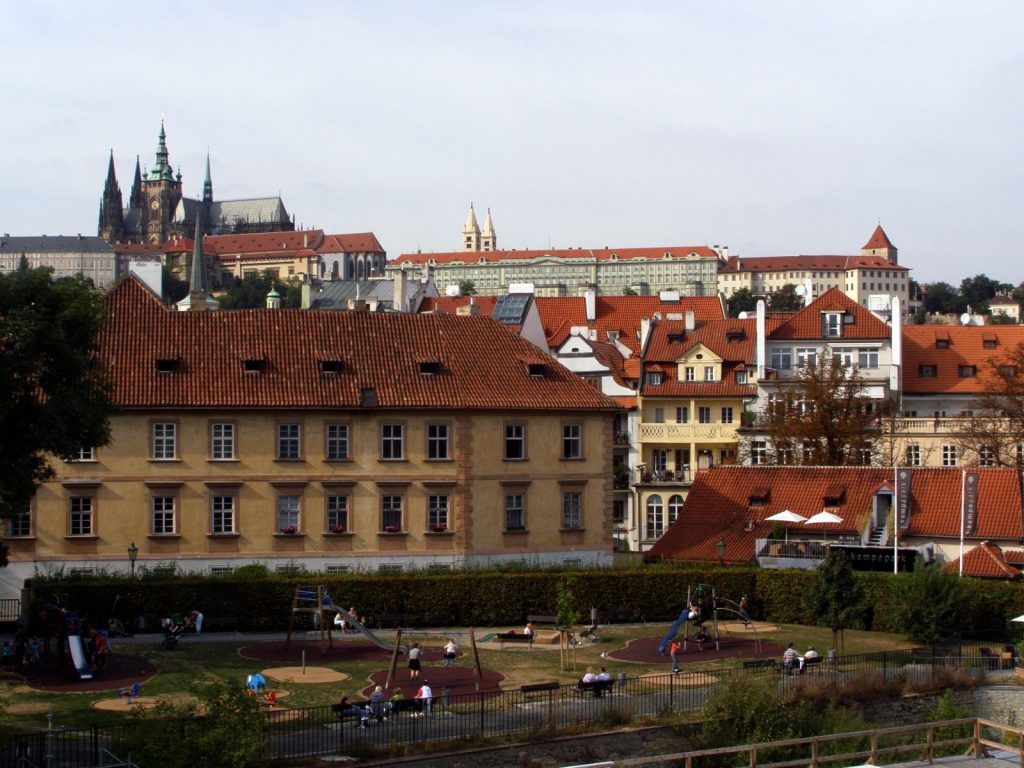
Kampa, with the castle above the Lesser Town roofs. Photo: Daniel Baránek / CC BY-SA 3.0
Cross the little bridge over the Devil’s Stream, a narrow channel of the river, and you are on Kampa, an island between the stream and the Vltava. Look for the old water wheel on the stream, from the days when mills stood here.
The southern part of the island is a park by the river, one of the most peaceful places in the centre. By the Kampa Museum, a gallery of modern Central European art, you will find three giant bronze babies with barcode faces by the sculptor David Černý.
Walk back north along the square, Na Kampě, to the stone staircase that leads up onto Charles Bridge.
11. Charles Bridge
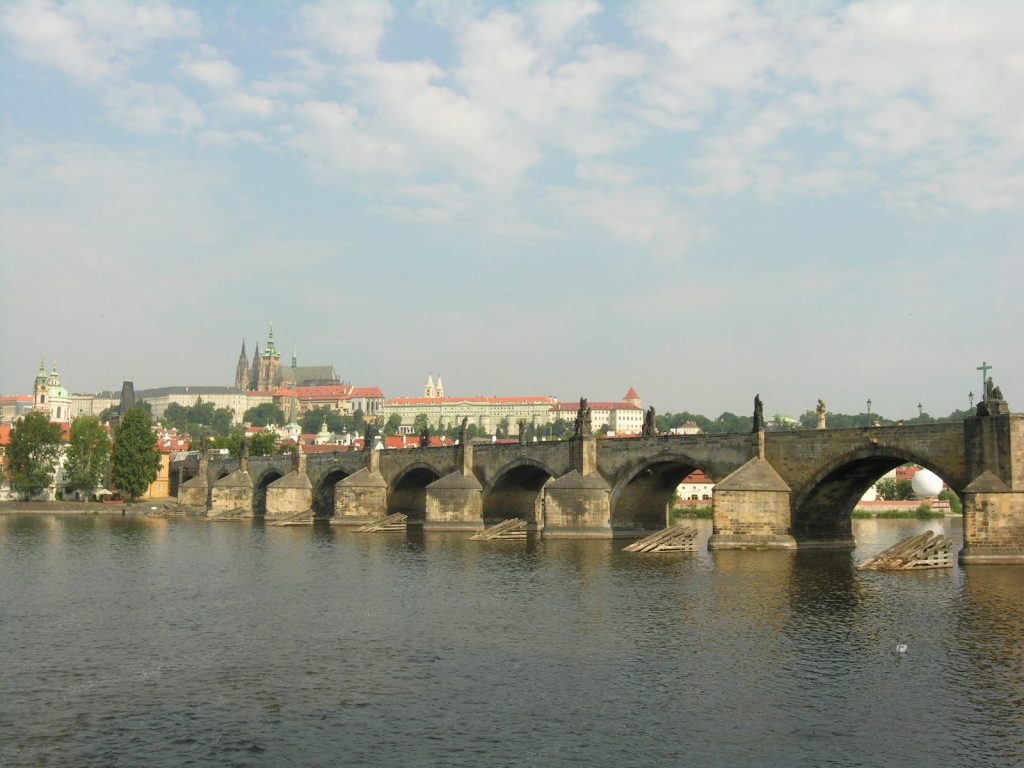
Charles Bridge, with the castle where you started on the hill behind. Photo: Lehotsky / CC BY-SA 3.0
Charles Bridge is the symbol of Prague. The foundation stone was laid by Charles the Fourth in 1357, and the bridge was built by the same Peter Parler who worked on the cathedral. For more than four hundred years it was the only bridge across the river in Prague, and it is about half a kilometre long.
The thirty statues of saints were added from the end of the 17th century; most of the ones you see today are copies, and the originals are in museums. Near the middle of the bridge, look for the statue with a crowd around it and its bronze plaques rubbed shiny. This is St John of Nepomuk, a priest who was thrown from this bridge into the river in 1393. People touch the bronze plaques below him for luck, and his statue is the oldest on the bridge.
Come early or late if you want to see the bridge rather than the crowd. At the far end is the Old Town Bridge Tower, also by Parler, with a viewing gallery at the top.
12. Karlova street and the Clementinum
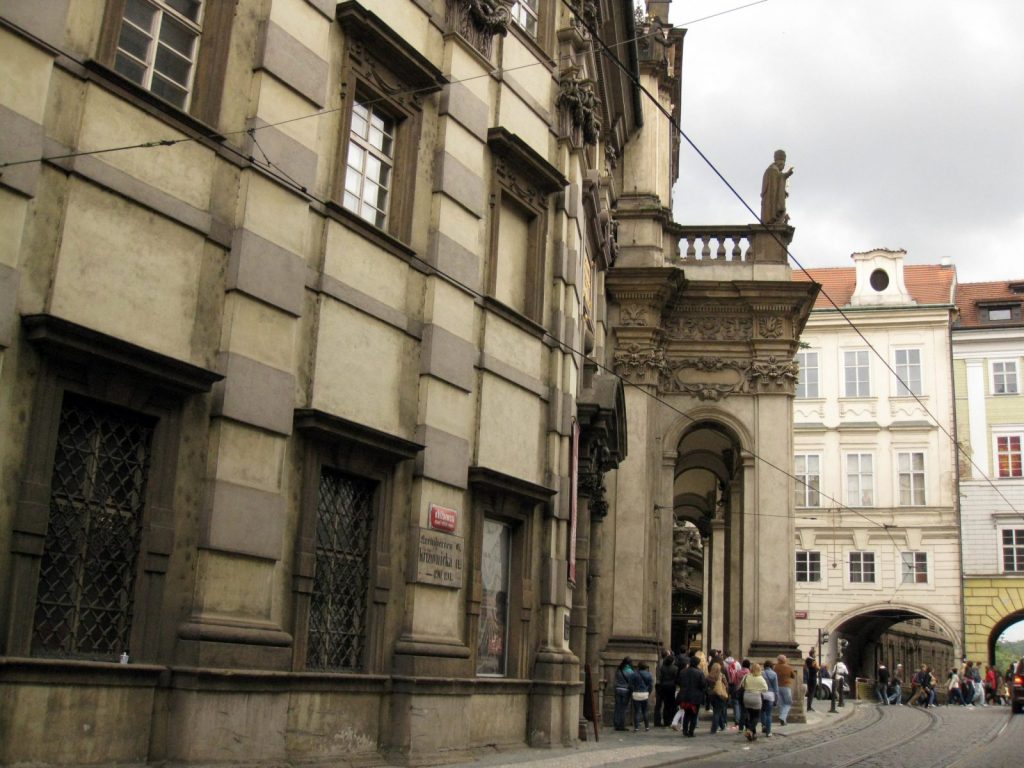
The Clementinum’s long front on Karlova street. Photo: Enfo / CC BY-SA 3.0
Go through the tower and follow Karlova, Charles Street, a narrow, winding street that takes the Royal Route on to the Old Town Square. It is full of shops and crowds, so keep an eye on the signs and on your bag.
The huge building on your left is the Clementinum, the old Jesuit college, now the National Library. Its guided tour shows one of the most beautiful Baroque libraries in the world and climbs the astronomical tower, where the weather in Prague has been measured every day since 1775.
13. Old Town Square
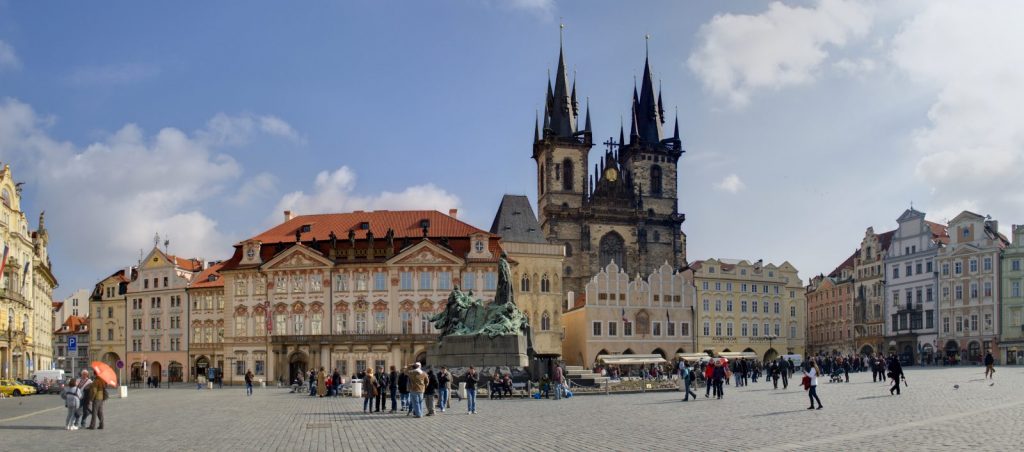
Old Town Square, with the Týn Church and the Jan Hus memorial. Photo: Mihael Grmek / CC BY-SA 3.0
Karlova opens into Old Town Square, the main square of Prague for more than eight hundred years. Look for the twin Gothic towers of the Týn Church, the pastel houses around the square and the memorial to Jan Hus, the church reformer who was burned at the stake in 1415.
On the tower of the Old Town Hall is the Astronomical Clock, made in 1410 and the oldest astronomical clock still working. Every hour from morning until late evening, small doors open above the dials and the twelve apostles pass by, while Death rings his bell. The show is short, so be there a few minutes before the hour. The Town Hall tower has a lift and a great view.
In Advent, from the end of November until early January, this is the heart of Christmas in Prague. Prague’s main Christmas tree stands in the middle of the square, lit up every evening, and the biggest Christmas market in the city fills the square around it, with a stage for carols, wooden stalls, mulled wine, trdelník and roast ham. Come after dark to see it at its best.
In the pavement in front of the Town Hall you will see twenty-seven white crosses. They mark the execution, here, in 1621, of twenty-seven leaders of the Bohemian uprising against the Habsburgs.
14. Wenceslas Square
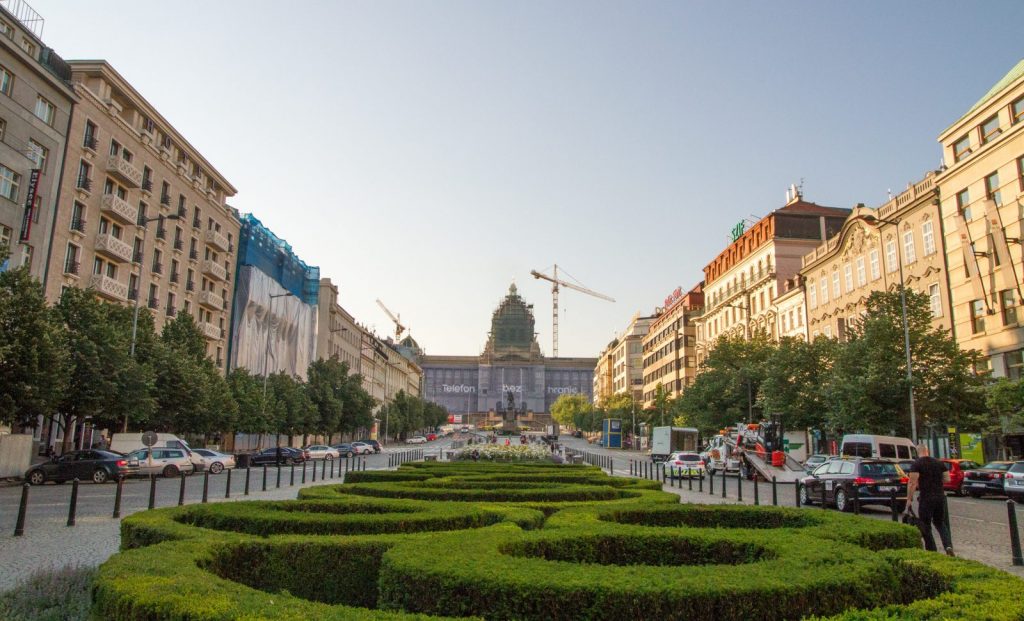
Wenceslas Square, looking up towards the National Museum. Photo: Maksym Kozlenko / CC BY-SA 4.0
Leave the square to the south, past the Havelská street market, and you come out at the bottom of Wenceslas Square. It is not really a square but a long, wide boulevard, laid out by Charles the Fourth in 1348 as the horse market of the New Town. In Advent, the lower end of the boulevard has its own Christmas market, the second largest in Prague after Old Town Square.
Walk up the boulevard to the top, where the statue of St Wenceslas on his horse stands in front of the National Museum. This square is where the big moments of modern Czech history happened. In January 1969 the student Jan Palach set himself on fire near here in protest against the Soviet occupation; there is a memorial in the pavement in front of the museum. In November 1989, hundreds of thousands of people filled the square every day, and Václav Havel spoke to them from a balcony. Within weeks, communism in Czechoslovakia was over.
This is the end of the walk. If you came with a driver, this is where you are picked up.
Getting up to the castle
The walk is easy because it starts at the top. With the offer above, a driver collects you from your hotel, drops you at the castle and picks you up at Wenceslas Square. By public transport, take tram 22 or 23 to Pražský hrad or Pohořelec. If you would rather have a car for longer and stop wherever you like, see our private Prague city tour, and for a licensed guide who walks with you, our guided tours of Prague.
Frequently asked questions
Is there a free audio guide to Prague in English?
Yes — this page. Every stop has its own English audio track that plays in your phone’s browser, and the whole tour is also one MP3 you can download before you go. No app or account is needed.
How long does this walk around Prague take?
Four to five hours with visits for this 5 km route, and about an hour and a quarter of walking if you do not go inside anything. Give the castle at least an hour and a half.
Is it better to walk Prague from the castle down?
Yes. The castle is on a steep hill, and starting at the top means the whole walk is downhill or flat. Take a car or tram 22 up, and walk down.
Is Prague Castle free to visit?
The courtyards, the gardens in season and the front part of St Vitus Cathedral are free. The rest of the cathedral, the Old Royal Palace, St George’s Basilica and Golden Lane need one castle ticket.
When is the changing of the guard at Prague Castle?
Every hour on the hour during the day at the castle gates. The biggest ceremony, with a fanfare, takes place at noon in the first courtyard.
Where are the Christmas markets and the Christmas tree in Prague?
The main Christmas tree and the biggest market are on Old Town Square, stop 13 of this walk. There are also markets at the bottom of Wenceslas Square, stop 14, and on the square by St George’s Basilica at Prague Castle, stop 4. They run from the end of November, around the first Sunday of Advent, until early January.
Where does the driver pick us up at the end?
At the top of Wenceslas Square, by the statue of St Wenceslas in front of the National Museum. The time is agreed in advance, or you send a message when you are close.