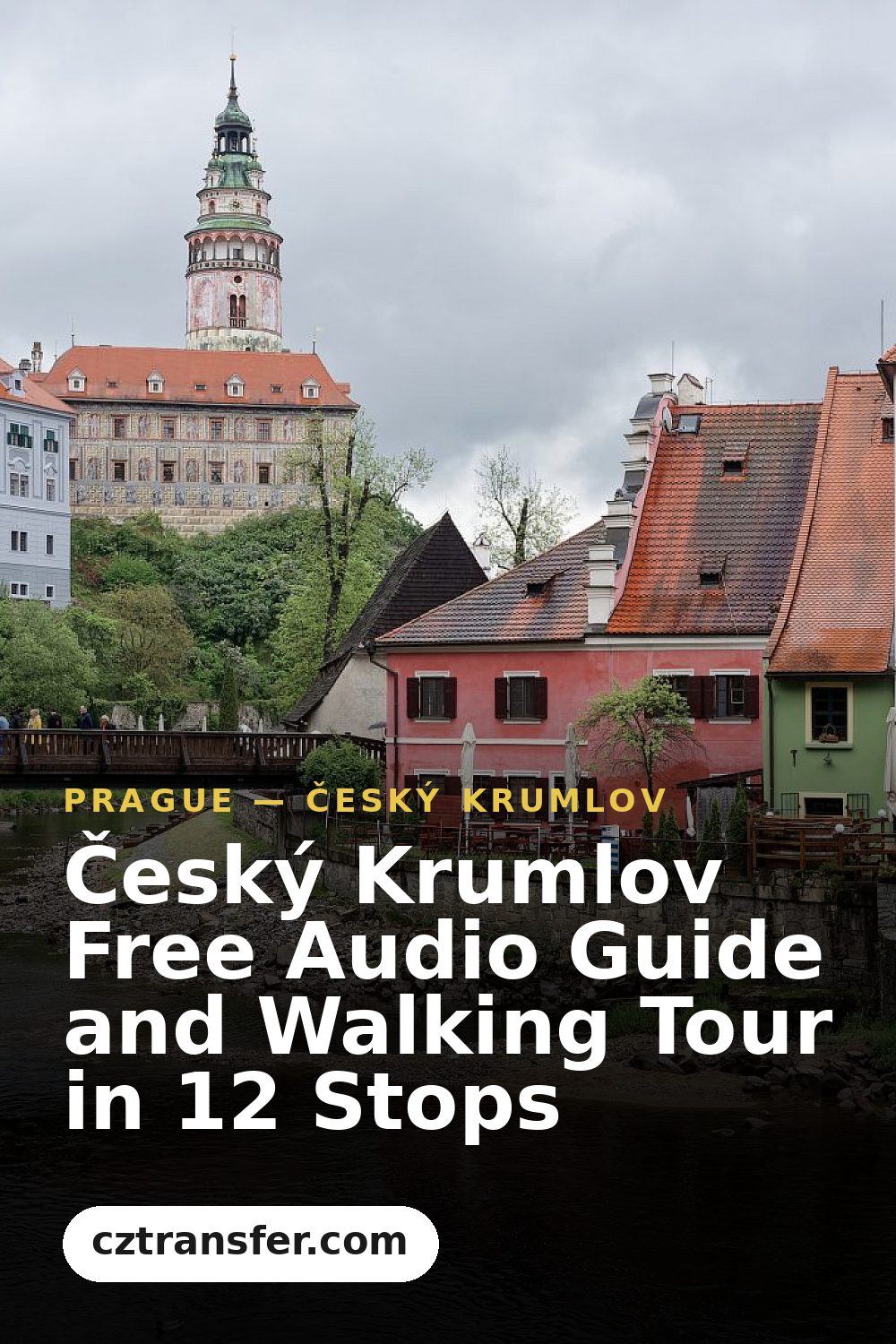
Český Krumlov Free Audio Guide and Walking Tour in 12 Stops
The free audio guide to Český Krumlov on izi.TRAVEL is in Ukrainian only, so here is the same walk in English, written out and read aloud: twelve stops from the top of the castle down to the Church of St Vitus, about 2.8 km and two to three hours at an easy pace. Keep this page open on your phone and play or read each stop as you reach it. Walking the route costs nothing; you only pay if you go inside the castle, the tower or a museum.
Listen to the audio guide — each stop below has its own track, about a minute long. Start with the introduction:
Or download the whole tour as one MP3 (9 minutes, 4 MB) before you leave, so it plays without mobile data.
€230 car, up to 4 · €260 minivan, up to 8
Private day trip from your Prague hotel to Český Krumlov and back
- Pick-up at your hotel or apartment in Prague, at the time you choose
- About two and a half hours to Krumlov; the driver drops you as close to the old town as cars may go
- The driver waits while you walk this route, have lunch and visit the castle — five or six hours is usual
- Back to your hotel in Prague the same evening, about twelve hours door to door
- Price for the whole car, not per person: fuel, tolls, parking, waiting and child seats included
Tell us the date, your hotel in Prague, when you would like to leave and how many of you there are — we confirm the car and the price in writing. +420 773 477 799 (WhatsApp, Viber, Telegram) · cz@cztransfer.com · more about the day trip
Order
How you can pay
- Cash to the driver — euros, Czech crowns, US dollars or pounds sterling
- Card to the driver, contactless — Visa, Mastercard, Maestro, American Express, or pay by phone
- Card or PayPal online, before the trip — Visa, Mastercard, American Express; the payment processor adds a 6% fee
- Crypto, before the trip — USDT (TRC-20) or Bitcoin
Payment details · no deposit, pay at the end of the trip if you like
Before you set off
- Distance: about 2.8 km, almost all of it downhill or flat
- Time: two to three hours with stops; add an hour or more for a castle tour
- Free: the castle courtyards, the Cloak Bridge, the bear moat, the streets and the viewpoints. The castle garden is open from April to October
- Paid: the castle interiors and the Baroque theatre (guided tours only), the castle tower, the museums
- Shoes: the whole old town is cobbled and the castle lanes are steep — wear flat, comfortable shoes
- Map: open the route in Google Maps
The walk starts at the top on purpose. Cars cannot enter the old town, but they can reach the upper side of the castle, so you begin at the garden end and let gravity do the work.
Route map
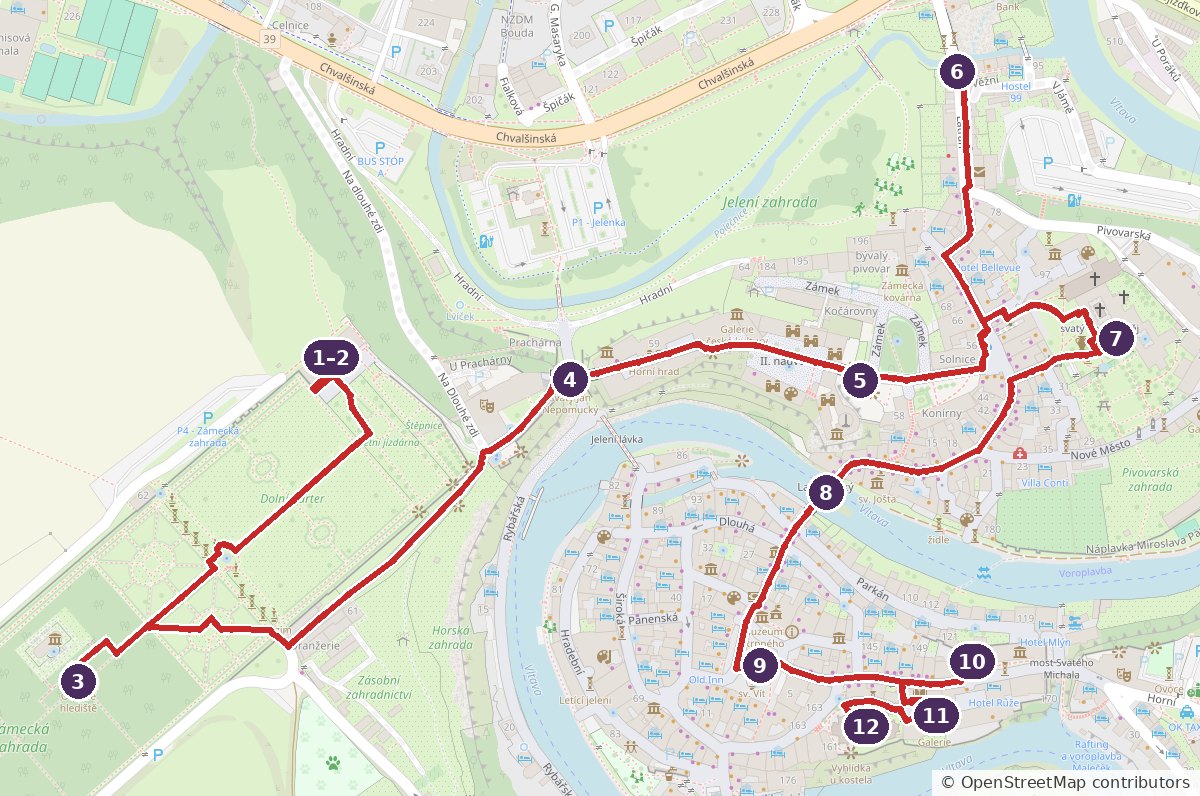
1–2 Winter Riding School · 3 castle garden and revolving theatre · 4 Cloak Bridge · 5 courtyards and bear moat · 6 Budějovice Gate · 7 monasteries · 8 Barber’s Bridge · 9 main square · 10 Seminary Garden viewpoint · 11 Prelature · 12 St Vitus. Tap the map to open it full size. Map data © OpenStreetMap contributors.
1. Start: the town of the five-petalled rose
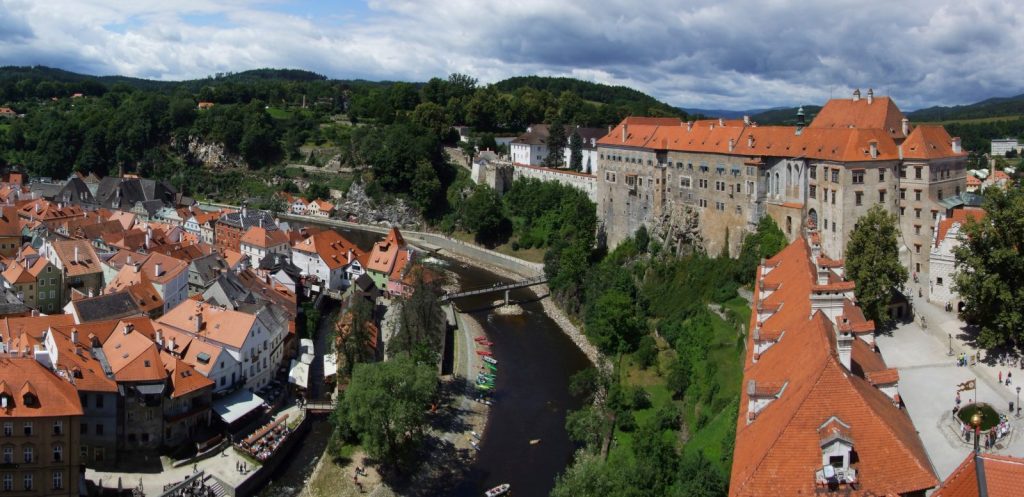
The castle and the old town in the loop of the Vltava. Photo: Pudelek (Marcin Szala) / CC BY-SA 3.0
Everything you are about to see was built around one family. The lords of Rosenberg (Rožmberk in Czech), a branch of the powerful Vítkovci clan, took their name and their coat of arms — a red rose with five petals — from their first castle further up the Vltava. The castle at Krumlov is first recorded in 1253, and in 1302 the Rosenbergs made it their main seat.
For the next three centuries they were among the richest lords in the Kingdom of Bohemia, and the town below the rock grew to serve them: soldiers, craftsmen, brewers, clerks. You will see the rose carved over doorways and painted on walls all the way down.
The Rosenberg line ended with Petr Vok, who sold Krumlov to Emperor Rudolf II in 1602. It then passed to the Eggenbergs and, from 1719, to the Schwarzenbergs, who held it until 1947. Almost nothing was pulled down in between, which is why the whole old town has been on the UNESCO World Heritage list since 1992.
2. The Winter Riding School
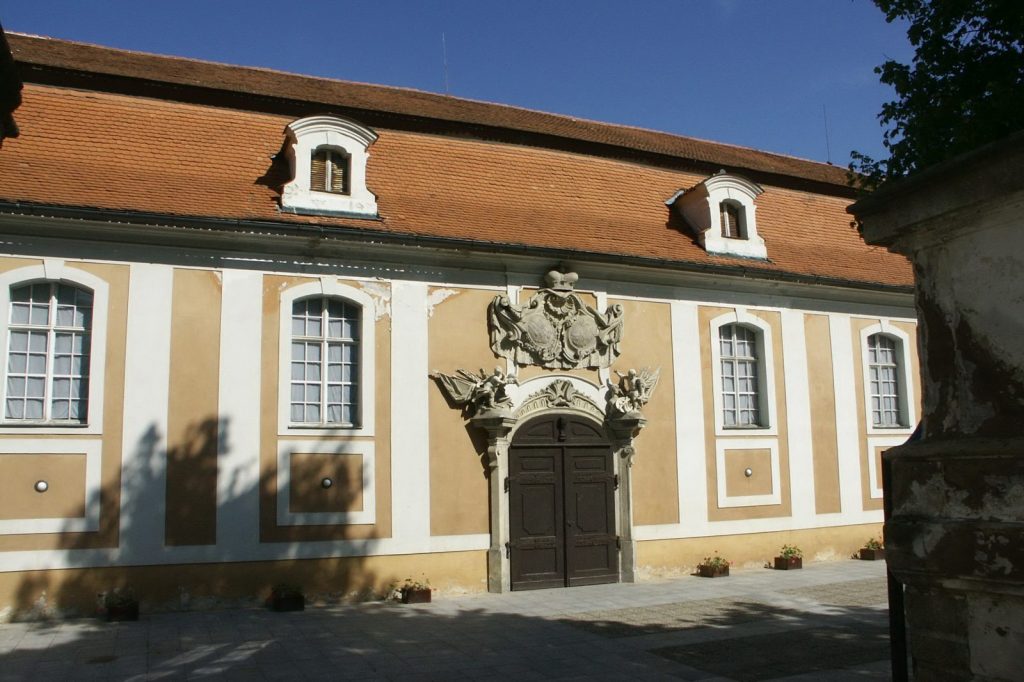
The Winter Riding School, with the carved portal in the middle of its front. Photo: lienyuan lee / CC BY 3.0
The long Baroque building at the entrance to the garden is the Winter Riding School, built by the Schwarzenbergs in the 1740s so that horses could be trained and shown off in any weather. A great household of the time measured its standing in horses, carriages and hunts as much as in paintings.
The ornate hall upstairs is now used for receptions and exhibitions. Before you go into the garden, look back at the castle from here: you are standing at its newest end, and the buildings get older the further down the rock you walk.
3. The castle garden and the revolving theatre
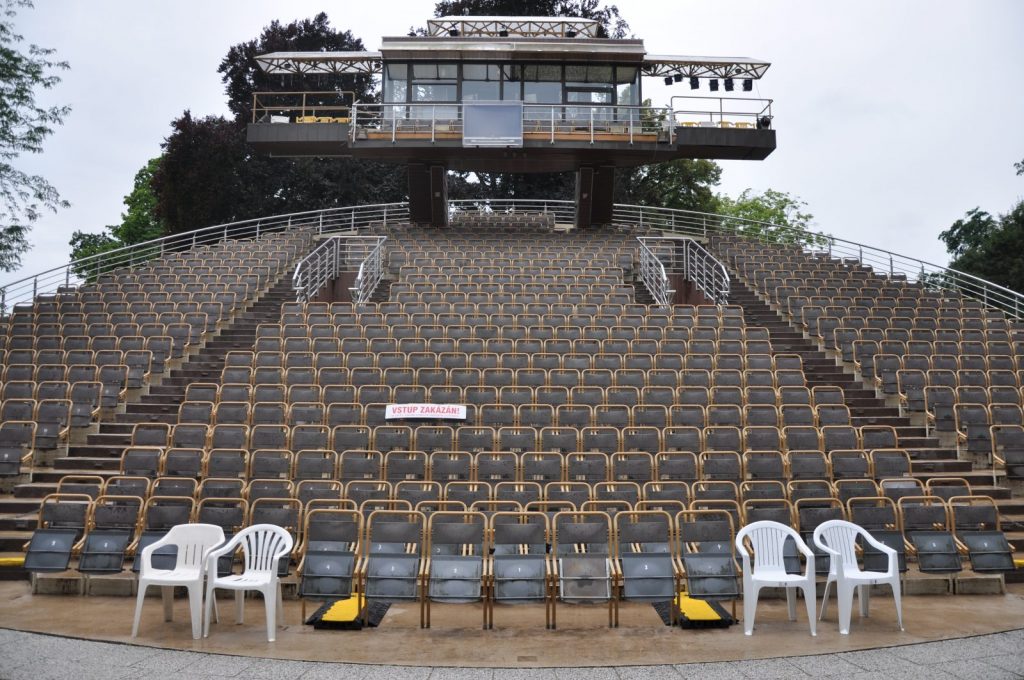
The revolving open-air auditorium in the castle garden. Photo: Ben Skála / CC BY-SA 3.0
Behind the riding school lies the castle garden, about eleven hectares of Baroque terraces, hedges and fountains laid out in the seventeenth and eighteenth centuries. Look for the cascade fountain with its statues and, at the far end of the main axis, the Bellarie summer house.
In front of Bellarie stands something you will not find in many palace gardens: an open-air auditorium that turns on its own axis, built in 1958. The audience rotates to face each new scene, and the garden itself — trees, the summer house, the water — is the stage set. Plays and operas are performed here in summer. It has been argued about for decades, because a modern structure sits in a protected historic garden, but it remains one of the most unusual theatres in Europe.
The garden is free and open from April to October. In winter, skip this stop and go straight on to the Cloak Bridge.
4. The Cloak Bridge
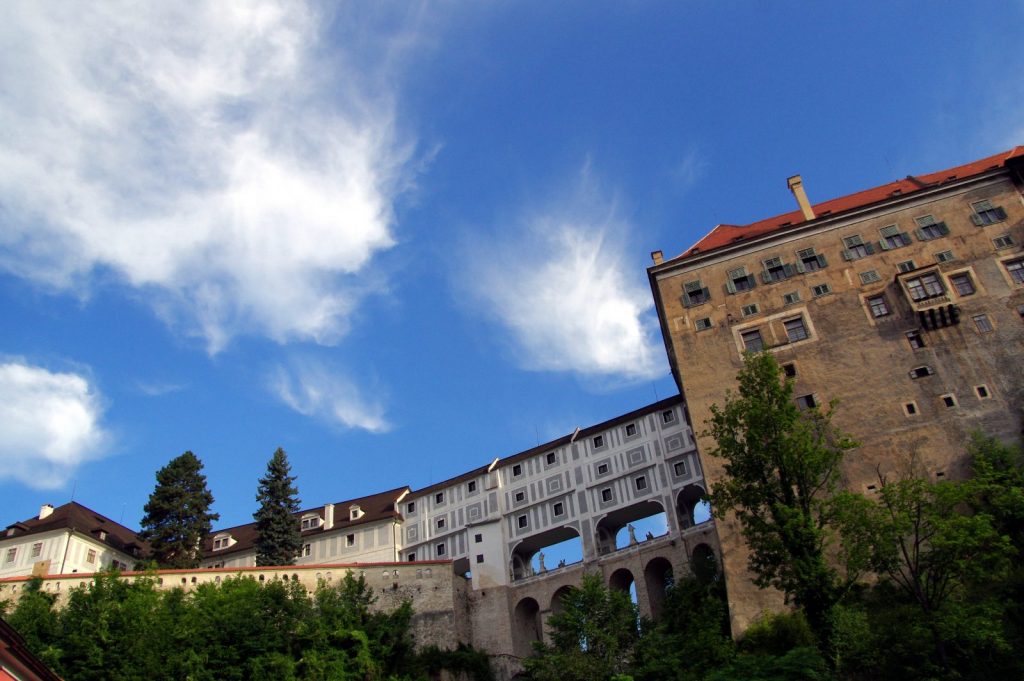
The Cloak Bridge on its storeys of arches, seen from below. Photo: donald judge / CC BY 2.0
Walking back from the garden towards the castle, you cross the Cloak Bridge (Plášťový most), one of the best-known sights in the town. It spans a deep ravine on several storeys of stone arches, with covered corridors on top that let the family walk from their apartments to the theatre and the garden without going outside.
Stop in the middle and look down: the drop is the reason the castle could be built here at all. From the open passage below the corridors you get one of the best views over the red roofs of the town and the bend of the river.
Right next to the bridge is the castle’s Baroque theatre, from 1766 — one of very few in the world that still has its original stage machinery, scenery and costumes. It can only be seen on a guided tour, and only in season.
5. Through the courtyards to the bear moat
From the bridge, the route leads down through the castle courtyards. Look at the walls: many of the «stone blocks», windows and statues are painted on flat plaster. This trompe-l’œil painting was a Renaissance fashion and the Rosenbergs used it everywhere.
Above you rises the castle tower, painted in its present colours in 1590. You can climb it for the view (ticket required).
Between the courtyards, look over the parapet into the moat. Bears have been kept here for centuries, and there are still bears in it today. The usual explanation is a family legend: the Rosenbergs claimed to be related to the Italian Orsini, whose name comes from orso, a bear. You leave the castle through the Red Gate at the bottom of the first courtyard.
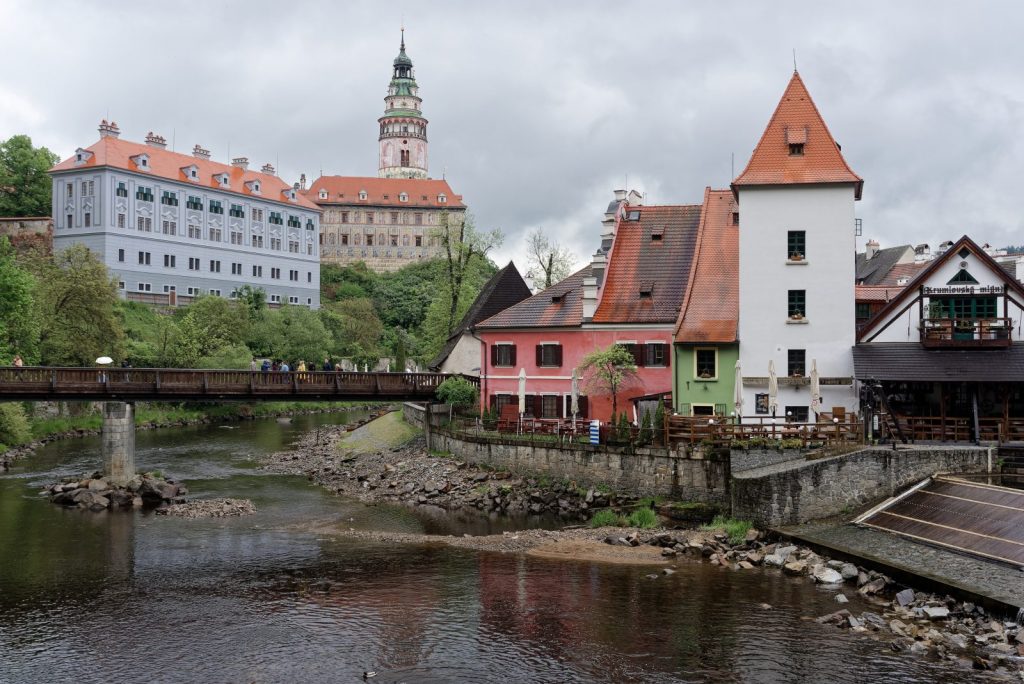
Photo: Jakub Hałun / CC BY 4.0
6. Latrán and the Budějovice Gate
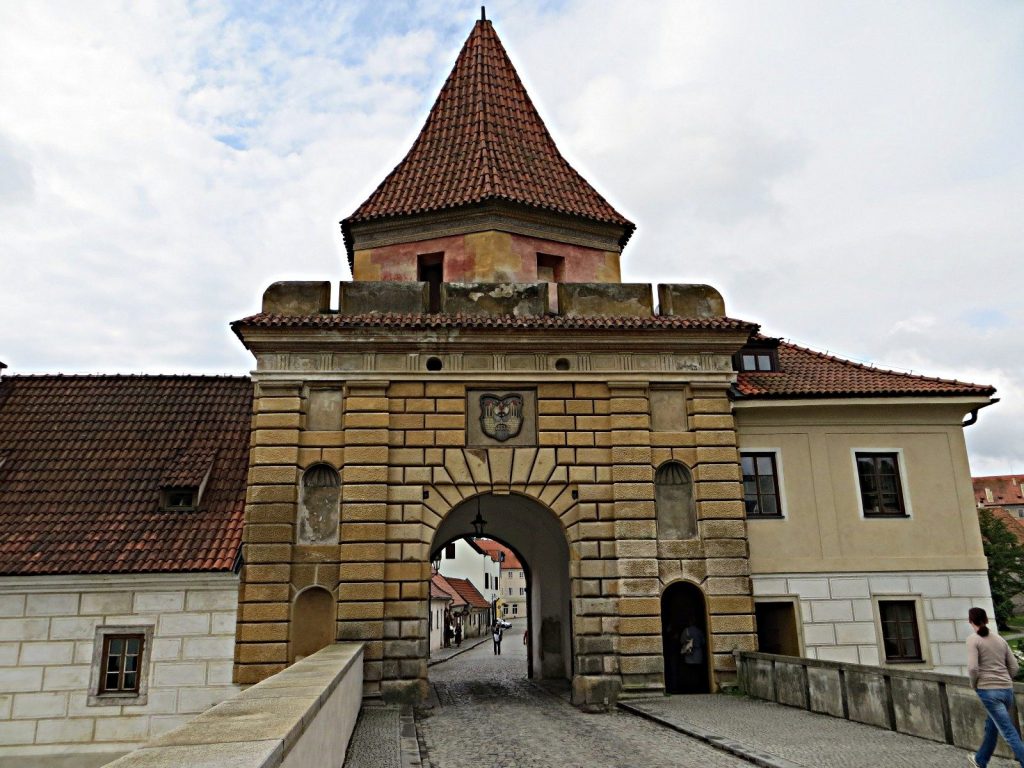
Below the castle you are in Latrán, the old settlement that grew up at the foot of the rock to serve it. For centuries it was a separate community from the town across the river, with its own rights.
Walk a few minutes up Latrán street, away from the river, to the Budějovice Gate. Built at the very end of the sixteenth century, it is the only one of the town’s gates still standing. Then turn back towards the river. Just off this street is the Eggenberg brewery, which has been brewing below the castle for centuries — remember it for later.
7. Klášterní street and the monasteries
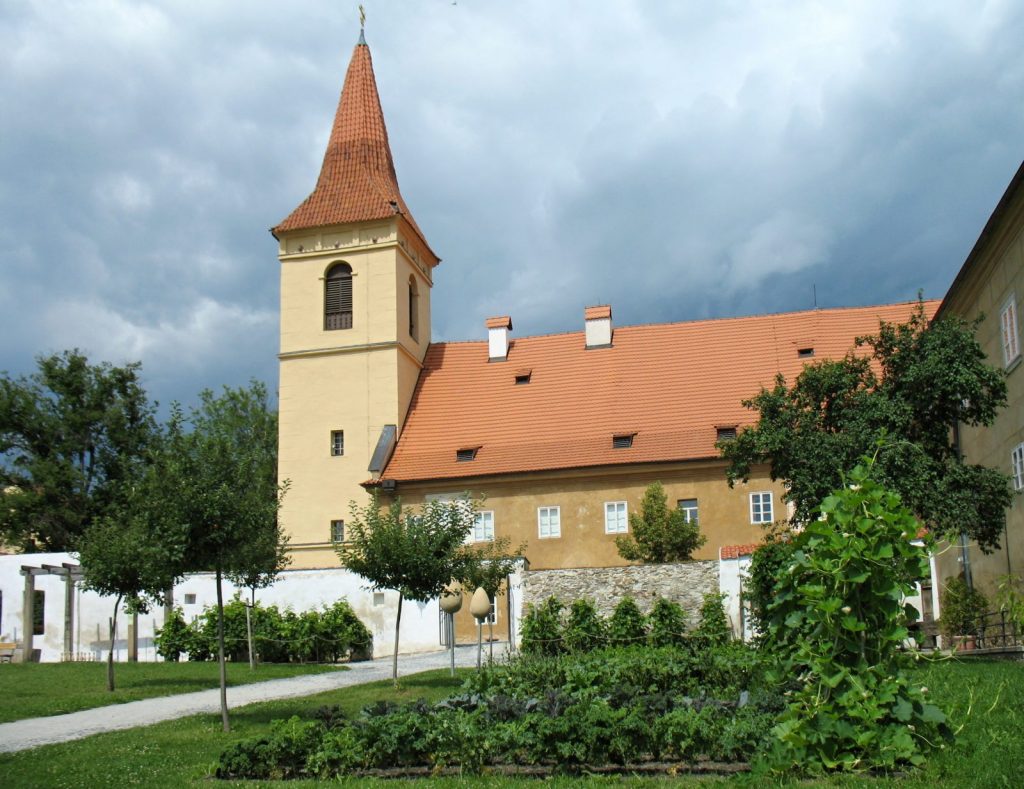
The Minorite church and the monastery garden off Klášterní street. Photo: Marie Čcheidzeová / CC BY-SA 4.0
Turn into Klášterní (Monastery Street). In 1350 the Rosenbergs founded two religious houses side by side here: a monastery of the Minorite friars and a convent of the Poor Clares. A double foundation like this, of friars and nuns sharing one church, was unusual.
The complex has been restored and opened to visitors as Kláštery Český Krumlov, with exhibitions, a café and craft workshops in the old cloisters. The courtyard is a quiet place to sit for a minute away from the crowds on the main street.
8. The Barber’s Bridge
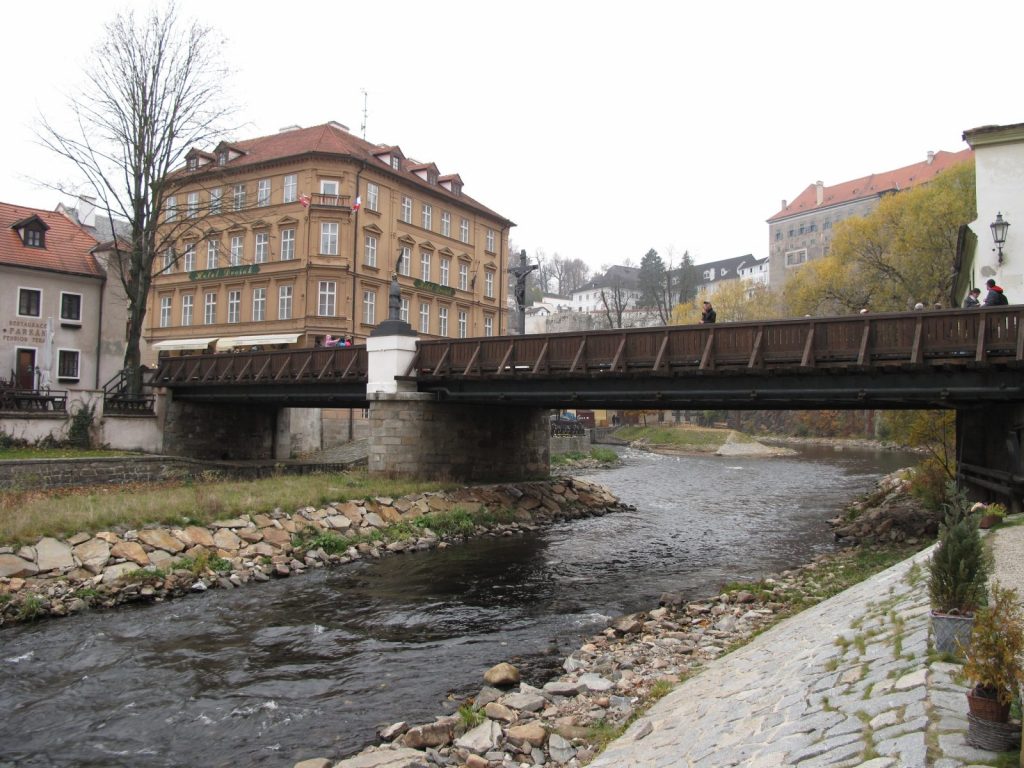
The wooden Barber’s Bridge over the Vltava. Photo: Juandev / CC BY-SA 3.0
Back on Latrán, the street brings you to the wooden Barber’s Bridge (Lazebnický most), with a statue of St John of Nepomuk and a crucifix in the middle. It is named after the bath-house and barber’s shop that stood by it.
It is also the scene of the town’s darkest story. In 1607 Emperor Rudolf II sent his illegitimate son, Julius, to live in the castle he had just bought. Julius was mentally ill and violent; in 1608 he murdered Markéta Pichlerová, the barber’s daughter, who had been living with him in the castle. He was locked up in the castle and died there the following year.
Stand on the bridge and look back up at the castle — this is one of the classic photographs of Krumlov.
9. Radniční street and the main square
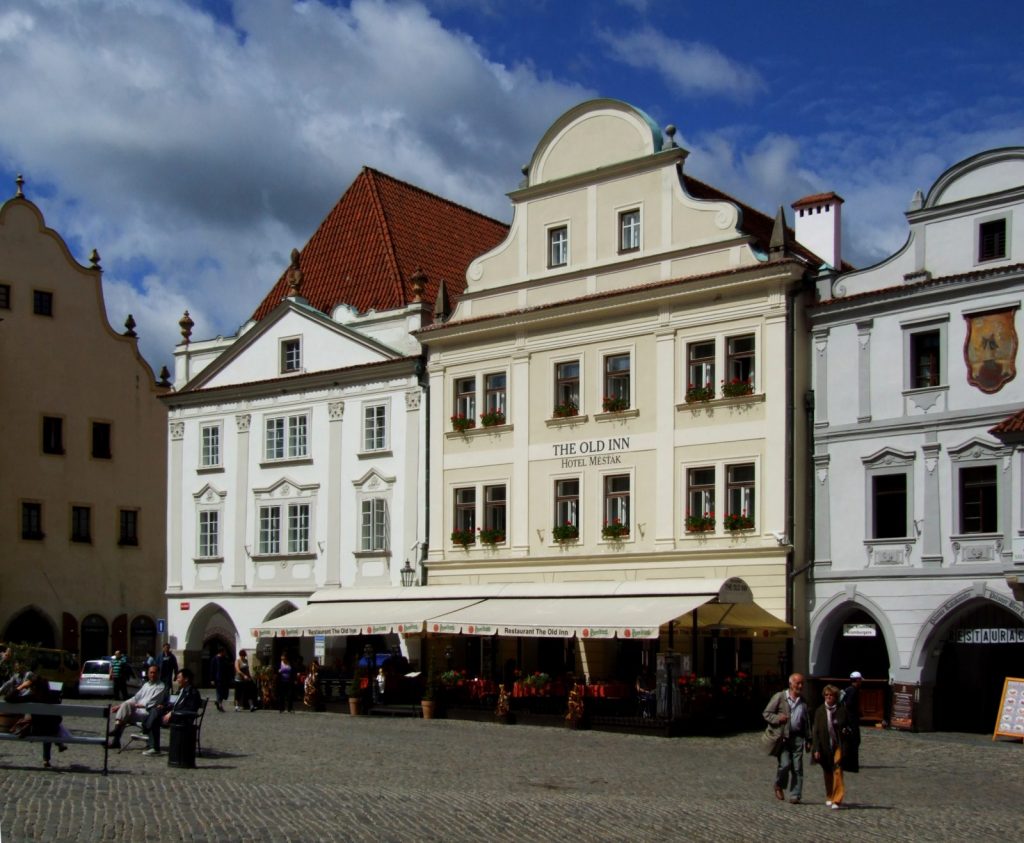
Houses on the main square, náměstí Svornosti. Photo: Pudelek (Marcin Szala) / CC BY-SA 3.0
Across the bridge you are in the old town proper, on the island inside the loop of the river. Radniční (Town Hall Street) leads you straight up to the main square, náměstí Svornosti — the Square of Concord.
On one side of it, the town hall was made by joining several older houses behind one long front. In the middle stands the Marian plague column from the early eighteenth century, put up in thanks after the plague. The square is the natural middle of the walk: cafés, the tourist information centre and toilets are all here.
If you have time for a detour, the Egon Schiele Art Centrum is a few minutes away on Široká street. The painter, whose mother came from Krumlov, lived here in 1911 until the townspeople’s disapproval drove him out.
10. The viewpoint over the castle
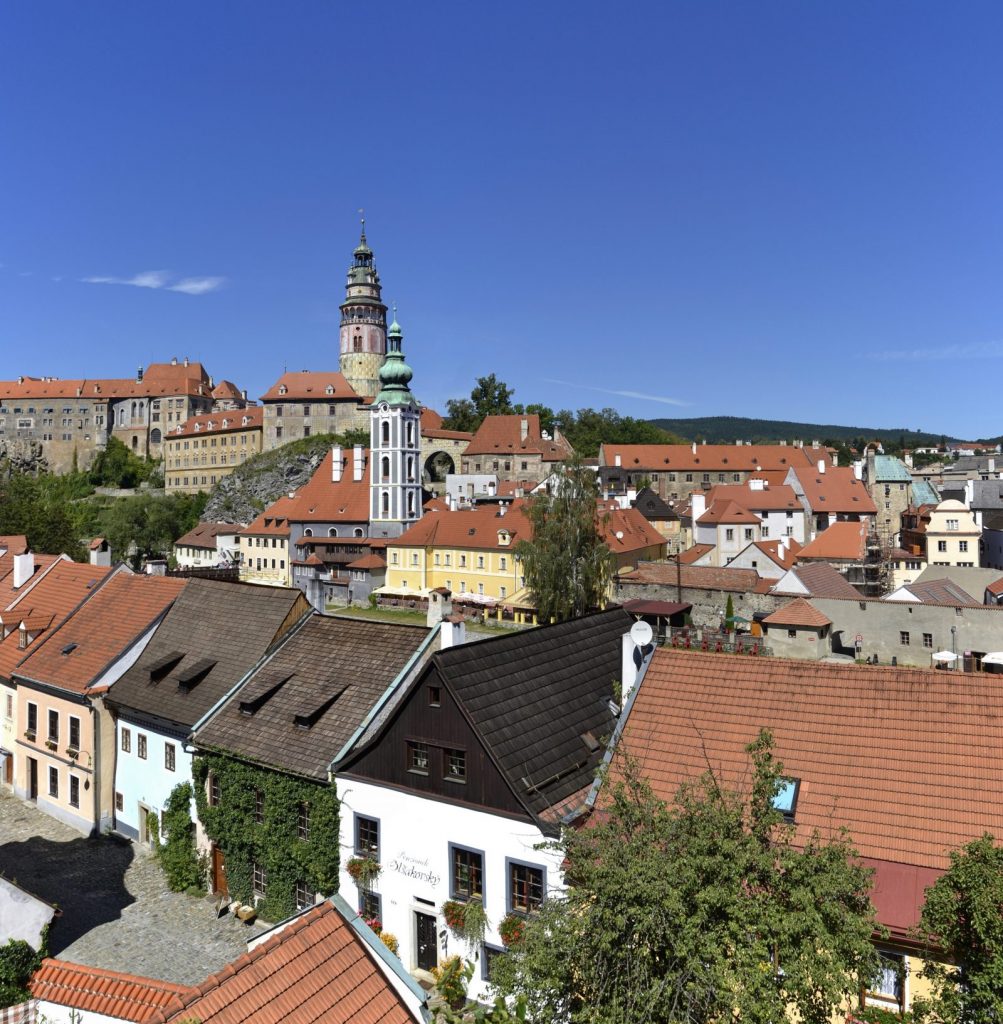
From the square, walk up Horní street, the upper street of the old town. The large building on the left is the former Jesuit seminary, now the Regional Museum. Behind it, the Seminary Garden (Seminární zahrada) is a small terrace with the view everyone comes for: the castle, the tower and the Cloak Bridge across the river, with the town’s roofs below.
It is free and the best place for a photograph of the whole castle. Take a minute here — you have now walked from one end of that view to the other.
11. The Krumlov Prelature
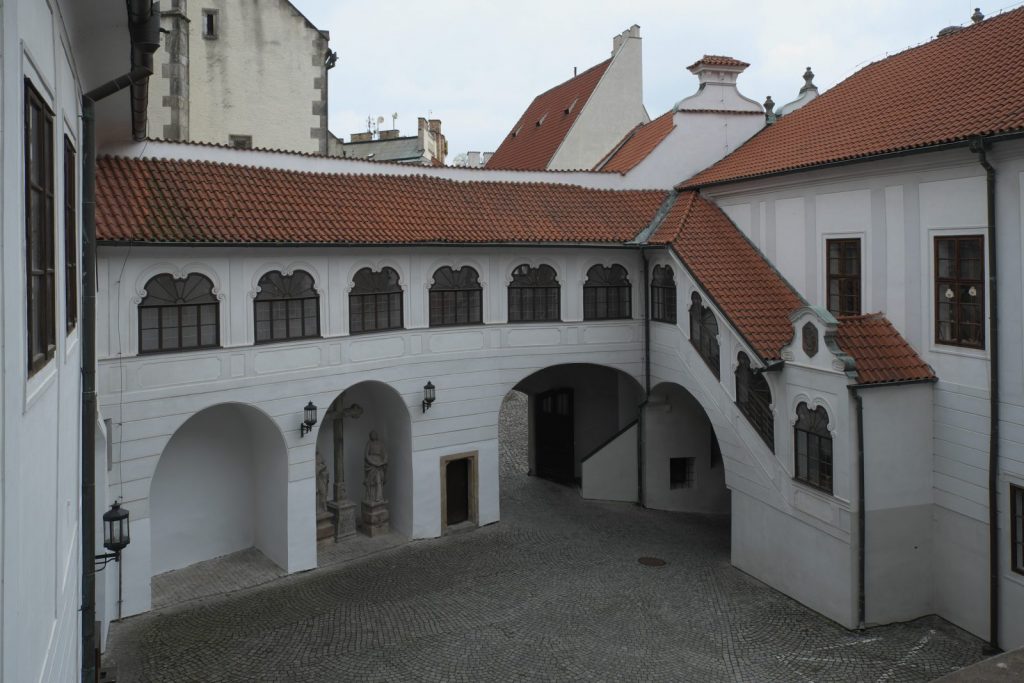
The arcaded courtyard of the Prelature. Photo: GFreihalter / CC BY-SA 3.0
A few steps further, the old house standing beside the church above the river is the Prelature, for centuries the residence of the priests who ran the parish of St Vitus. Its walls, terraces and garden sit on the edge of the old town’s rock and look down onto the Vltava.
The building has been restored and is now used for exhibitions and events; check on the spot whether it is open on the day you visit.
12. The Church of St Vitus
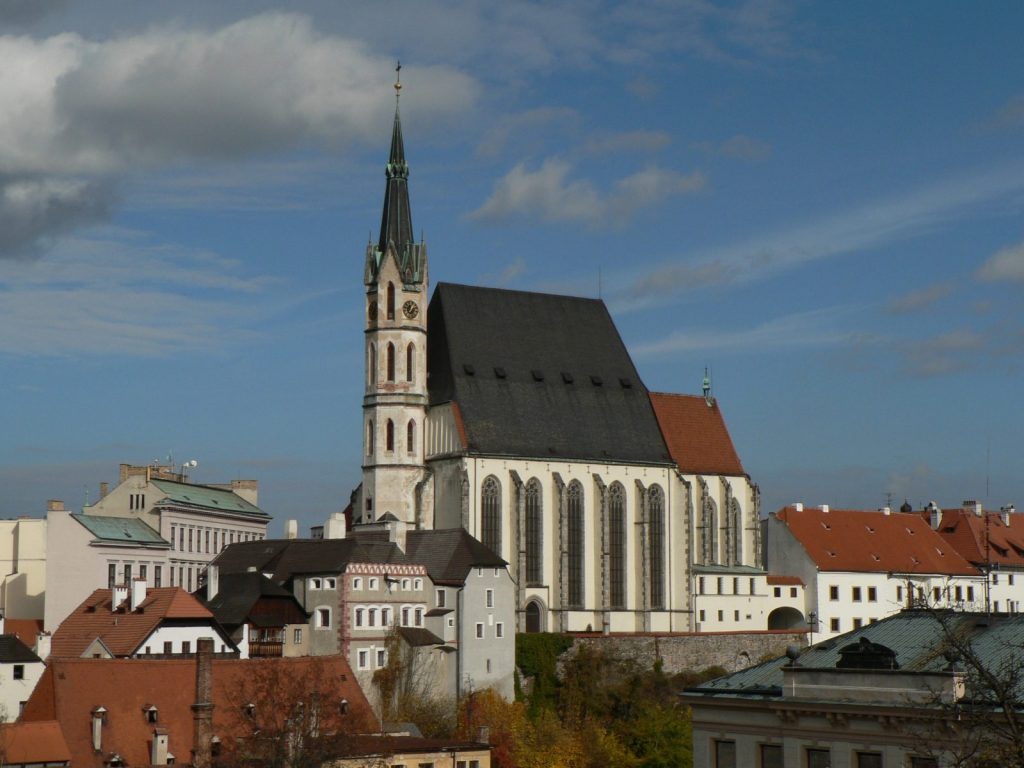
The Church of St Vitus above the roofs of the old town. Photo: Martin Vavřík / public domain
The walk ends at the Church of St Vitus, the parish church of Český Krumlov, whose tower you have seen from every viewpoint on the way. The Gothic church was completed in the first half of the fifteenth century; its slim tower took its present form in the nineteenth century.
Inside, look for the Gothic vaulting and the side chapels added over the centuries by the families who ruled the town.
From the church it is a two-minute walk back down to the square. That beer at the Eggenberg brewery is ten minutes away.
Prefer to listen, in Ukrainian?
The original audio walk this route follows is «Чеський Крумлов від БоБа» on izi.TRAVEL. It is free and in Ukrainian, with the same twelve stops. Download it in the free izi.TRAVEL app before you leave, so you do not depend on mobile data in the old town. The text on this page is our own, not a translation.
If you want a person rather than a phone, the town’s official licensed guides lead tours in English and several other languages; the tourist information centre on the main square can book one.
Getting to Český Krumlov from Prague
Krumlov is about 175 km and two and a half hours by car from Prague. If you are coming for the day, a private day trip gives you a driver who drops you at the top of this walk and collects you at the end. If you are staying in Krumlov overnight, a one-way transfer from Prague or from Prague Airport is cheaper. Buses and trains are compared on our how to get there page.
Frequently asked questions
Is there a free audio guide to Český Krumlov in English?
Yes — this page. Every stop has its own English audio track that plays in your phone’s browser, and the whole tour is also one 9-minute MP3 you can download before you go. No app or account is needed.
How long does a walk around Český Krumlov take?
About two to three hours for this 2.8 km route at an easy pace, with stops. A castle tour adds about an hour, and a long lunch or a museum adds more.
Is it free to visit Český Krumlov Castle?
The courtyards, the Cloak Bridge, the bear moat and, from April to October, the castle garden are free. The castle interiors, the Baroque theatre and the tower need a ticket.
Can we do this walk on a day trip from Prague?
Yes. A private day trip picks you up at your Prague hotel, waits in Krumlov and brings you back the same evening, from €230 for the car. Five or six hours in town is enough for the whole walk, a castle tour and lunch. Start early to have the streets before the coach groups arrive.
Do I need a guide to walk around Český Krumlov?
No. The old town is small and easy to find your way around, and this page covers the main sights. Castle interiors can only be seen on the castle’s own guided tours, which you join on the spot.
What shoes should I wear in Český Krumlov?
Flat, comfortable shoes with a good grip. The whole old town is cobbled, the castle lanes are steep, and the stones are slippery after rain.