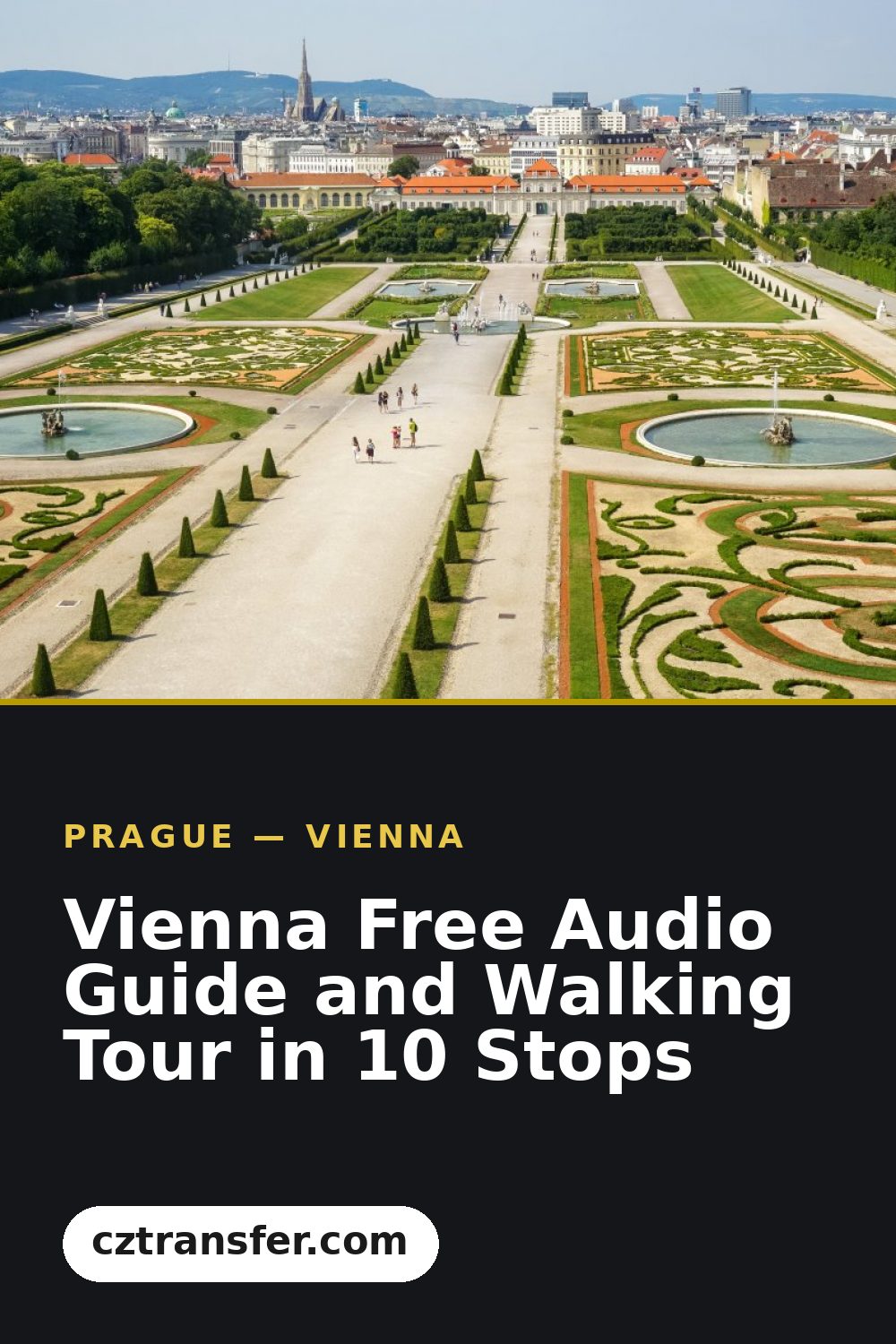
Vienna Free Audio Guide and Walking Tour in 10 Stops
Vienna was the capital of the Habsburg empire for six hundred years, and its old centre is still an imperial city of palaces, churches and coffee houses. It is a long day from Prague — about four hours each way — so the trick is one good walk rather than a rush between sights. This page is a free audio guide to that walk in English, written out and read aloud: ten stops from the Karlskirche to St Stephen’s Cathedral, about 4 km and three to four hours with short visits. Keep the page open on your phone and play or read each stop as you reach it. The walk costs nothing; you pay only for what you go into.
Listen to the audio guide — each stop below has its own track, about a minute long. Start with the introduction:
Or download the whole tour as one MP3 (8 minutes, 4 MB) and listen to it in the car on the way, or offline in Vienna.
€370 car, up to 4 · €380 minivan, up to 8
Private day trip from your Prague hotel to Vienna and back
- An early pick-up at your hotel or apartment in Prague, at the time you choose
- About four hours to Vienna; the driver drops you at the Karlskirche, the start of this walk
- Five to six hours in the city while the driver waits
- The driver collects you near St Stephen’s Cathedral, the end of the walk, and takes you back to your hotel in Prague the same night
- Price for the whole car and the whole day, not per person: fuel, tolls, motorway vignettes, parking, waiting and child seats included
Tell us the date, your hotel in Prague, when you would like to leave and how many of you there are — we confirm the car and the price in writing. +420 773 477 799 (WhatsApp, Viber, Telegram) · cz@cztransfer.com · more about the day trip
Order
How you can pay
- Cash to the driver — euros, Czech crowns, US dollars or pounds sterling
- Card to the driver, contactless — Visa, Mastercard, Maestro, American Express, or pay by phone
- Card or PayPal online, before the trip — Visa, Mastercard, American Express; the payment processor adds a 6% fee
- Crypto, before the trip — USDT (TRC-20) or Bitcoin
Payment details · no deposit, pay at the end of the trip if you like
Before you set off
- The day: about fourteen hours door to door. Leave Prague early, around six or seven, to be in Vienna before eleven
- Distance: about 4 km, flat, almost all inside the old town, the First District
- Passports: Vienna is in Austria. Both countries are in Schengen, but there can be police checks at the border, so every passenger needs a passport or national ID card
- Choose one inside visit: with five or six hours, pick one — the Hofburg and the Sisi Museum, the State Hall of the National Library, or the cathedral towers. Schönbrunn Palace is outside the centre and is a separate half day
- Free: all the squares, the Heldenplatz, the Volksgarten, and the main nave of St Stephen’s Cathedral
- Paid: the Karlskirche, the opera tour, the Albertina, the National Library, the Hofburg, the Spanish Riding School and the cathedral towers
- In Advent: from mid-November until Christmas, the walk passes Christmas markets at the Karlskirche, on the Rathausplatz with the city’s big Christmas tree, at Am Hof and by the cathedral
- Map: open the route in Google Maps
Take a coffee break somewhere along the way. Vienna’s coffee-house culture is officially listed as intangible cultural heritage, and sitting for an hour over one coffee is exactly what they are for.
Route map
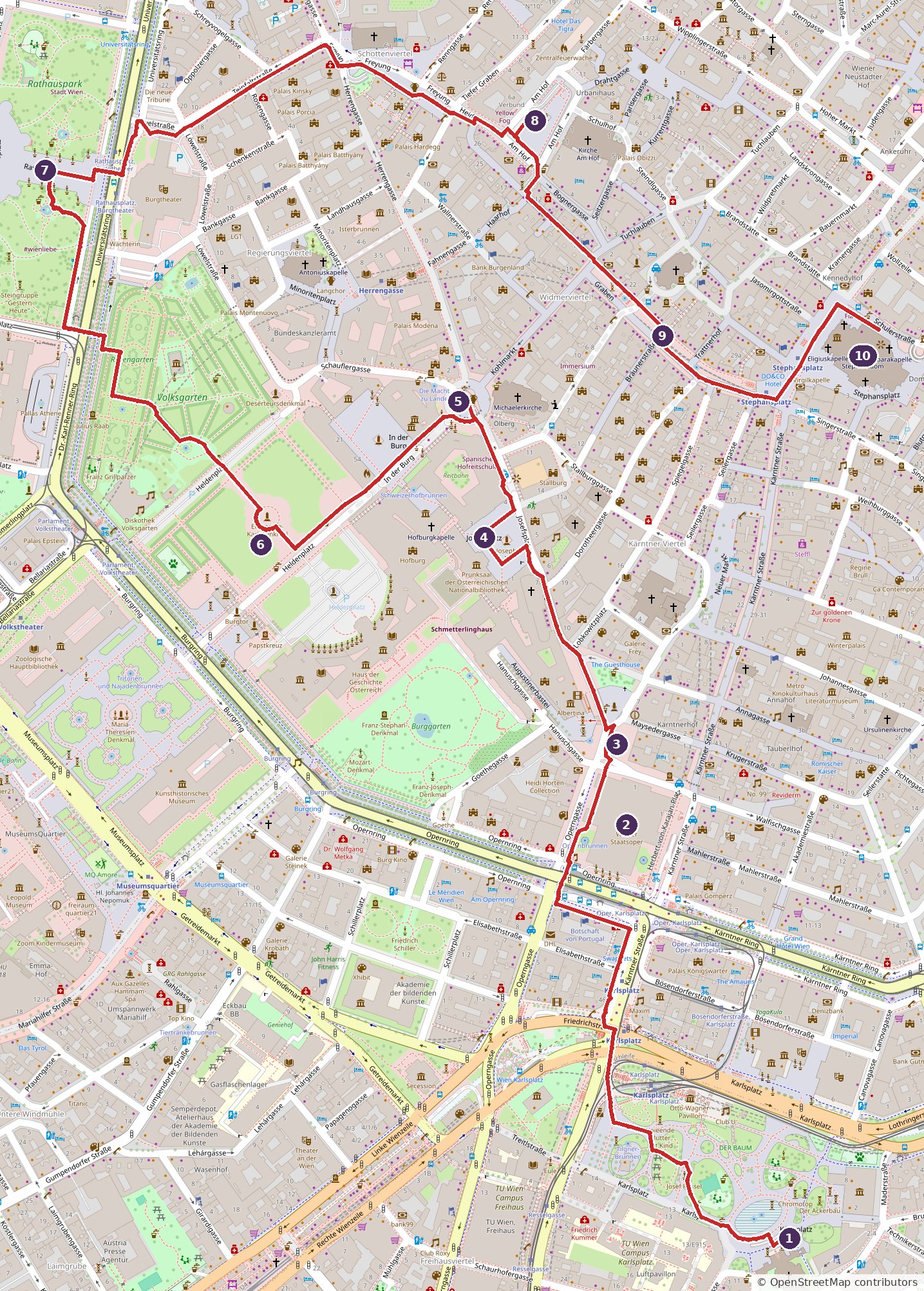
1 the Karlskirche · 2 the State Opera · 3 the Albertina · 4 Josefsplatz and the National Library · 5 Michaelerplatz and the Hofburg · 6 the Heldenplatz · 7 the City Hall and the Burgtheater · 8 Am Hof · 9 the Graben and the Plague Column · 10 St Stephen’s Cathedral. Tap the map to open it full size. Map data © OpenStreetMap contributors.
1. The Karlskirche
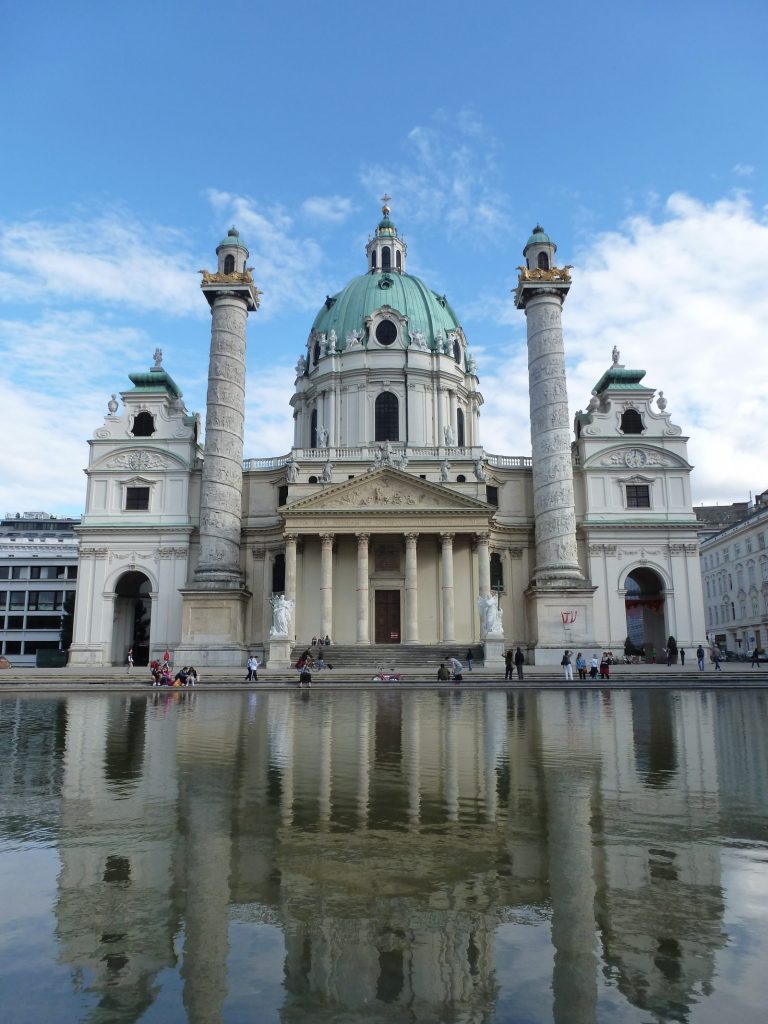
The Karlskirche, with its two columns, reflected in the Karlsplatz pool. Photo: Alexcriswell / CC BY-SA 3.0 at
Welcome to Vienna. The great domed church in front of you, reflected in the pond, is the Karlskirche, St Charles’s Church, the finest Baroque church in the city.
In 1713, during one of the last great plague epidemics, Emperor Charles the Sixth promised to build a church if the plague ended. It did, and the church was built from 1716 by Johann Bernhard Fischer von Erlach, the leading architect of Baroque Vienna, and finished by his son. It is dedicated to St Charles Borromeo, a saint who cared for plague victims. Look at the two tall columns on either side of the entrance: they are modelled on Trajan’s Column in Rome, and spiral reliefs on them tell the saint’s life.
In Advent, the square in front of the church holds a relaxed Christmas market of art and crafts.
2. The State Opera
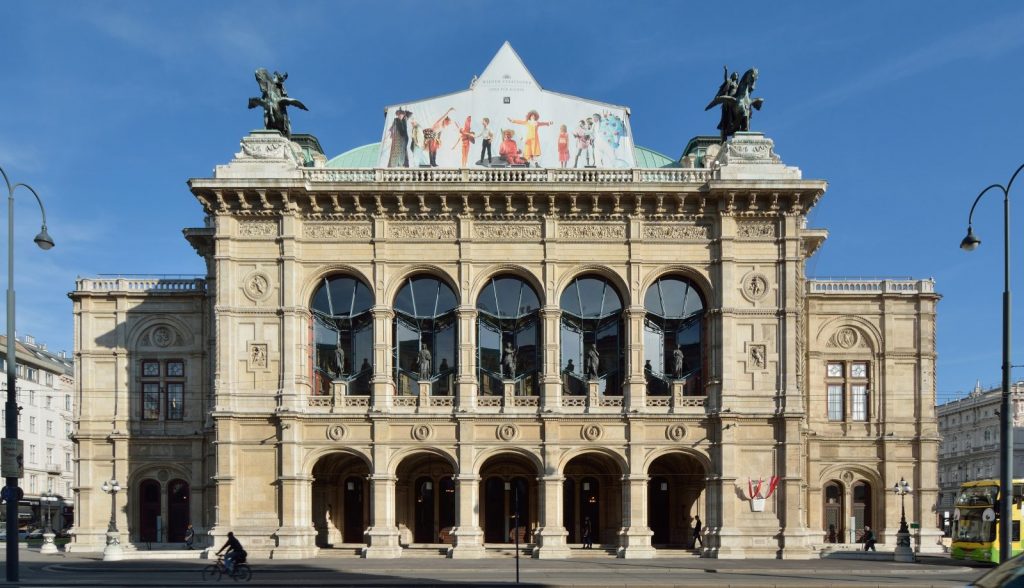
The State Opera, opened on the Ring in 1869. Photo: P e z i / CC BY-SA 3.0 at
Walk north, across the busy road, to the State Opera. It was the first great building on the Ringstrasse, the boulevard laid out in the 1860s where the old city walls had stood, and it opened in 1869 with Mozart’s Don Giovanni.
The Viennese did not like it at first, and the criticism was so harsh that one of its two architects took his own life before the opening. Today it is one of the most important opera houses in the world, with a performance almost every evening of the season. Standing tickets, sold on the day, cost only a few euros.
Just behind the opera is the Hotel Sacher, home of the Sachertorte, the famous chocolate cake with a layer of apricot jam.
3. The Albertina
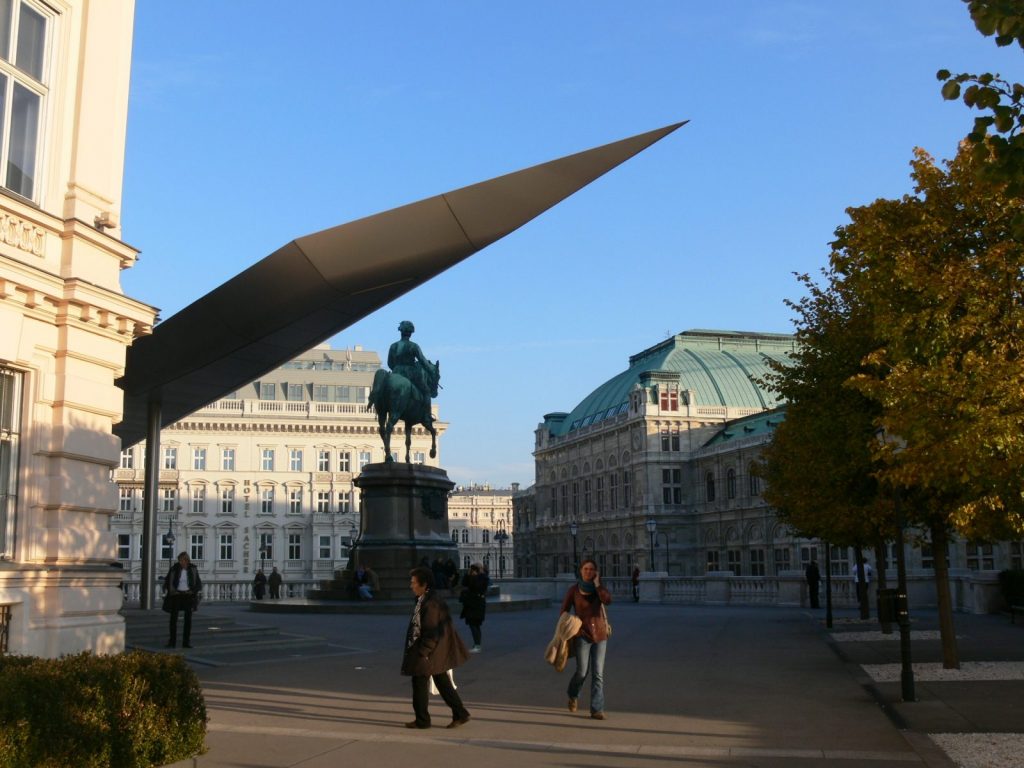
The Albertina on its bastion, with the Opera behind. Photo: Wolfgang Sauber / CC BY-SA 3.0
On the small square beside the opera, steps lead up to the Albertina, a Habsburg palace built on top of the old city wall. It holds one of the greatest collections of drawings and prints in the world, including Albrecht Dürer’s famous Young Hare, and big exhibitions of modern art. From the terrace there is a good view back over the opera.
In the middle of the square stands the Monument against War and Fascism by Alfred Hrdlicka, from 1988. Look for the bronze figure of a kneeling Jewish man, scrubbing the street: it remembers how Vienna’s Jews were humiliated in public in 1938, after Austria was joined to Nazi Germany.
4. Josefsplatz and the National Library
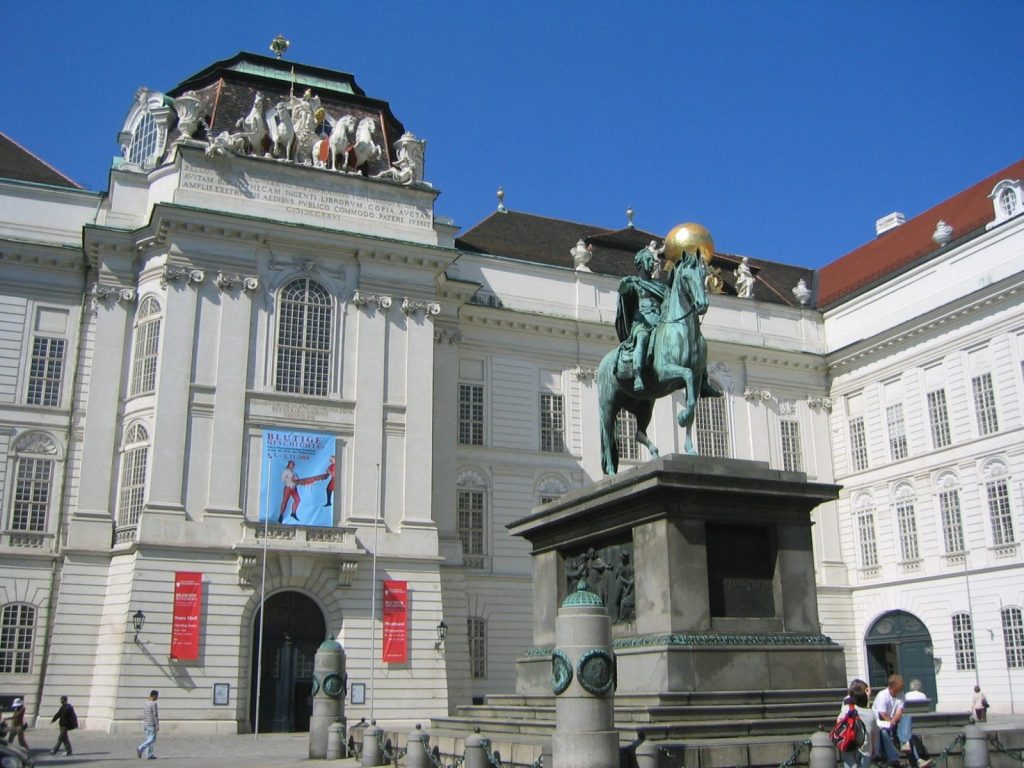
Josefsplatz, with the National Library behind Joseph II. Photo: UrLunkwill / CC BY 2.5
Walk north along Augustinerstraße to Josefsplatz, a quiet, elegant square closed on three sides by wings of the Hofburg, the imperial palace. In the middle, Emperor Joseph the Second rides a bronze horse dressed as a Roman emperor.
One wing of the square holds the State Hall of the Austrian National Library, one of the most beautiful libraries in the world: a long Baroque hall under a painted dome, lined with about two hundred thousand old books. It was built in the 1720s to designs by Fischer von Erlach, the architect of the Karlskirche. Entry is paid, but if you go into one building today, this could be it.
5. Michaelerplatz and the Hofburg
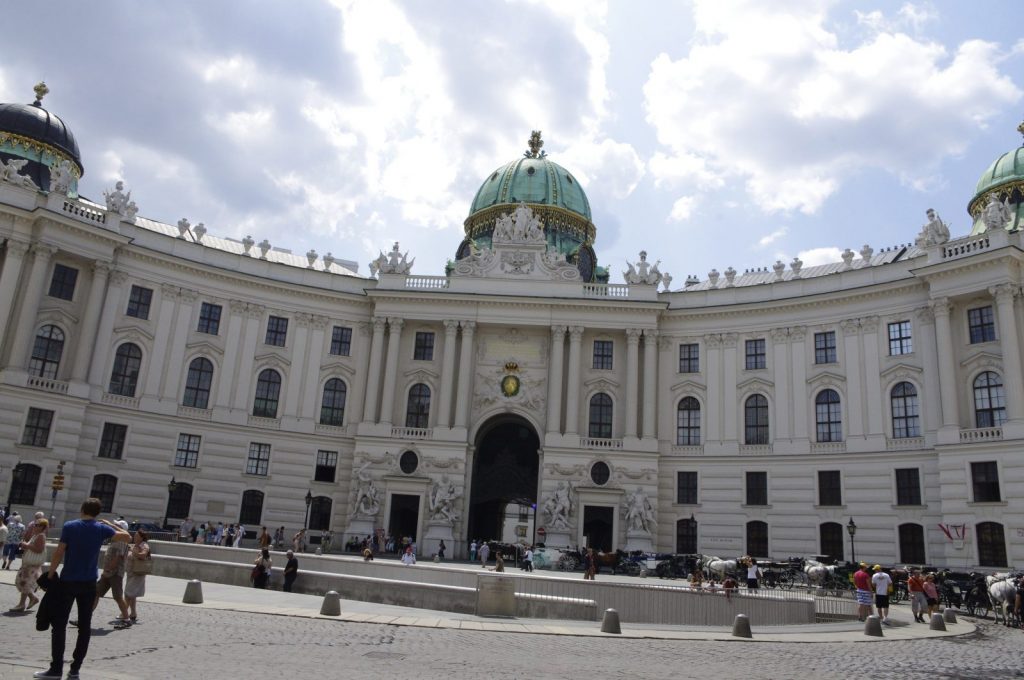
The Michaeler wing of the Hofburg. Photo: Traumrune / CC BY-SA 3.0
Continue to Michaelerplatz, the round square in front of the great domed gate of the Hofburg. The Habsburgs lived here for more than six hundred years, and the palace grew into a city within the city.
Between this square and Josefsplatz, in the palace’s Winter Riding School, is the Spanish Riding School, where the white Lipizzaner horses perform; you can watch their morning training on many days. Through the gate are the Imperial Apartments and the Sisi Museum, about Empress Elisabeth, the most famous and most unhappy empress of Austria.
Now turn around. The plain building opposite the palace is the Looshaus, built in 1910 by Adolf Loos. With no decoration over its windows, it shocked the city, and Emperor Franz Joseph is said to have hated it. In the middle of the square you can see the remains of Roman Vienna.
6. The Heldenplatz
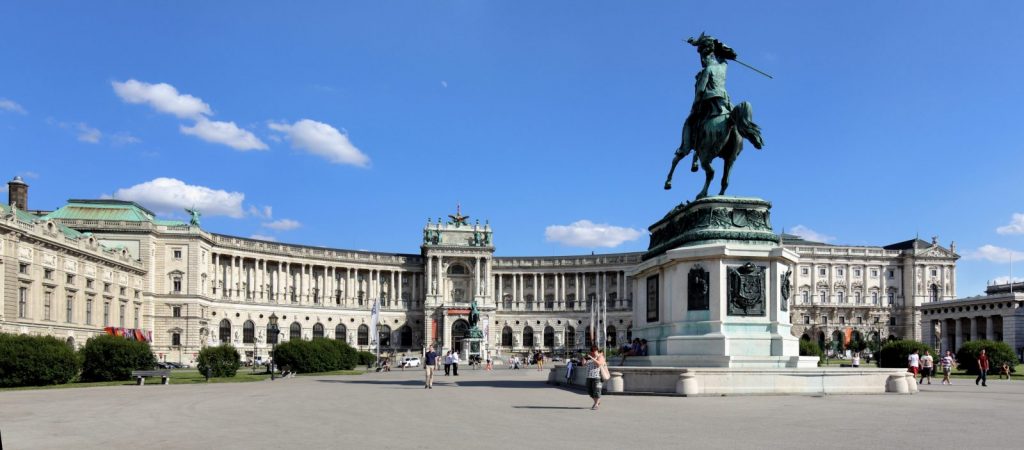
Heldenplatz, with Archduke Charles in front of the Neue Burg. Photo: C.Stadler/Bwag / CC BY-SA 3.0 at
Walk through the domed gate and the palace courtyards to the Heldenplatz, Heroes’ Square, an enormous open space framed by the curved wing of the New Hofburg. The two equestrian statues show Prince Eugene of Savoy, who defeated the Turks, and Archduke Charles, who defeated Napoleon at Aspern in 1809.
It was from the balcony of the curved wing that Hitler spoke to a huge crowd in March 1938, after the Anschluss, the annexation of Austria. Today the New Hofburg holds museums and part of the National Library, and another wing of the Hofburg houses the offices of the Austrian president.
7. The City Hall and the Burgtheater
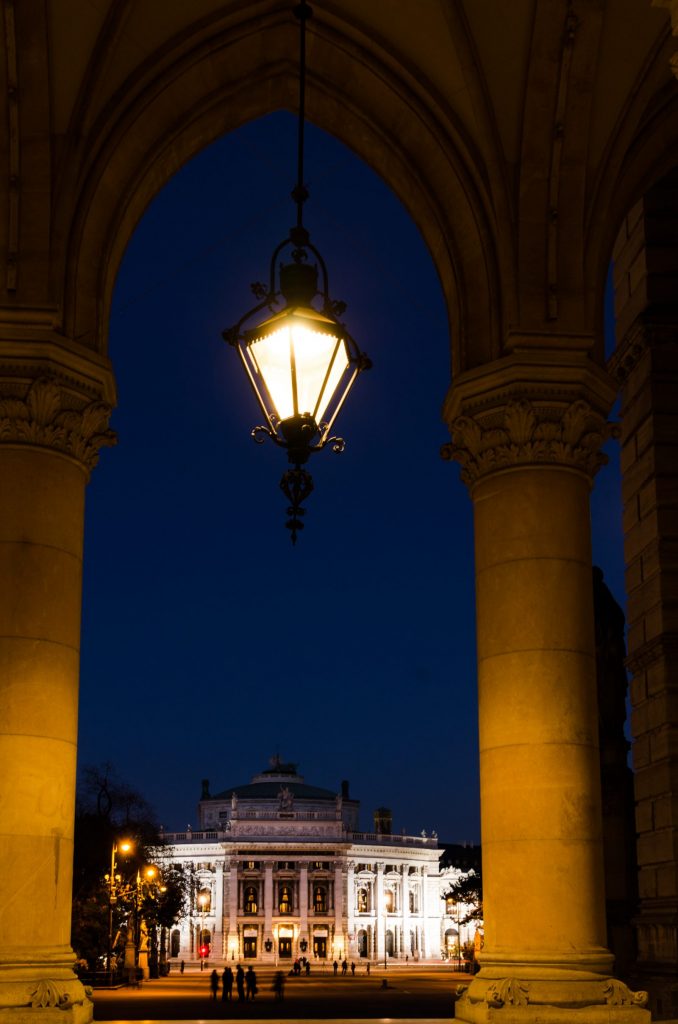
The Burgtheater, seen through the arcades of the City Hall across the Ring. Photo: Krokotraene / CC BY-SA 4.0
Cross the Volksgarten, the People’s Garden, famous for its roses in summer, and the Ringstrasse, to the Rathausplatz. In front of you rises the City Hall, the Rathaus, a neo-Gothic building from 1883 with a tall tower topped by an iron knight, the Rathausmann. Turn around, and facing it across the square is the Burgtheater, one of the most famous theatres in the German-speaking world; its grand staircases were painted by the young Gustav Klimt.
In Advent, the square in front of the City Hall holds Vienna’s biggest Christmas market, the Christkindlmarkt, with the city’s great Christmas tree, lit-up trees in the park and the City Hall glowing behind the stalls.
8. Am Hof
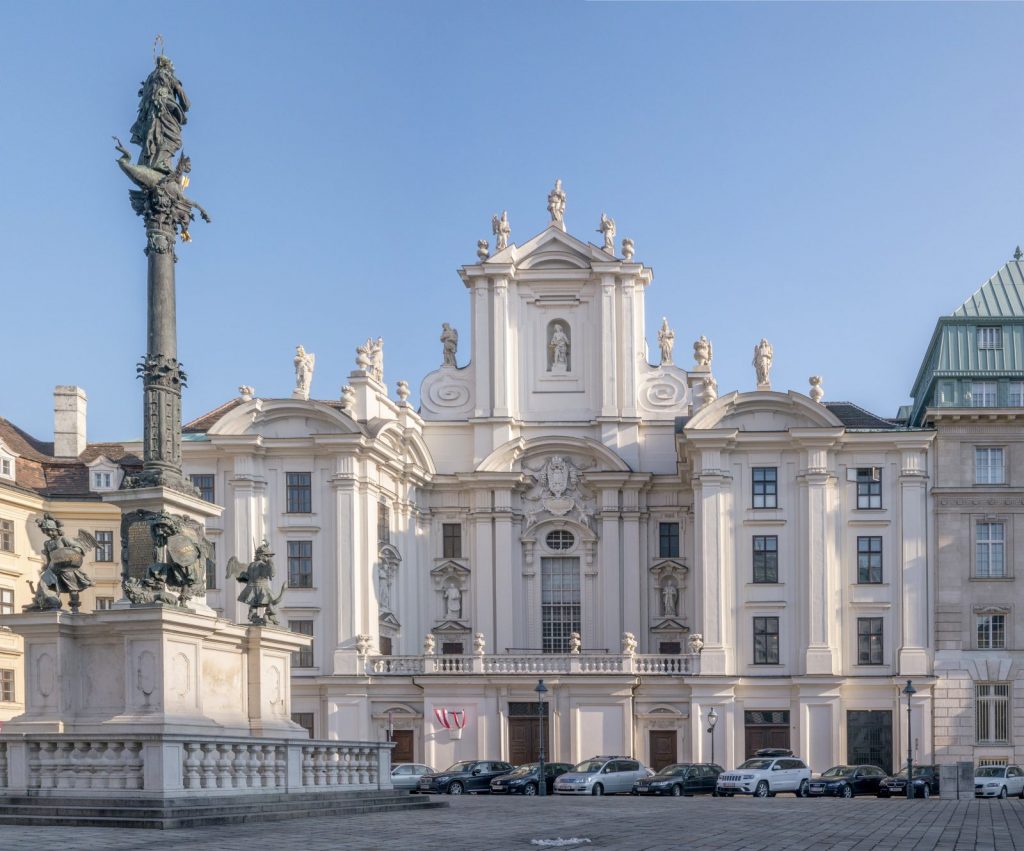
Am Hof, with the Church of the Nine Choirs of Angels and the Marian column. Photo: Thomas Ledl / CC BY-SA 3.0 at
Walk back into the old town past the Freyung, a long square of palaces, to Am Hof, one of the largest squares in the centre. The dukes of Austria had their first castle here.
Look at the white church with a wide balcony on its front, the Church of the Nine Choirs of Angels. In 1806, a herald stood on that balcony and announced that Emperor Francis the Second had laid down the crown of the Holy Roman Empire, which had existed for a thousand years. In Advent, Am Hof has one of the most traditional Christmas markets in the city.
9. The Graben and the Plague Column
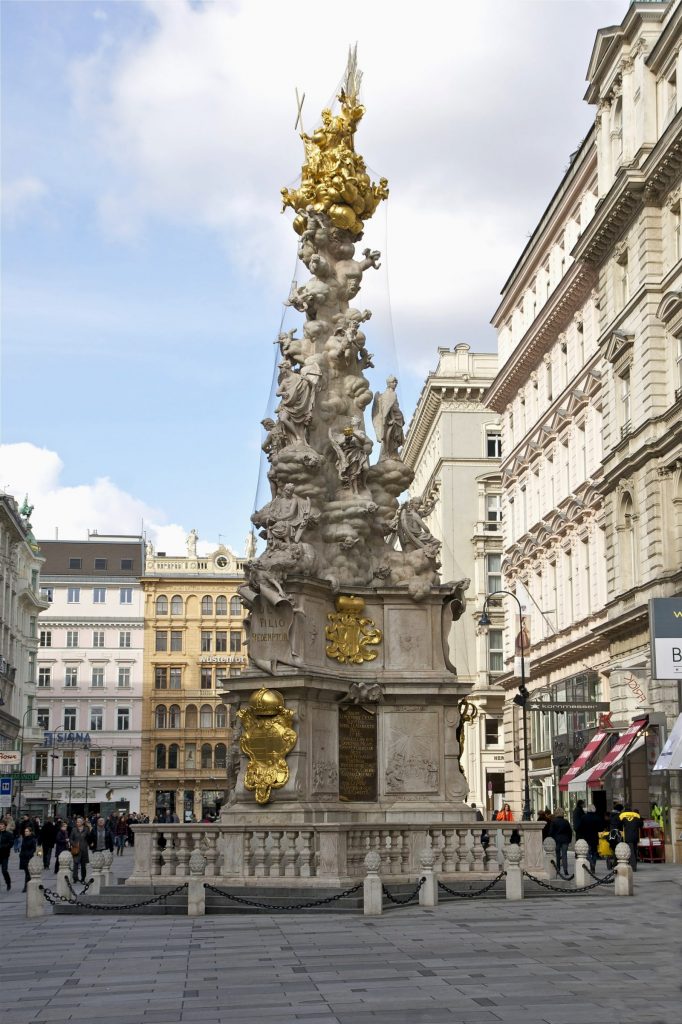
The Plague Column on the Graben. Photo: Jebulon / CC BY-SA 3.0
Walk on to the Graben, Vienna’s grandest shopping street. Its name means the moat: the Roman camp had its ditch here.
In the middle stands the Plague Column, a tower of clouds, angels and saints. Emperor Leopold the First promised it during the plague of 1679, which killed tens of thousands of people in Vienna, and it was finished in 1693. Look for the emperor himself, kneeling in prayer, and for the figure of Faith throwing an old woman, the plague, down into the abyss.
Just behind the column, on the left, the green dome of St Peter’s Church rises over the rooftops.
10. St Stephen’s Cathedral
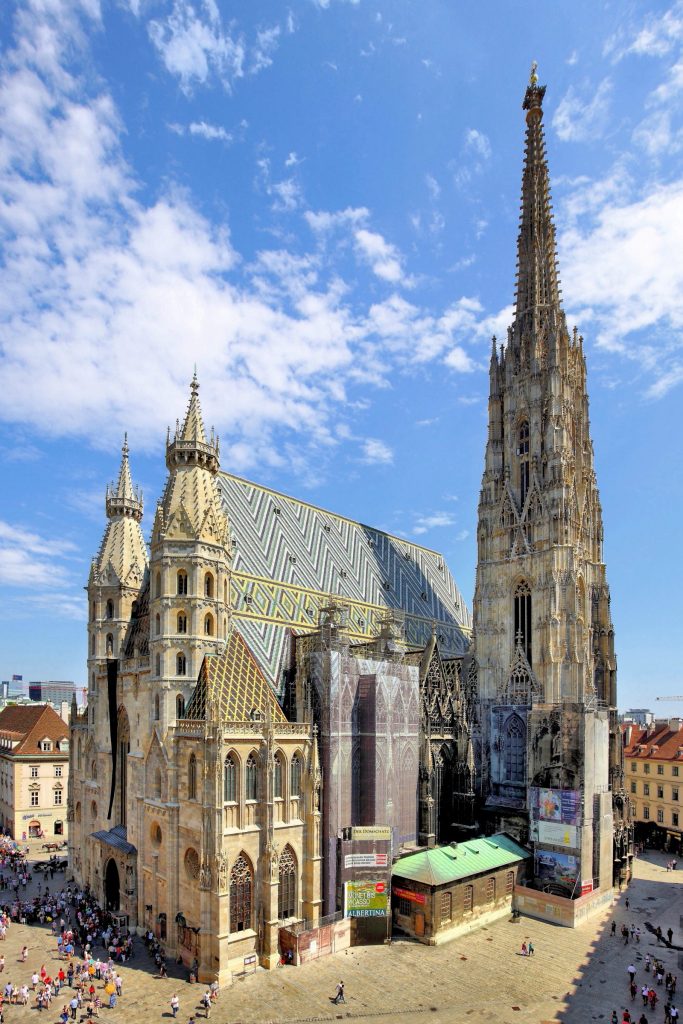
St Stephen’s Cathedral, with its tiled roof and the south tower. Photo: C.Stadler/Bwag / CC BY-SA 4.0
At the end of the Graben, the walk ends at St Stephen’s Cathedral, the heart of Vienna. Its Gothic south tower is 136 metres high, and the Viennese call it simply the Steffl. You can climb its 343 steps for a view over the city, or take a lift up the shorter north tower to see the Pummerin, the largest bell in Austria.
Look up at the roof, covered with more than two hundred thousand coloured tiles, with the double-headed eagle of the Habsburgs on one side. Inside, the nave is free. Mozart was married in this cathedral in 1782, and nine years later his funeral service was held here. Under the church are the catacombs, with the remains of thousands of Viennese and the urns that hold the inner organs of the Habsburgs.
In Advent there is a Christmas market around the cathedral, too. This is the end of the walk. If you came on the day trip, your driver meets you at the agreed point a few minutes from here.
Getting to Vienna from Prague
Vienna is about 330 km and four hours by car from Prague. A day trip is long, but with a driver you can rest on the way, and the day trip above drops you at the start of this walk. If you are staying in Vienna, see our one-way taxi from Prague to Vienna. Trains and buses are compared on our how to get there page.
Frequently asked questions
Is there a free audio guide to Vienna in English?
Yes — this page. Every stop has its own English audio track that plays in your phone’s browser, and the whole tour is also one MP3 you can download before you go. No app or account is needed.
Can you see Vienna in a day trip from Prague?
Yes, if you start early and accept a long day. It is about four hours each way, so you have five to six hours in Vienna — enough for this walk and one inside visit, but not for Schönbrunn as well.
Do I need a passport to go from Prague to Vienna?
Yes, take a passport or national ID card. Both countries are in Schengen, but there can be police checks at the border.
Is St Stephen’s Cathedral free to visit?
The main part of the nave is free outside services. The south tower climb, the north tower lift, the catacombs and the guided tours are paid.
Where are the Christmas markets in Vienna?
On this walk, the biggest is on the Rathausplatz, stop 7, with the city’s Christmas tree. There are also markets at the Karlskirche, stop 1, at Am Hof, stop 8, and around St Stephen’s Cathedral, stop 10. They run from mid-November until Christmas.
Can I visit Schönbrunn on the same day?
Only if you skip most of this walk. Schönbrunn is about 5 km from the centre and needs at least two to three hours. If you want both, ask us about an overnight trip.