Dresden Free Audio Guide and Walking Tour in 9 Stops
Dresden, the old capital of Saxony, is two hours from Prague and one of the most beautiful Baroque cities in Europe — and almost all of it was rebuilt after 1945. This page is a free audio guide to its old town in English, written out and read aloud: nine stops from the Zwinger to the Altmarkt, about 2 km and three to four hours with visits, plus as much museum time as you like. Keep the page open on your phone and play or read each stop as you reach it. The walk costs nothing; you pay only for the museums and towers you go into.
Listen to the audio guide — each stop below has its own track, about a minute long. Start with the introduction:
Or download the whole tour as one MP3 (9 minutes, 4 MB) before you leave, so it plays without mobile data in Germany.
€210 car, up to 4 · €230 minivan, up to 8
Private day trip from your Prague hotel to Dresden and back
- Pick-up at your hotel or apartment in Prague, at the time you choose
- About two hours to Dresden, the last part along the Elbe valley; the driver drops you by the Zwinger, the start of this walk
- The driver waits while you walk, visit the museums and have lunch
- The driver collects you at the Altmarkt, the end of the walk, and takes you back to your hotel in Prague the same evening
- Price for the whole car and the whole day, not per person: fuel, tolls, parking, waiting and child seats included
Tell us the date, your hotel in Prague, when you would like to leave and how many of you there are — we confirm the car and the price in writing. +420 773 477 799 (WhatsApp, Viber, Telegram) · cz@cztransfer.com · more about the day trip
Order
How you can pay
- Cash to the driver — euros, Czech crowns, US dollars or pounds sterling
- Card to the driver, contactless — Visa, Mastercard, Maestro, American Express, or pay by phone
- Card or PayPal online, before the trip — Visa, Mastercard, American Express; the payment processor adds a 6% fee
- Crypto, before the trip — USDT (TRC-20) or Bitcoin
Payment details · no deposit, pay at the end of the trip if you like
Before you set off
- Distance: about 2 km, flat, all inside the old town
- Time: three to four hours with a few visits; a whole day if you want the big museums
- Passports: Dresden is in Germany. Both countries are in Schengen, but Germany runs checks at its land borders, so every passenger needs a passport or national ID card
- Museum days: the museums in the Royal Palace, including the Green Vault, close on Tuesdays; the Zwinger galleries and the Albertinum close on Mondays. Book the Historic Green Vault ahead, it has timed tickets
- Free: the Zwinger courtyard, the cathedral, the Fürstenzug, Brühl’s Terrace, the Frauenkirche outside services, and all the squares
- Paid: the Old Masters Gallery, the Green Vault, the Albertinum, the Semperoper tour and the climbs up the towers and the Frauenkirche dome
- In Advent: from the end of November until Christmas, the walk passes three Christmas markets — the medieval one in the Stallhof, one around the Frauenkirche, and the Striezelmarkt on the Altmarkt, one of the oldest in Germany
- Map: open the route in Google Maps
Dresden was destroyed in the air raids of February 1945, and the old town you walk through has been rebuilt piece by piece since then — some of it only in the last twenty years. Knowing that changes how it looks.
Route map
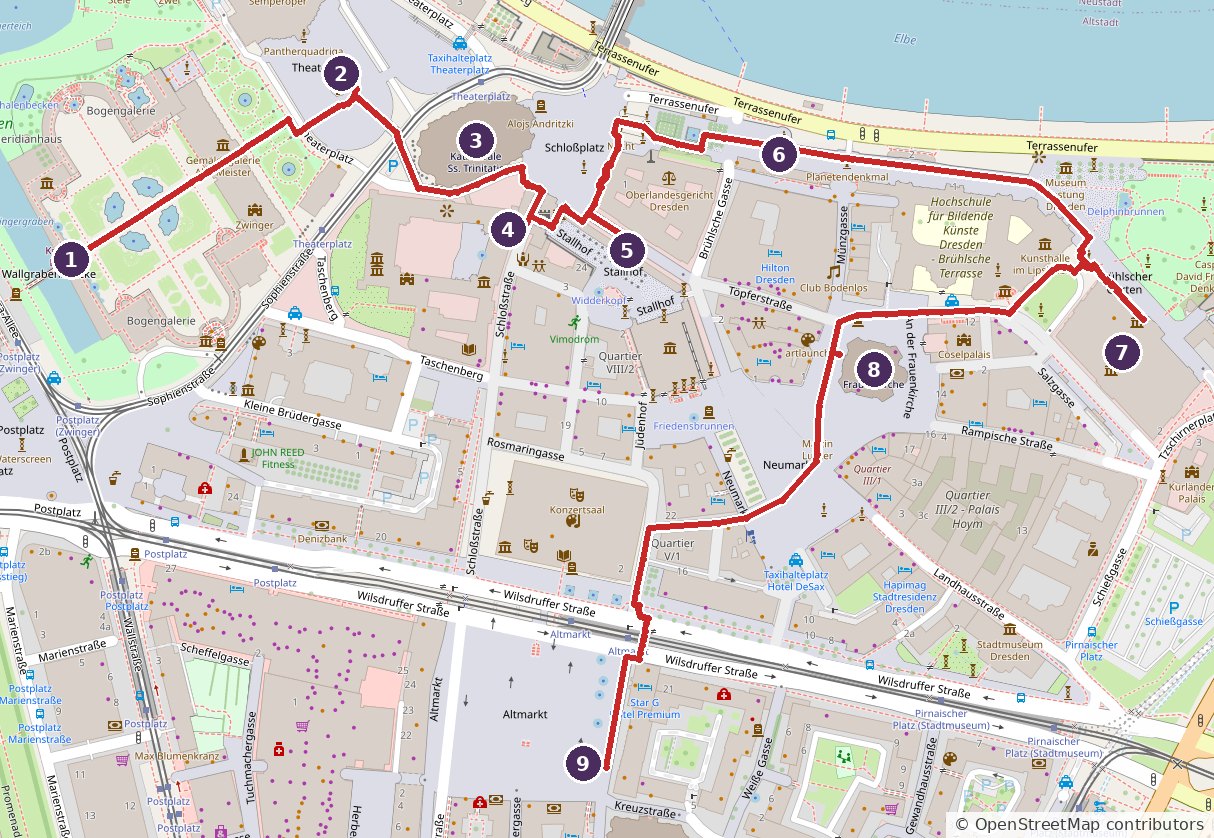
1 the Zwinger · 2 Theaterplatz and the Semperoper · 3 the Catholic Court Church · 4 the Royal Palace and the Green Vault · 5 the Fürstenzug · 6 Brühl’s Terrace · 7 the Albertinum · 8 the Frauenkirche and the Neumarkt · 9 the Altmarkt and the Kreuzkirche. Tap the map to open it full size. Map data © OpenStreetMap contributors.
1. The Zwinger
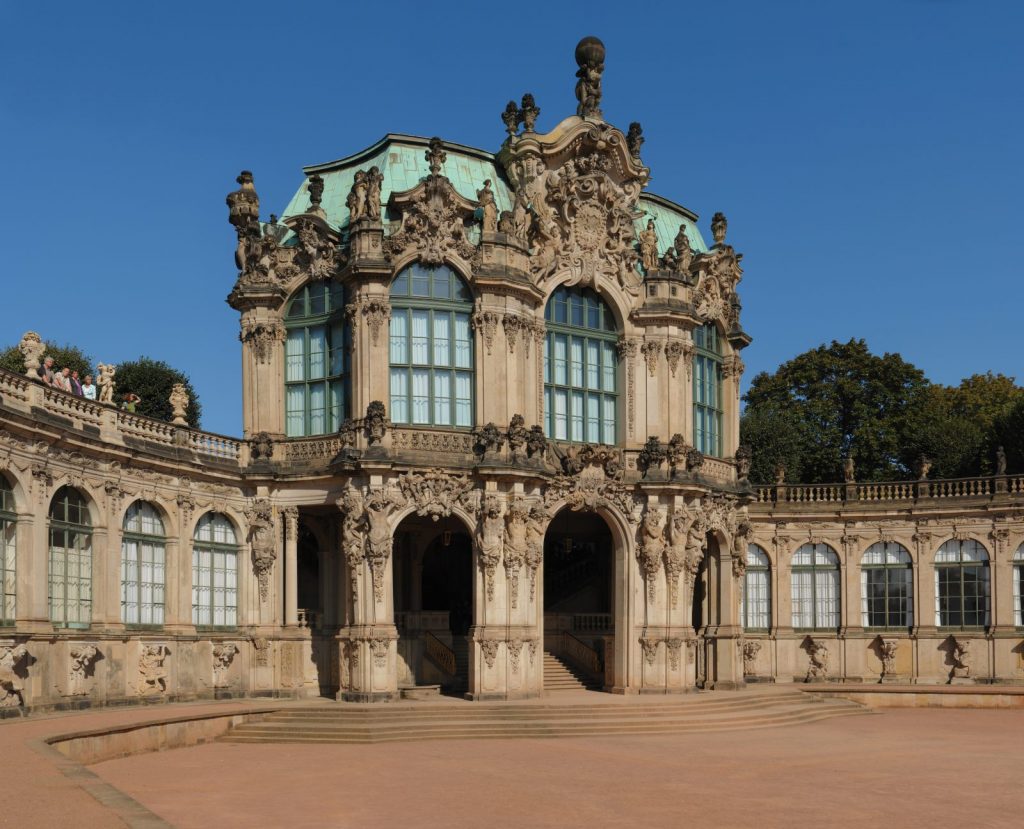
Start at the Crown Gate, the tower with a golden crown on top, which you reach over a bridge across the old moat. Behind it lies the Zwinger, the masterpiece of Dresden Baroque.
It was built between 1710 and 1728 for Augustus the Strong, Elector of Saxony and King of Poland, by the architect Matthäus Daniel Pöppelmann and the sculptor Balthasar Permoser. It was not a palace to live in but a stage for court festivals: a huge courtyard framed by galleries and pavilions, crowded with stone gods, nymphs and satyrs. The crown on the gate is the Polish crown, a reminder of how far Augustus’s ambitions reached. Look for the Nymphs’ Bath, a hidden fountain grotto in the north-west corner.
The courtyard is free. The long building closing the north side, added later by Gottfried Semper, holds the Old Masters Gallery, with Raphael’s Sistine Madonna and its two famous little angels. The Zwinger also holds Augustus’s porcelain collection and a salon of historic clocks and scientific instruments.
2. Theaterplatz and the Semperoper
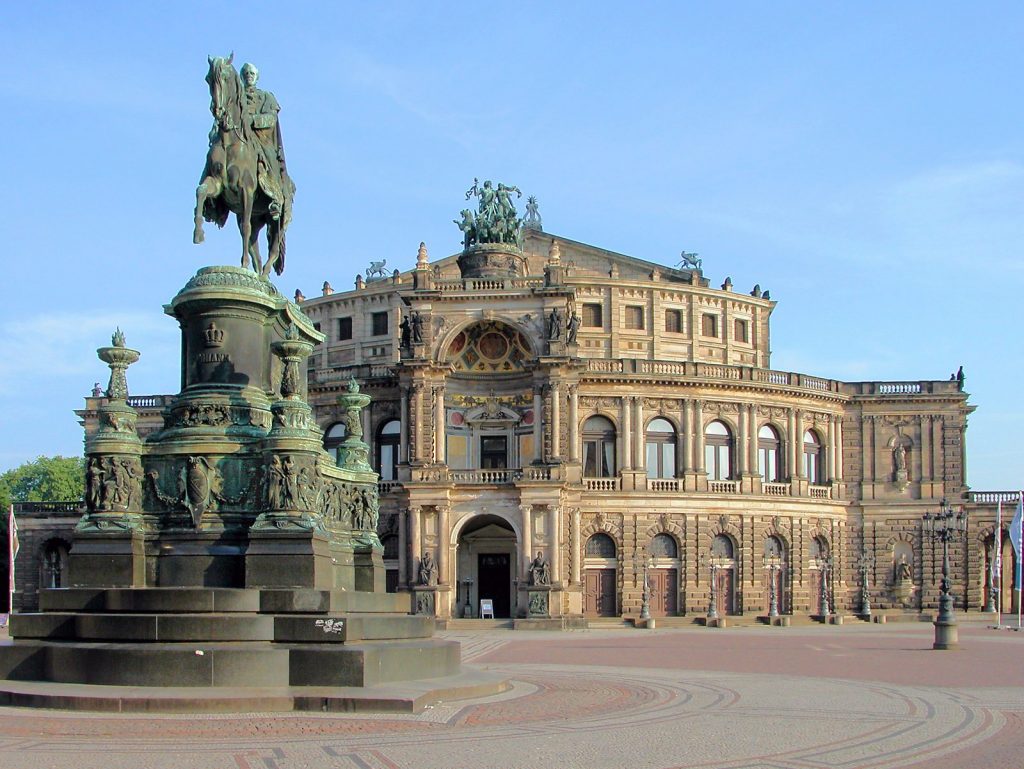
The Semperoper on Theaterplatz. Photo: Jörg Blobelt / CC BY-SA 4.0
Leave the Zwinger through the gate in the Semper building, and you are on Theaterplatz, with the statue of King John of Saxony on horseback in the middle.
In front of you stands the Semperoper, the opera house, named after its architect Gottfried Semper. His first theatre here burned down in 1869, and a second one, built to his plans, opened in 1878. Richard Wagner conducted here, and Richard Strauss gave Dresden the premieres of nine of his operas, including Salome and Der Rosenkavalier. The building burned again in the bombing of 1945 and reopened in 1985, forty years to the day after the raid.
You can see the inside on a guided tour, or come back one evening for a performance.
3. The Catholic Court Church
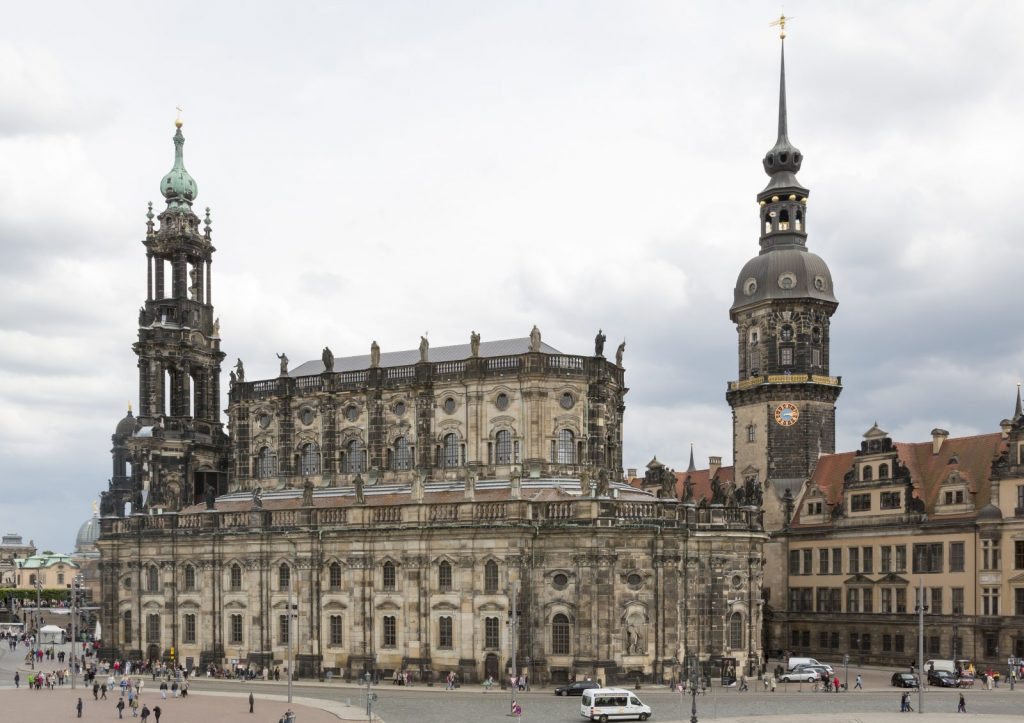
The Catholic Court Church, with the palace tower behind. Photo: CEphoto, Uwe Aranas / CC BY-SA 3.0
On the riverside corner of the square stands the Catholic Court Church, now Dresden’s cathedral. Its story explains a lot about Saxony. To become King of Poland, Augustus the Strong had to become a Catholic, but his Saxon subjects were Protestant. His son built this church in the middle of the 18th century for the Catholic court, to plans by the Italian architect Gaetano Chiaveri, and linked it to the palace by a covered bridge.
Look up at the balustrades, lined with almost eighty stone saints. Inside, the church is bright and white, with the last organ built by the great organ maker Gottfried Silbermann. In the crypt lie the kings of Saxony, and in a small vessel, the heart of Augustus the Strong. His body is buried in Kraków, as a Polish king.
Entry is free.
4. The Royal Palace and the Green Vault
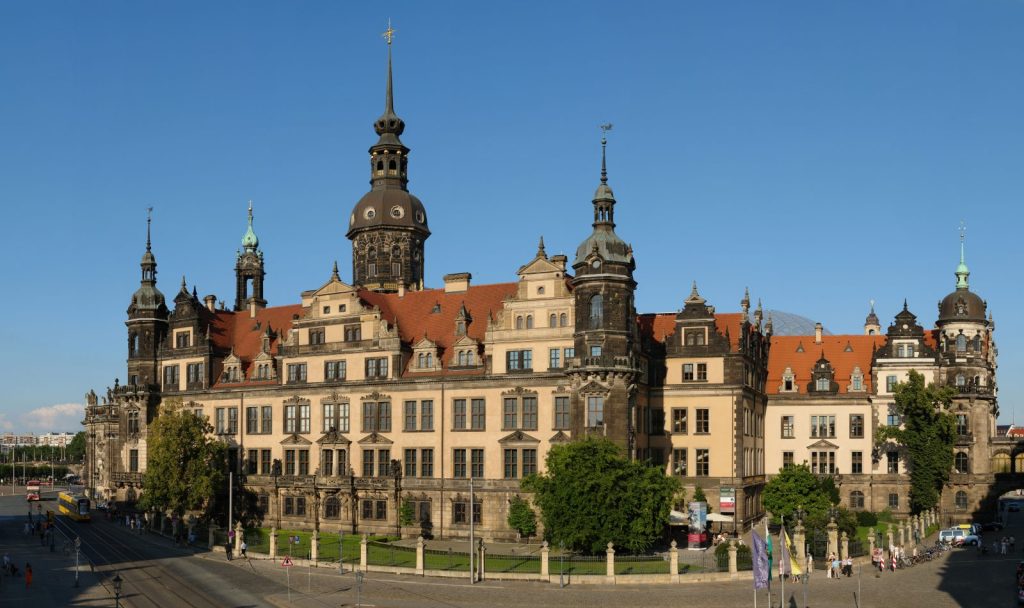
The Royal Palace, home of the Green Vault. Photo: Kolossos / CC BY-SA 3.0
Across the street is the Residenzschloss, the Royal Palace, home of the rulers of Saxony for four hundred years. The tall Hausmann Tower can be climbed for a view over the old town.
The palace holds the treasures the electors collected, and the most famous is the Green Vault, one of the richest treasure chambers in Europe. The Historic Green Vault shows about three thousand pieces of gold, silver, ivory and jewels in the mirrored Baroque rooms where Augustus displayed them; it has timed tickets, so book ahead. The New Green Vault shows single masterpieces, such as the Dresden Green Diamond and a whole tiny Indian court in gold and enamel. In 2019 thieves broke in and stole jewels from the historic rooms; most of them have since been recovered and put back on display.
The palace also holds the Turkish Chamber and the armoury. Remember that the palace museums are closed on Tuesdays.
5. The Fürstenzug
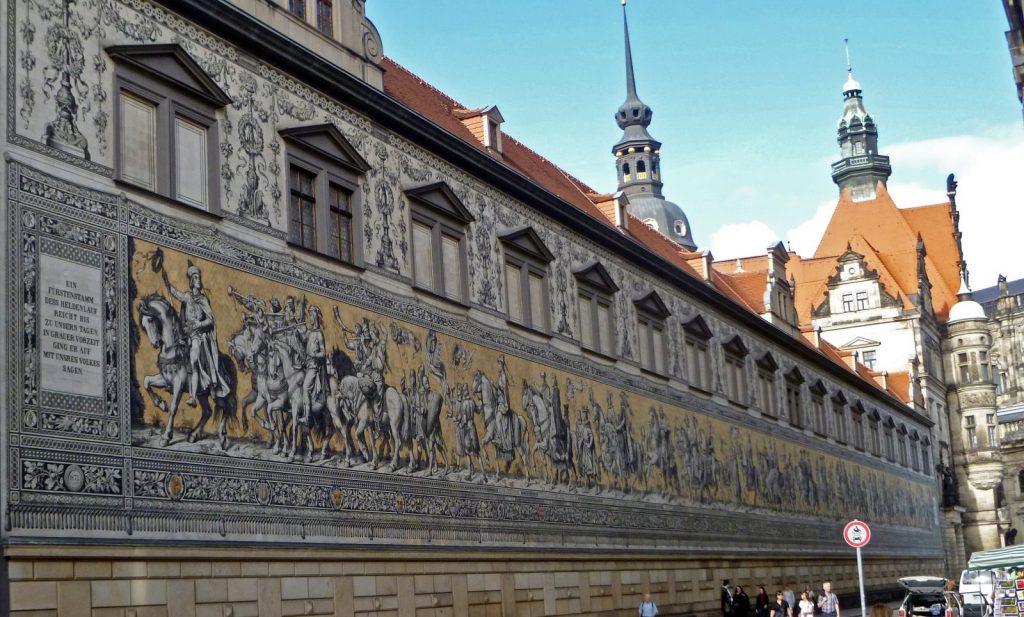
Walk through the palace gate onto Augustusstraße. The whole long wall on your right is the Fürstenzug, the Procession of Princes, 102 metres long. It shows the rulers of Saxony from the Wettin family, thirty-five margraves, dukes, electors and kings over eight centuries, riding one after another, with scholars, artists and soldiers following at the end.
It was first painted in the 1870s. Then, at the start of the 20th century, it was copied onto about twenty-three thousand tiles of Meissen porcelain, which is why it survived the 1945 bombing almost undamaged. Look for Augustus the Strong, and at the end for the artist, Wilhelm Walther, who put himself in the crowd.
Behind the wall is the Stallhof, the old stable courtyard, where tournaments were held. In Advent it holds a medieval Christmas market, with costumed traders and fire pits.
6. Brühl’s Terrace
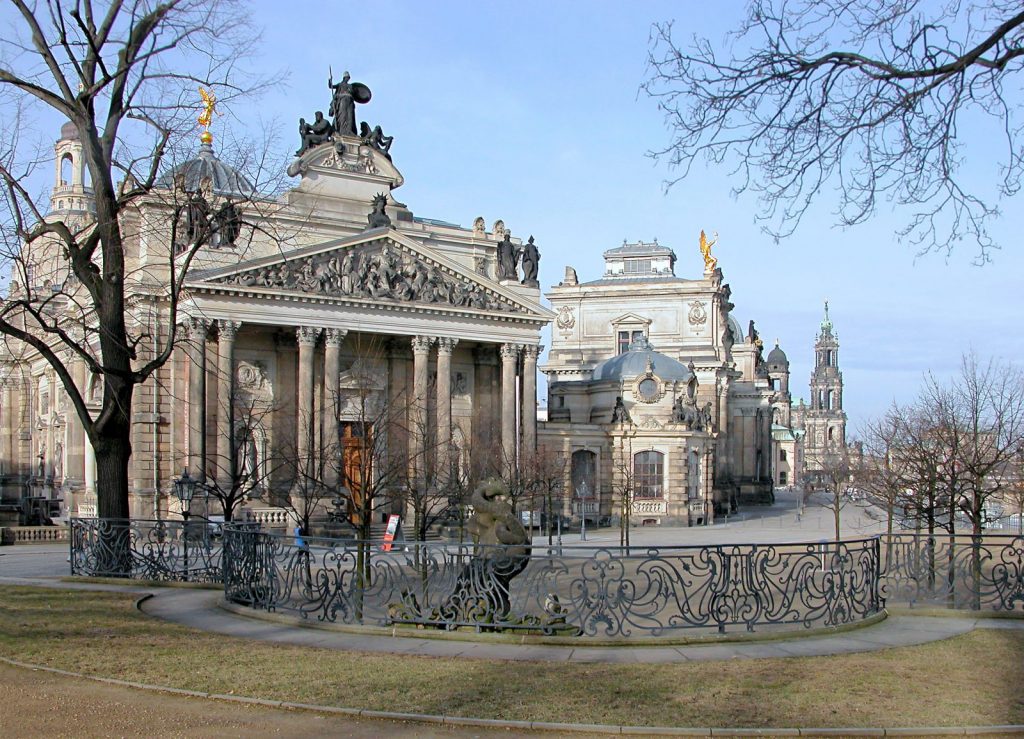
The Art Academy on Brühl’s Terrace. Photo: Jörg Blobelt / CC BY-SA 4.0
Walk back to the Schlossplatz, the square by the cathedral, and climb the wide staircase up to Brühl’s Terrace, the promenade along the old city wall above the Elbe. People call it the Balcony of Europe. It got its name from Count Heinrich von Brühl, minister to the son of Augustus the Strong, who turned these fortifications into his private gardens. In 1814 they were opened to the public.
Walk east along the terrace. Below you, the white paddle steamers of the Saxon steamship company — the oldest and largest fleet of paddle steamers in the world — set off on trips up the river. Across the water is the Neustadt, the New Town. The glass dome on your right, which locals call the lemon squeezer, belongs to the Academy of Fine Arts.
7. The Albertinum
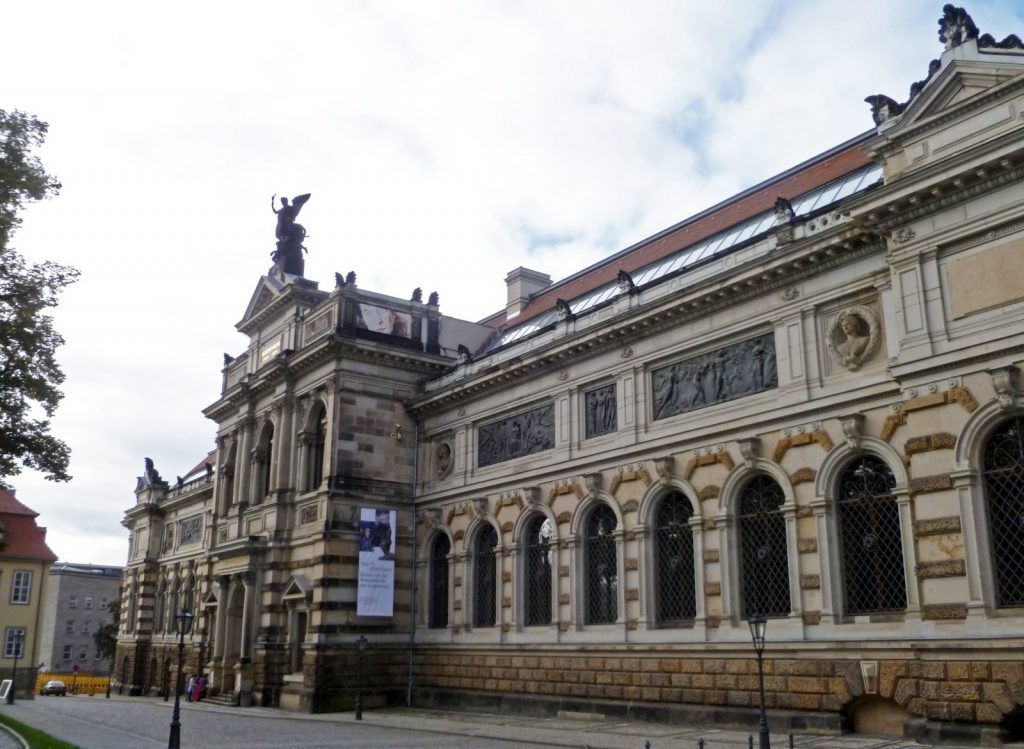
At the end of the terrace stands the Albertinum, Dresden’s museum of art from the Romantic period to today. It is the place to see the paintings of Caspar David Friedrich, the great German Romantic who lived in Dresden, including his moonlit landscapes. It also has rooms of works by Gerhard Richter, who was born in Dresden in 1932, and a large collection of sculpture.
If you do not go in, walk down the steps from the terrace by the Albertinum, and turn right towards the great stone dome you can already see.
8. The Frauenkirche and the Neumarkt
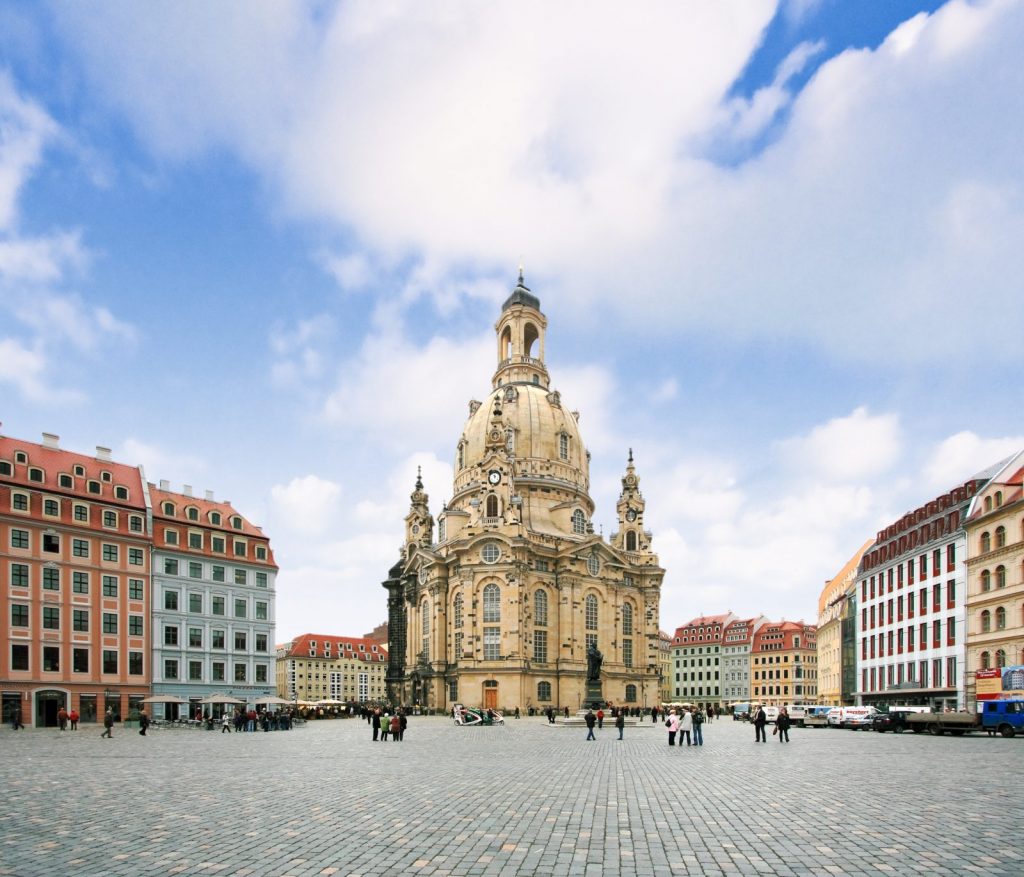
The Frauenkirche on the Neumarkt, rebuilt and reopened in 2005. Photo: Ronny Kreutel — Kausalkette / public domain
This is the symbol of Dresden. The Frauenkirche, the Church of Our Lady, was built from 1726 to 1743 by the city carpenter and architect George Bähr, with a huge dome of stone that people called the Stone Bell.
It survived the firestorm of February 1945 for two days, then collapsed. For almost fifty years, in East German times, it stayed a heap of rubble, as a memorial against war. After German reunification it was rebuilt, and it was consecrated again in 2005. The dark stones you see in the light walls are original blocks, found in the rubble and put back where they had been. The golden cross on the dome was made in London by a silversmith whose father had flown in the bombing raids on Dresden. The old, twisted cross stands inside the church.
Entry is free outside services, and you can climb the dome for a view. In front of the church stands a statue of Martin Luther. The Neumarkt around it, with its rows of rebuilt Baroque houses, is a good place for lunch. In Advent it holds the Christmas market around the Frauenkirche.
9. The Altmarkt and the Kreuzkirche
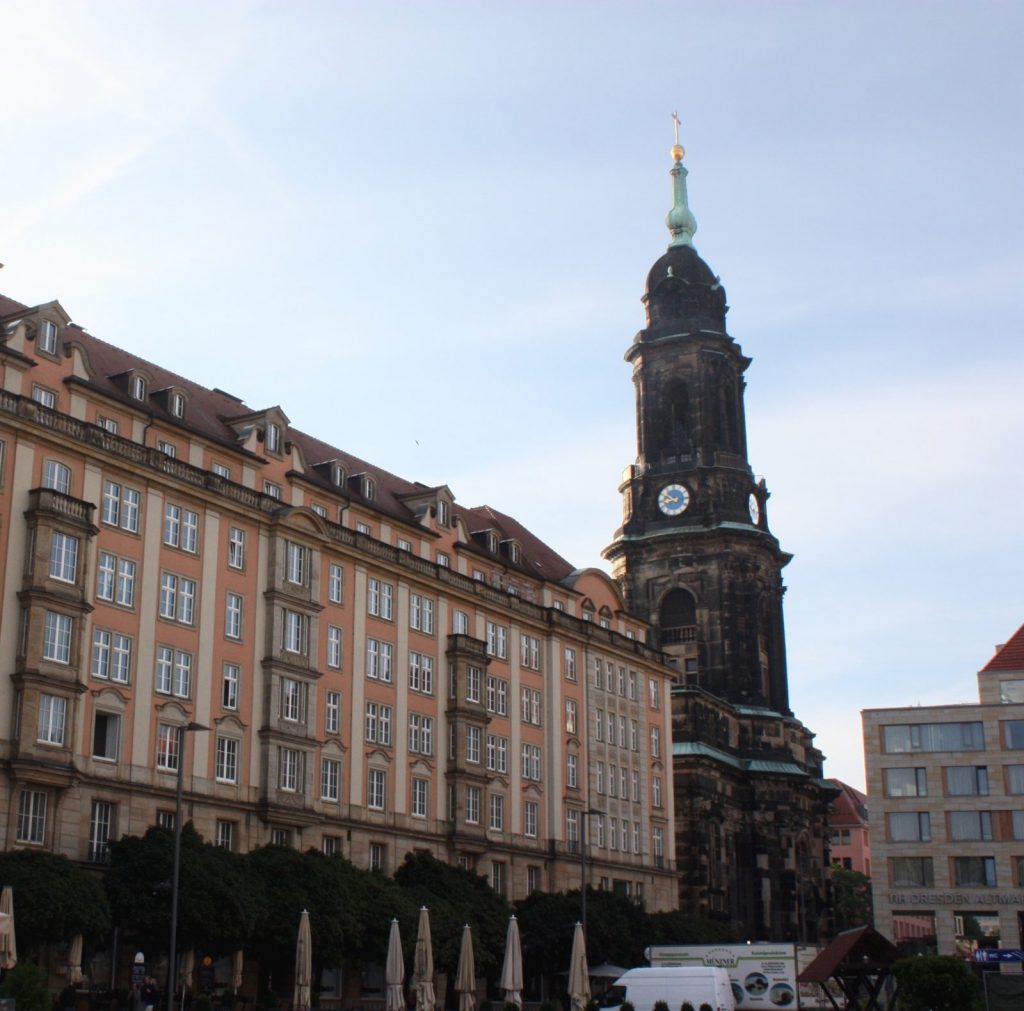
From the Neumarkt, walk south across the main road to the Altmarkt, the old market square, and the Kreuzkirche, the Church of the Holy Cross. This is the main Protestant church of Dresden and the home of the Kreuzchor, a boys’ choir that has sung here for more than seven hundred years. You can climb its tower for a view.
The Altmarkt is where Dresden has held its Christmas market, the Striezelmarkt, since 1434. It takes its name from Striezel, the old word for the Dresden Christmas cake, the Stollen. From the end of November until Christmas Eve the square fills with wooden stalls, a giant wooden Christmas pyramid and the city’s Christmas tree.
This is the end of the walk. If you came on the day trip, this is where your driver picks you up.
Getting to Dresden from Prague
Dresden is about 150 km and two hours by car from Prague, along the D8 motorway and the Elbe valley. If you are coming for the day, the day trip above gives you a driver who drops you at the Zwinger, waits and takes you home in the evening. For one way only, see our taxi from Prague to Dresden. Trains and buses are compared on our how to get there page.
Frequently asked questions
Is there a free audio guide to Dresden in English?
Yes — this page. Every stop has its own English audio track that plays in your phone’s browser, and the whole tour is also one MP3 you can download before you go. No app or account is needed.
Can you see Dresden in a day trip from Prague?
Yes. The old town is compact: this walk is about 2 km, and every stop is a few minutes from the next. With two hours’ drive each way, you still have five to six hours in the city.
Do I need a passport to go from Prague to Dresden?
Yes, take a passport or national ID card. Both countries are in Schengen, but Germany runs checks at its land borders, including the Czech one.
Do I need to book the Green Vault in advance?
For the Historic Green Vault, yes: it has timed tickets and a limited number of visitors. The New Green Vault and the other palace museums are easier, but all of them are closed on Tuesdays.
Where are the Christmas markets in Dresden?
The Striezelmarkt, the biggest and oldest, is on the Altmarkt, stop 9 of this walk, with the city’s Christmas tree. There is also a market around the Frauenkirche, stop 8, and a medieval one in the Stallhof behind the Fürstenzug, stop 5. They run from the end of November until Christmas.
Is the Frauenkirche free to visit?
Yes, outside services, though donations are welcome. The climb up to the dome viewing platform is paid.