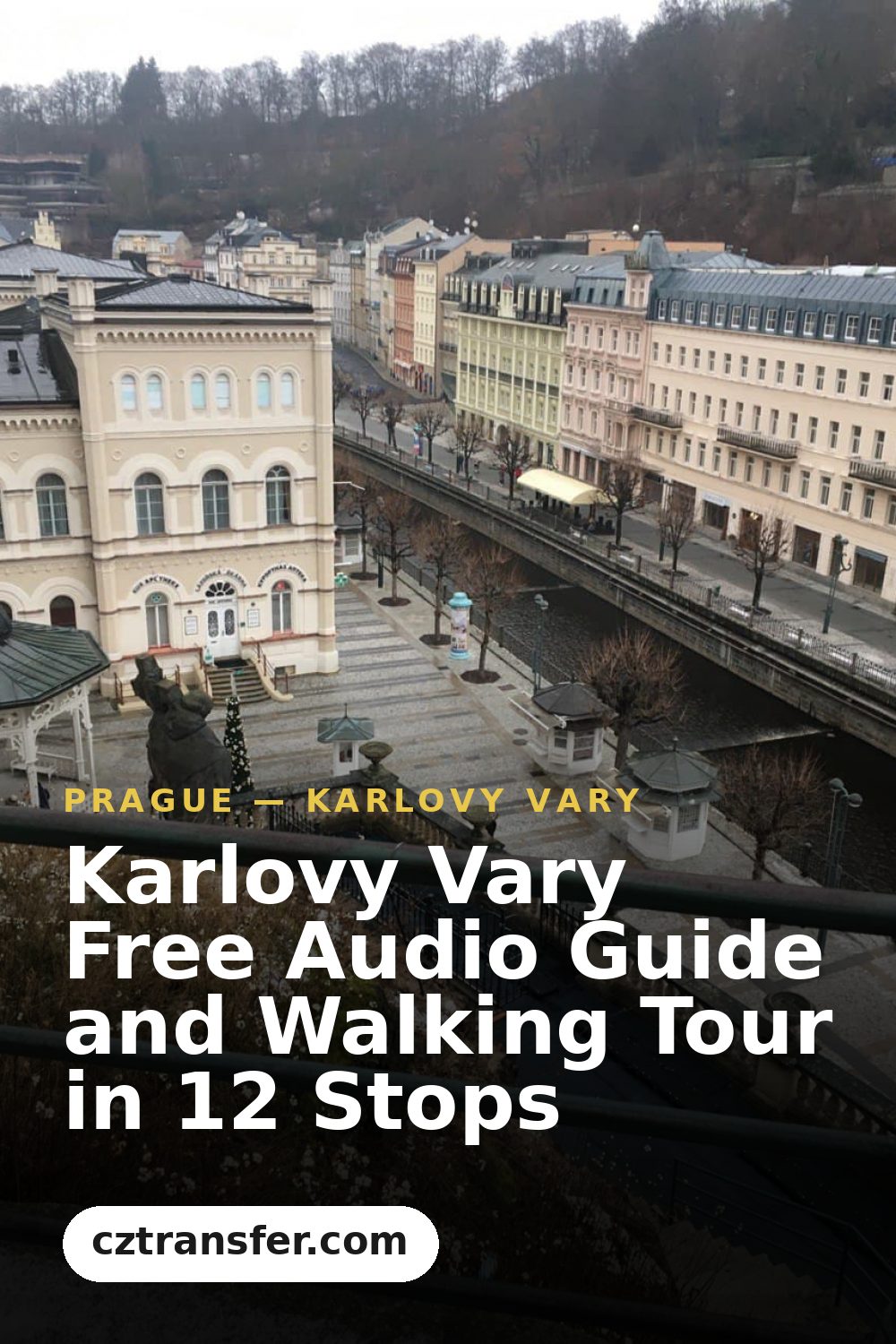
Karlovy Vary Free Audio Guide and Walking Tour in 12 Stops
Karlovy Vary is a town you can see on foot in an afternoon, and this page is a free audio guide to it in English, written out and read aloud: twelve stops along the Teplá river, from the Imperial Spa to the Becherovka museum, about 3.2 km and two to three hours at an easy pace. Almost all of it is flat. Keep the page open on your phone and play or read each stop as you reach it. Walking the route costs nothing; you only pay for the funicular, a museum or a glass of Becherovka.
Listen to the audio guide — each stop below has its own track, under a minute long. Start with the introduction:
Or download the whole tour as one MP3 (8 minutes, 4 MB) before you leave, so it plays without mobile data.
€170 car, up to 4 · €190 minivan, up to 8
Private day trip from your Prague hotel to Karlovy Vary and back
- Pick-up at your hotel or apartment in Prague, at the time you choose
- Under two hours to Karlovy Vary; the driver drops you at the start of this walk
- The driver waits while you walk the colonnades, have lunch and taste the springs
- Back to your hotel in Prague the same evening, about ten hours door to door
- Price for the whole car, not per person: fuel, tolls, parking, waiting and child seats included
Tell us the date, your hotel in Prague, when you would like to leave and how many of you there are — we confirm the car and the price in writing. +420 773 477 799 (WhatsApp, Viber, Telegram) · cz@cztransfer.com · more about the day trip
Order
How you can pay
- Cash to the driver — euros, Czech crowns, US dollars or pounds sterling
- Card to the driver, contactless — Visa, Mastercard, Maestro, American Express, or pay by phone
- Card or PayPal online, before the trip — Visa, Mastercard, American Express; the payment processor adds a 6% fee
- Crypto, before the trip — USDT (TRC-20) or Bitcoin
Payment details · no deposit, pay at the end of the trip if you like
Before you set off
- Distance: about 3.2 km, flat along the river, with one optional ride up the hill
- Time: two to three hours with stops; longer if you go up to the Diana tower or into the Becherovka museum
- Free: all the colonnades and their springs, the streets, the parks and the church
- Paid: the Diana funicular, the Becherovka museum (book ahead), tours of the Imperial Spa, the Thermal pool
- Bring: a cup if you want to taste the springs. Every spring in the colonnades has a public tap, and the traditional porcelain spa cups with a spout are sold all along the way
- Map: open the route in Google Maps
The walk goes from south to north, downstream with the river. The springs are the reason the town exists, and every one of them comes up within a few hundred metres of the water.
Route map
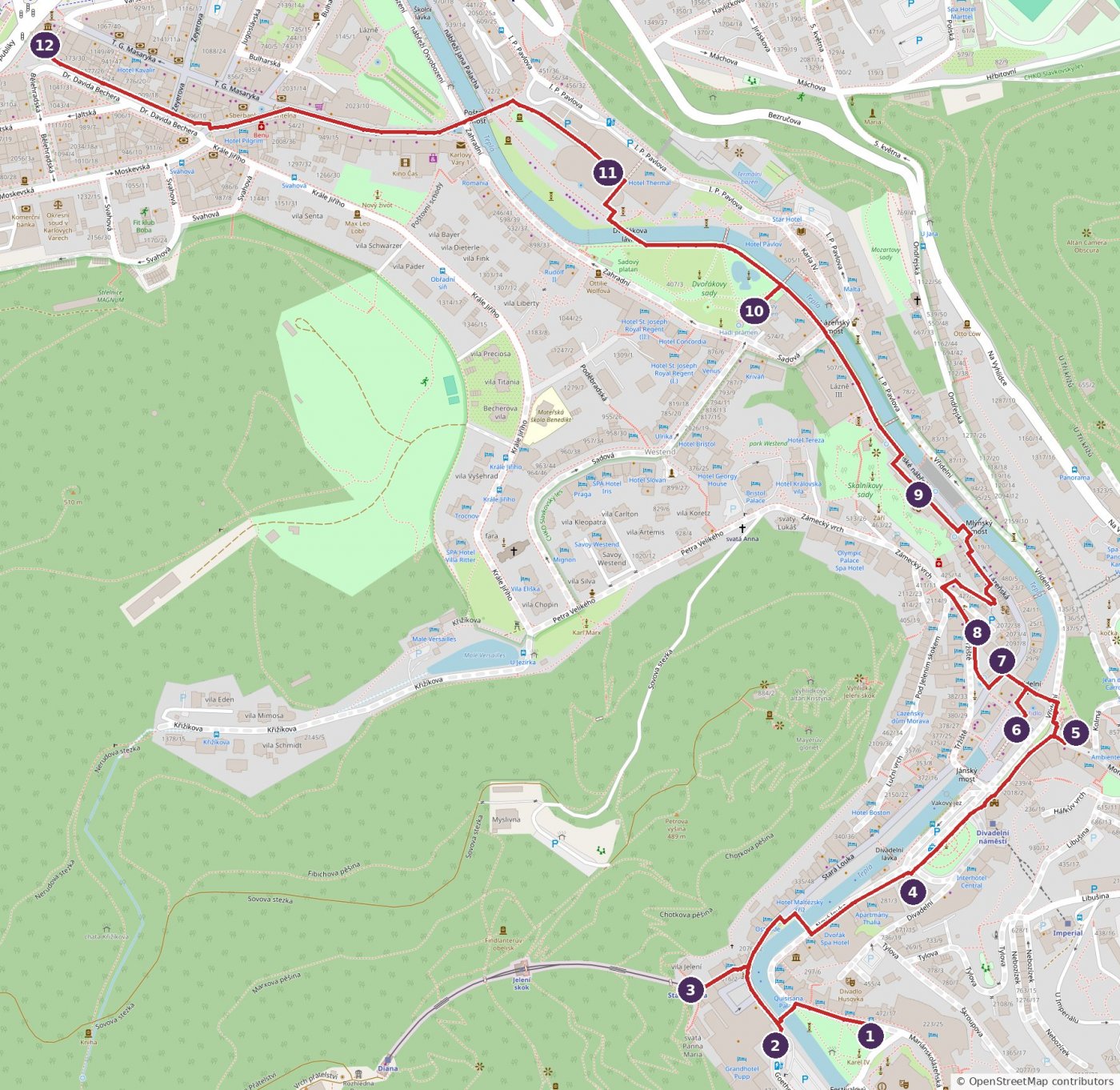
1 Imperial Spa · 2 Grandhotel Pupp · 3 Diana funicular · 4 Municipal Theatre · 5 Church of St Mary Magdalene · 6 Hot Spring Colonnade · 7 Market Colonnade · 8 Castle Tower and Castle Colonnade · 9 Mill Colonnade · 10 Park Colonnade · 11 Hotel Thermal · 12 Becherovka museum. Tap the map to open it full size. Map data © OpenStreetMap contributors.
1. The Imperial Spa
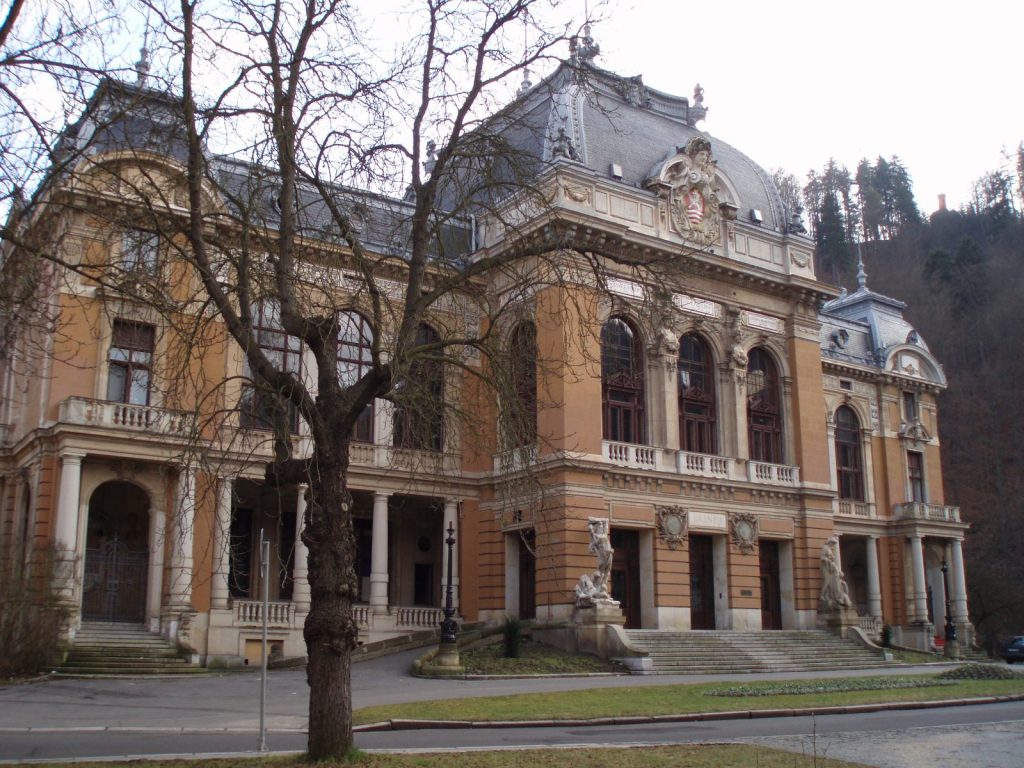
The Imperial Spa, built in the 1890s in the style of a Viennese palace. Photo: Stanislav Ferzik / CC BY-SA 4.0
Start at the grandest bath house in town. The Imperial Spa — Císařské lázně, or Lázně I — was built in the 1890s by Fellner and Helmer, the Viennese architects whose name you will hear again and again on this walk. For a century it gave Europe’s aristocracy mud baths, steam and the latest mechanical exercise machines.
In the late 20th century it fell into disrepair and stood closed for years. It reopened in 2023 after a long and expensive restoration, and today it is a cultural centre: you can take a guided tour of the old treatment rooms and the famous gym with its century-old Zander machines, or see an exhibition.
Karlovy Vary has been part of the UNESCO World Heritage site «Great Spa Towns of Europe» since 2021, together with Mariánské Lázně, Františkovy Lázně and eight other spas. This building is one of the reasons.
2. Grandhotel Pupp
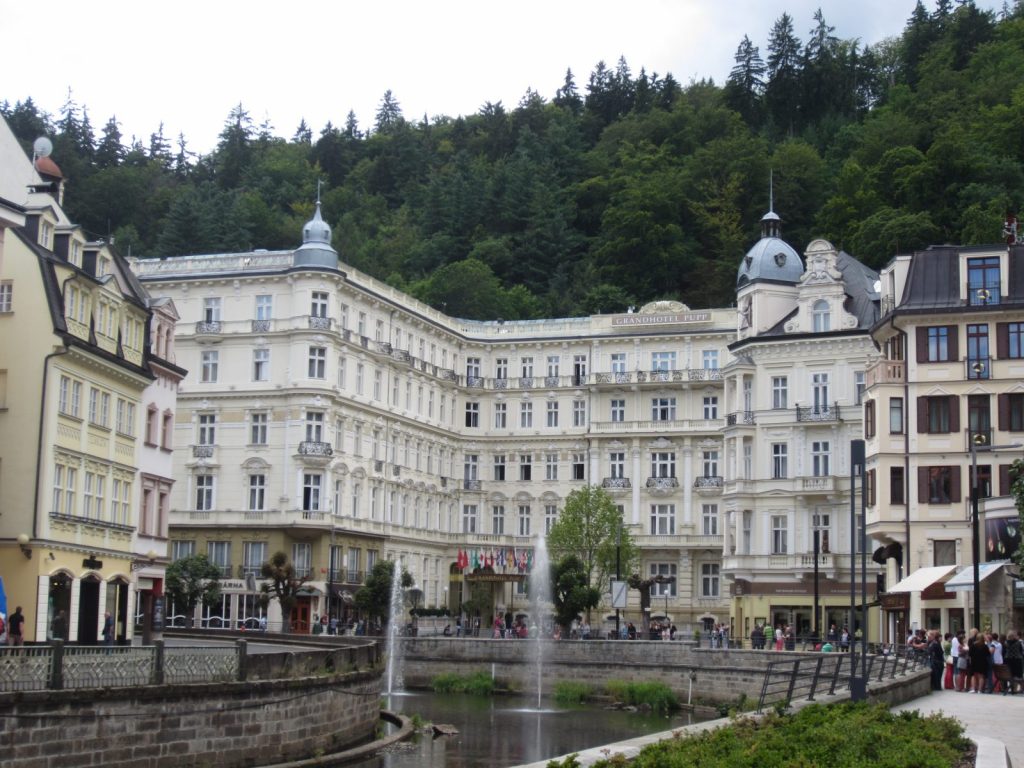
Grandhotel Pupp at the end of the promenade along the Teplá. Photo: Interfase / CC BY-SA 4.0
Across the river stands the Grandhotel Pupp, the most famous hotel in the town. Its story starts in the 18th century with a confectioner, Johann Georg Pupp, whose family grew a café and a dance hall into a hotel; the neo-Baroque palace you see took its present shape around 1900.
Film fans may recognise it: in the James Bond film Casino Royale it played the Hotel Splendide in Montenegro, and it is often named as one of the inspirations for The Grand Budapest Hotel. Every July the stars of the Karlovy Vary International Film Festival stay here. The hotel’s café is open to everyone, which is the cheapest way to see the interior.
3. The Diana funicular
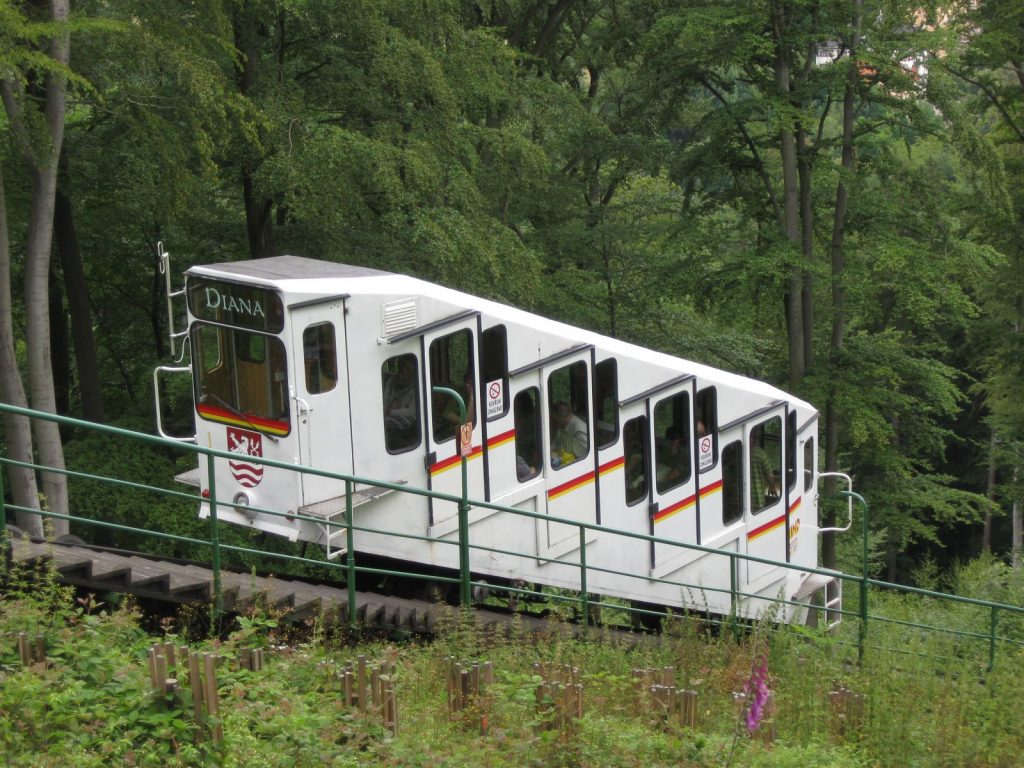
A Diana funicular car on its way up through the forest. Photo: Jiří Suchomel from Czech Republic / CC BY-SA 2.0
Behind the Pupp, a funicular climbs through the forest to the Diana lookout tower on the hill above the town. The ride takes a few minutes; at the top there is a tower with a view over the whole valley, a restaurant and a small zoo for children.
This is the only climb on the route, and it is optional. If you are short of time, skip it and walk on along the river. Check the timetable at the lower station: the funicular has a winter break, usually in January.
4. The Municipal Theatre
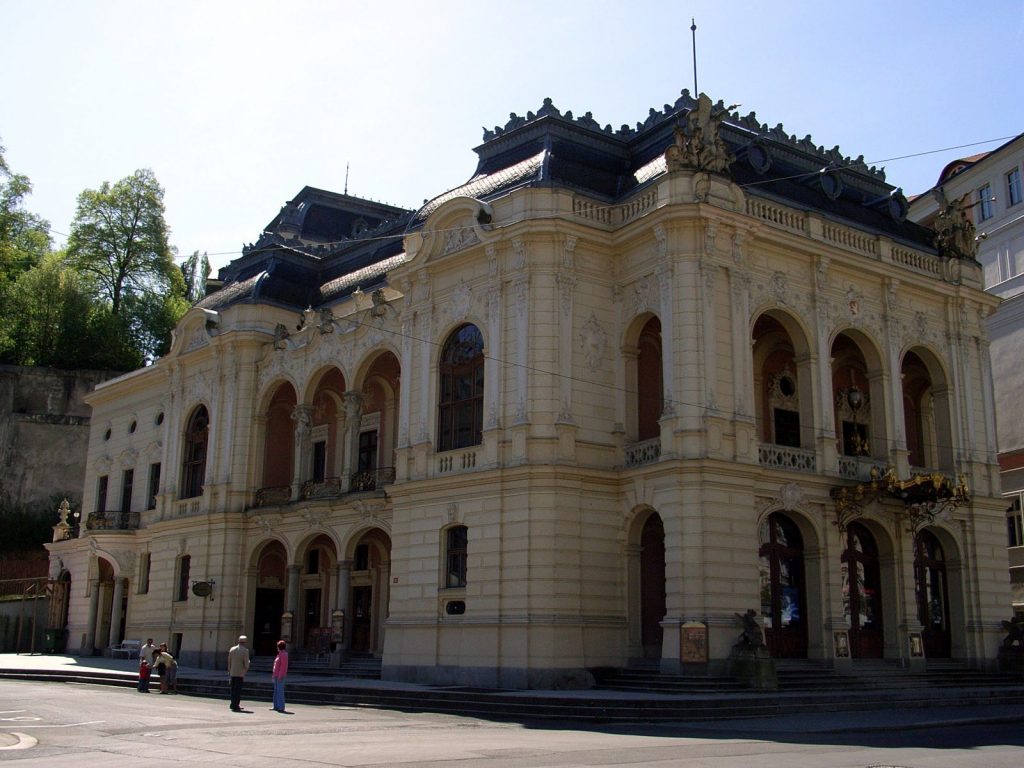
The Municipal Theatre, by the Viennese architects Fellner and Helmer. Photo: Manecke / CC BY-SA 3.0
Walk north along Stará louka, the Old Meadow, the town’s smartest street, lined with shops selling glass, porcelain and spa wafers, then cross the footbridge to Divadelní náměstí. Here stands the Municipal Theatre, opened in 1886 — by Fellner and Helmer, of course.
Its stage curtain is a real treasure. It was painted by three young artists from Vienna: Franz Matsch and the brothers Ernst and Gustav Klimt, years before Gustav became the most famous painter of the Vienna Secession. The curtain is sometimes lent out for exhibitions, so if you want to see it, ask at the box office about tours.
5. The Church of St Mary Magdalene
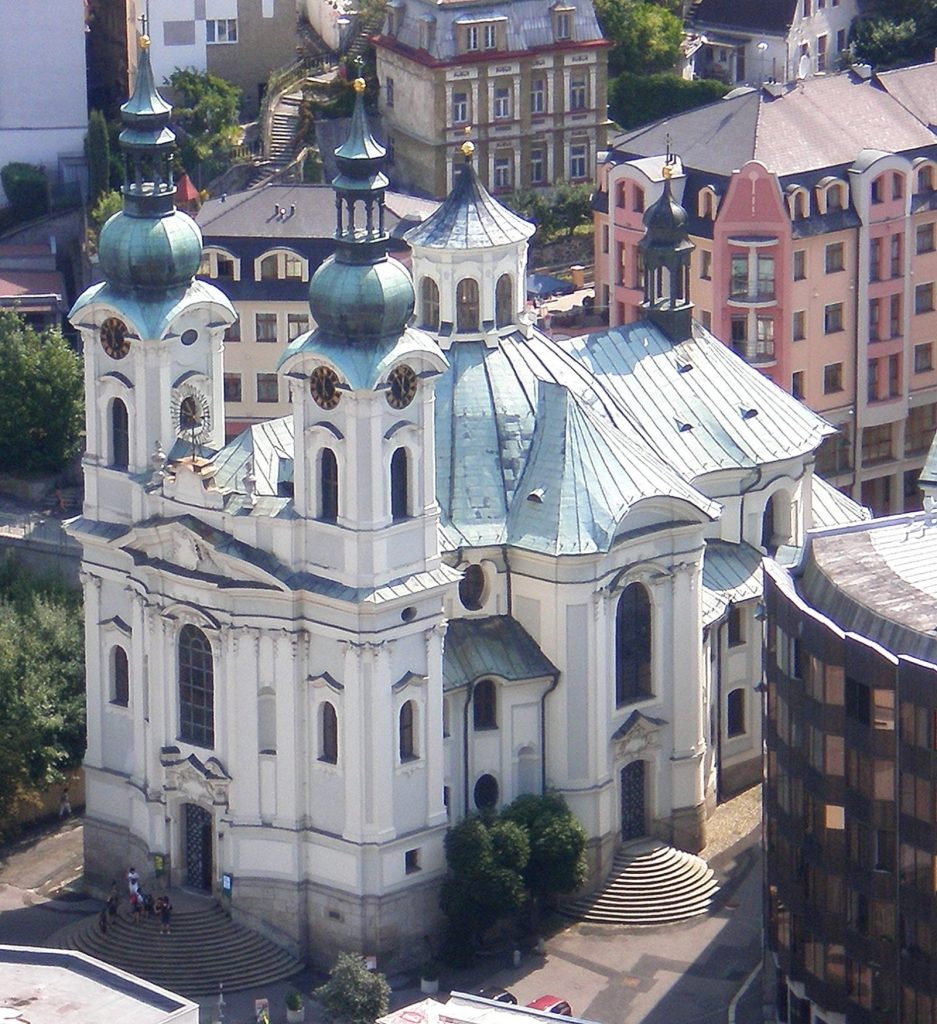
Walk on along this bank towards the Hot Spring Colonnade and look up: the white Baroque church on the terrace above is St Mary Magdalene, built in the 1730s by Kilian Ignaz Dientzenhofer, the architect who also built some of the most beautiful churches in Prague.
Building it here was not easy: the hot spring runs right under this part of town, which made the foundations a real challenge.
6. The Hot Spring Colonnade and the geyser
This is the heart of Karlovy Vary. Inside the glass hall, the Hot Spring — Vřídlo — shoots up from deep underground at around 72 degrees Celsius, in a column of water and steam that can reach about twelve metres. Around two thousand litres come up every minute.
In the next hall you can taste the spring at several taps of different temperatures. Hold your cup low, sip slowly, and do not expect anything pleasant: the water is warm, salty and metallic. Spa guests drink it in small amounts on a doctor’s advice.
The hall reopened after a long renovation in 2022. Expect building work around it in 2026 and 2027, when the footbridge and the spring-water pipes are being replaced; the hall itself stays open.
7. The Market Colonnade
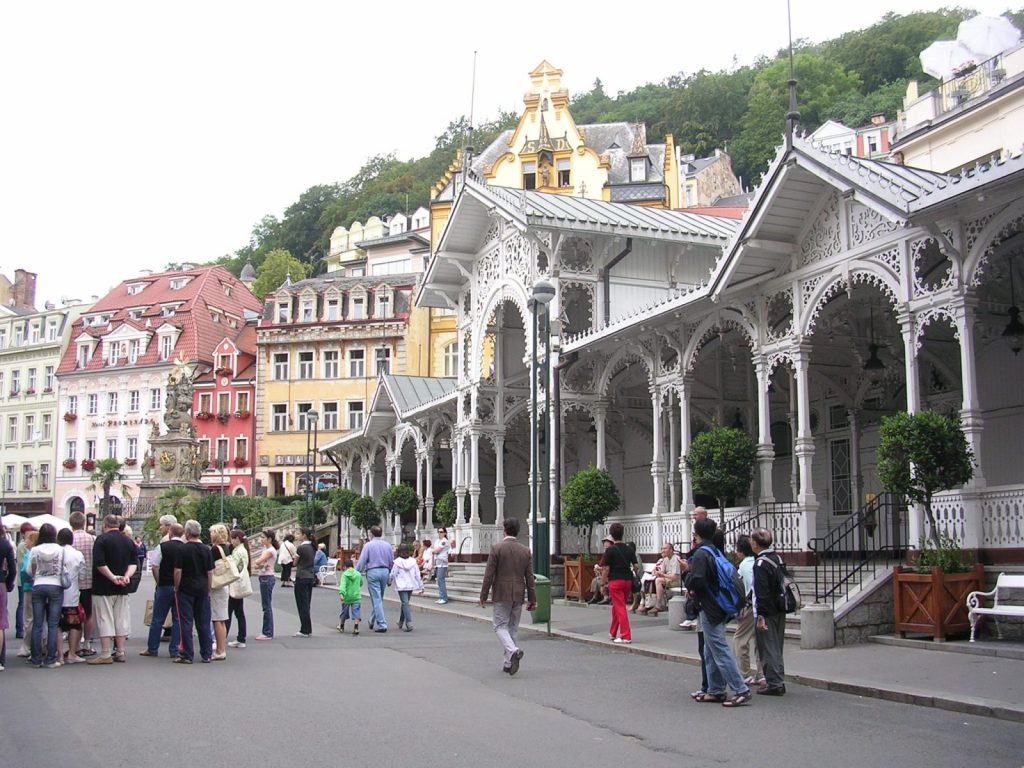
The carved wooden Market Colonnade. Photo: ŠJů / CC BY-SA 3.0
A little further on is the Market Colonnade, a white wooden building with lace-like carving, from the early 1880s. It was meant to stand for only a few years and has now lasted for well over a century.
Under it flows the Charles IV spring. According to legend, the emperor Charles IV discovered the springs while hunting in the forests here in the 14th century, when one of his hounds chasing a stag fell into a hot pool. He founded a spa, and in 1370 he gave the town its privileges. Karlovy Vary means «Charles’s Hot Baths».
8. The Castle Tower and the Castle Colonnade
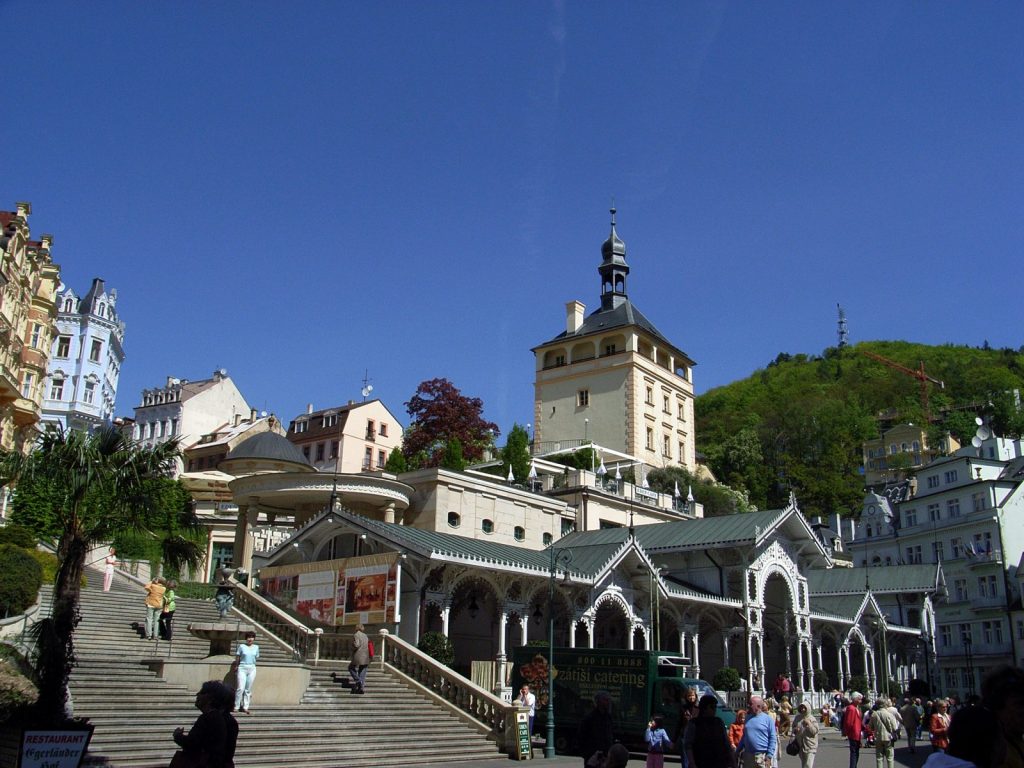
The Castle Tower on its rock above the colonnades. Photo: Manecke / CC BY-SA 3.0
Above the Market Colonnade rises the Castle Tower. It stands where Charles IV’s hunting lodge once stood; the tower you see was built after a fire in the early 17th century.
Below it, the Castle Colonnade is an Art Nouveau building from the years just before the First World War, by the Viennese architect Friedrich Ohmann. The upper part belongs to the Castle Spa, but the spring in the lower hall is open to everyone.
9. The Mill Colonnade
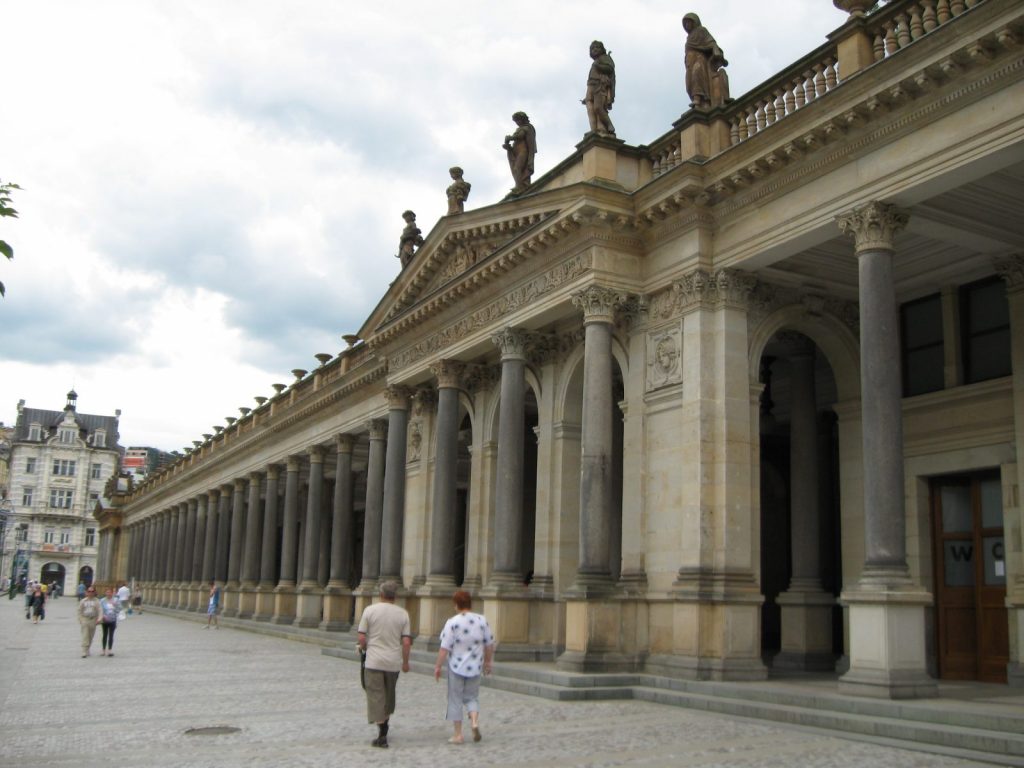
The Mill Colonnade, with its columns and the statues on the roof. Photo: Juan de Vojníkov / CC BY-SA 3.0
Now comes the largest colonnade in the town. The Mill Colonnade was built between 1871 and 1881 by Josef Zítek, the architect of the National Theatre in Prague. Its roof rests on 124 Corinthian columns, and on the balustrade above stand twelve statues representing the months of the year.
Five springs rise here, each with its own temperature and taste, and each is labelled. This is the best place on the walk to compare them: start with the cooler ones and work your way up.
10. The Park Colonnade
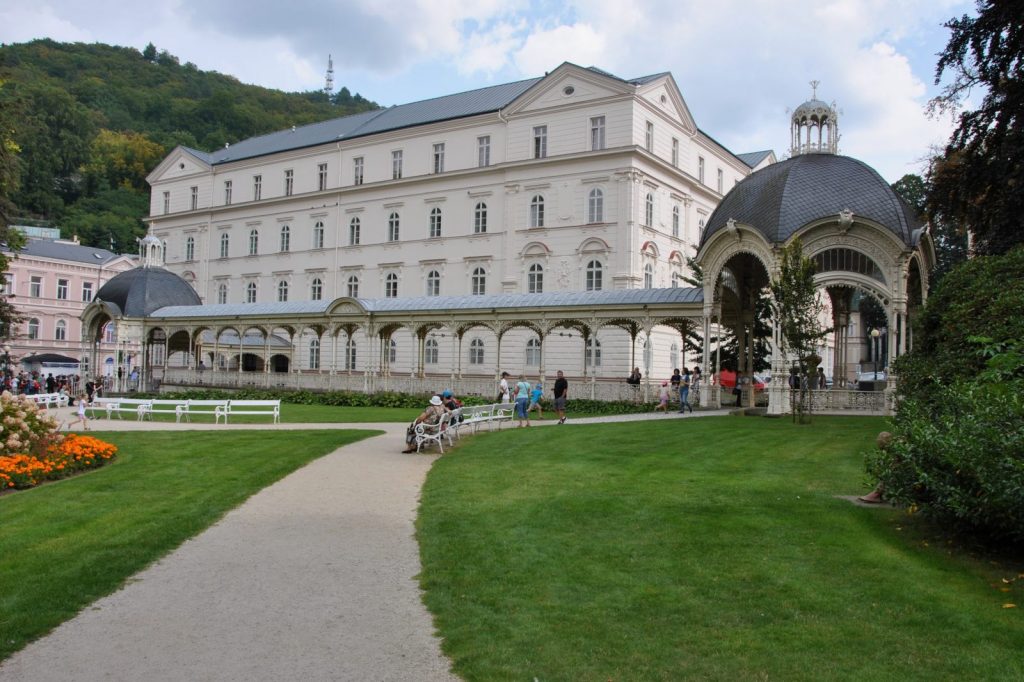
The cast-iron Park Colonnade in Dvořák Park. Photo: Lidka21 / CC BY-SA 4.0
Follow the river and cross the next bridge into Dvořák Gardens. At their edge stands the Park Colonnade, a white cast-iron pavilion from 1881, once more by Fellner and Helmer. It is the lightest and most delicate of the colonnades.
Look for the Snake Spring nearby: the water comes out of a snake’s mouth. The garden is named after the composer Antonín Dvořák, who visited Karlovy Vary several times and has a statue in the park.
11. Hotel Thermal
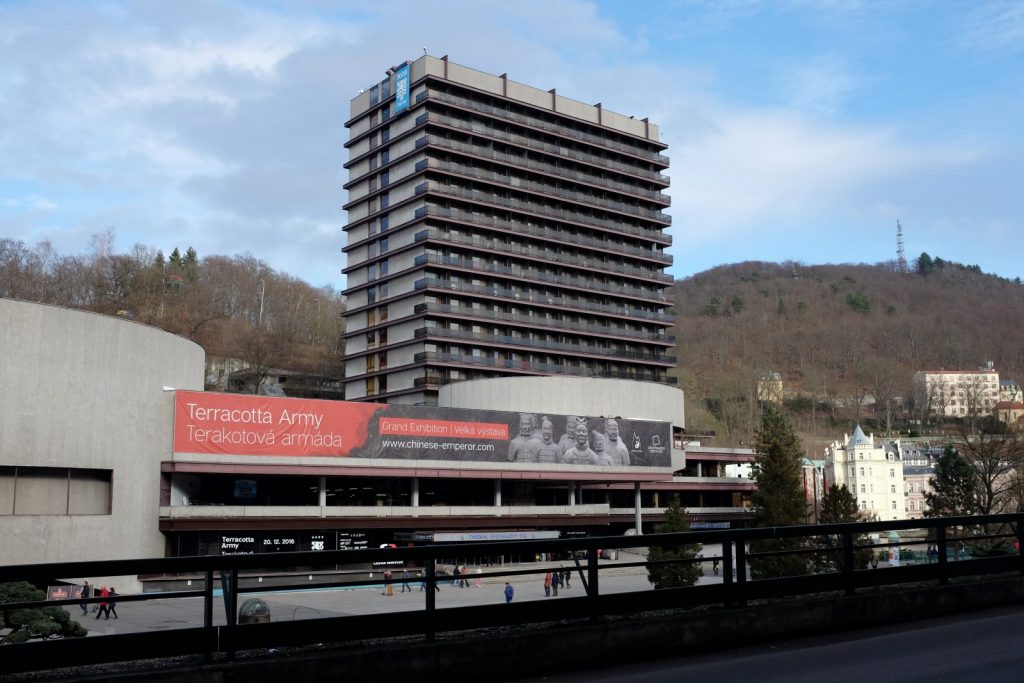
Hotel Thermal, the 1970s home of the film festival. Photo: Lubor Ferenc / CC BY-SA 4.0
A few minutes further along the river rises a concrete giant: the Hotel Thermal, built between 1967 and 1976 by the architects Věra and Vladimír Machonin. It divides opinion — some see it as an eyesore, others as one of the best buildings of its era in the country — but it is the home of the International Film Festival every July.
Above the hotel, on the hillside, is the Thermal’s public swimming pool, warmed by spring water and open all year, with a view over the town. If you have time and a towel, it is a fine way to end the day.
12. The Becherovka museum
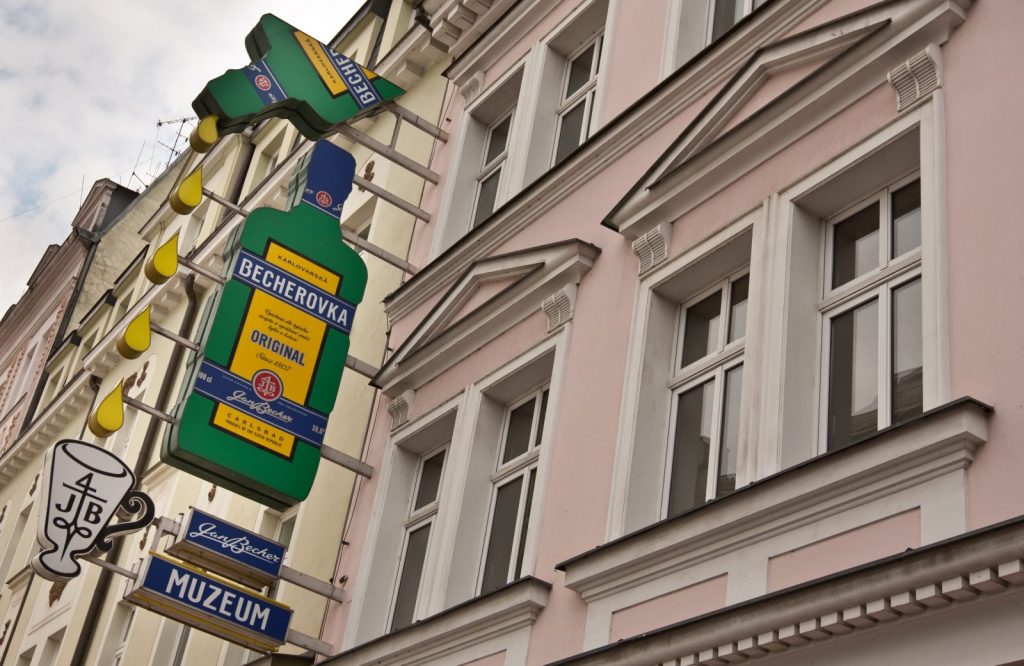
The Becherovka bottle hanging over the museum entrance. Photo: Karlovarská Becherovka / CC BY-SA 3.0
The walk ends in the newer part of town, at the Jan Becher Museum. Becherovka, the herbal liqueur sometimes called the thirteenth spring of Karlovy Vary, was first sold in the early 19th century by Josef Becher, a local pharmacist. The recipe is still a secret, known to only two people at a time.
The museum is in the old factory and can be seen only on a guided tour with a tasting at the end. Tours run from Tuesday to Sunday and must be booked in advance on the Becherovka website. Next door is a shop and a café.
From here it is ten minutes’ walk back to the river, and a short taxi ride to anywhere in town.
Getting to Karlovy Vary from Prague
Karlovy Vary is about 130 km and under two hours by car from Prague. If you are coming for the day, the day trip above gives you a driver who drops you at the start of this walk and takes you home in the evening. If you are staying in Karlovy Vary, a one-way taxi or transfer from Prague or from Prague Airport is cheaper. Buses and trains are compared in our guide to getting there, and the town’s pool and the Imperial Spa have their own page.
Frequently asked questions
Is there a free audio guide to Karlovy Vary in English?
Yes — this page. Every stop has its own English audio track that plays in your phone’s browser, and the whole tour is also one MP3 you can download before you go. No app or account is needed.
How long does a walk around Karlovy Vary take?
About two to three hours for this 3.2 km route at an easy pace, with stops at the springs. The funicular to the Diana tower adds about an hour, the Becherovka museum another hour.
Can you drink the spring water in Karlovy Vary?
Yes, from the public taps in the colonnades, and it is free. It is mineral water, not drinking water: warm, salty and strong. Take a few sips to taste it; the spa cure means small doses prescribed by a doctor.
Is the walk around Karlovy Vary hilly?
No. The whole route follows the river and is flat, except for a few steps up to the church. The only real climb is the hill to the Diana tower, and the funicular does that for you.
Can we do this walk on a day trip from Prague?
Yes. A private day trip picks you up at your Prague hotel, waits in Karlovy Vary and brings you back the same evening, from €170 for the car. That leaves time for the whole walk, lunch and the Becherovka museum.
Do I need to book the Becherovka museum?
Yes. Visits are only on guided tours with a tasting, from Tuesday to Sunday, in small groups, and they must be booked in advance on the Becherovka website.