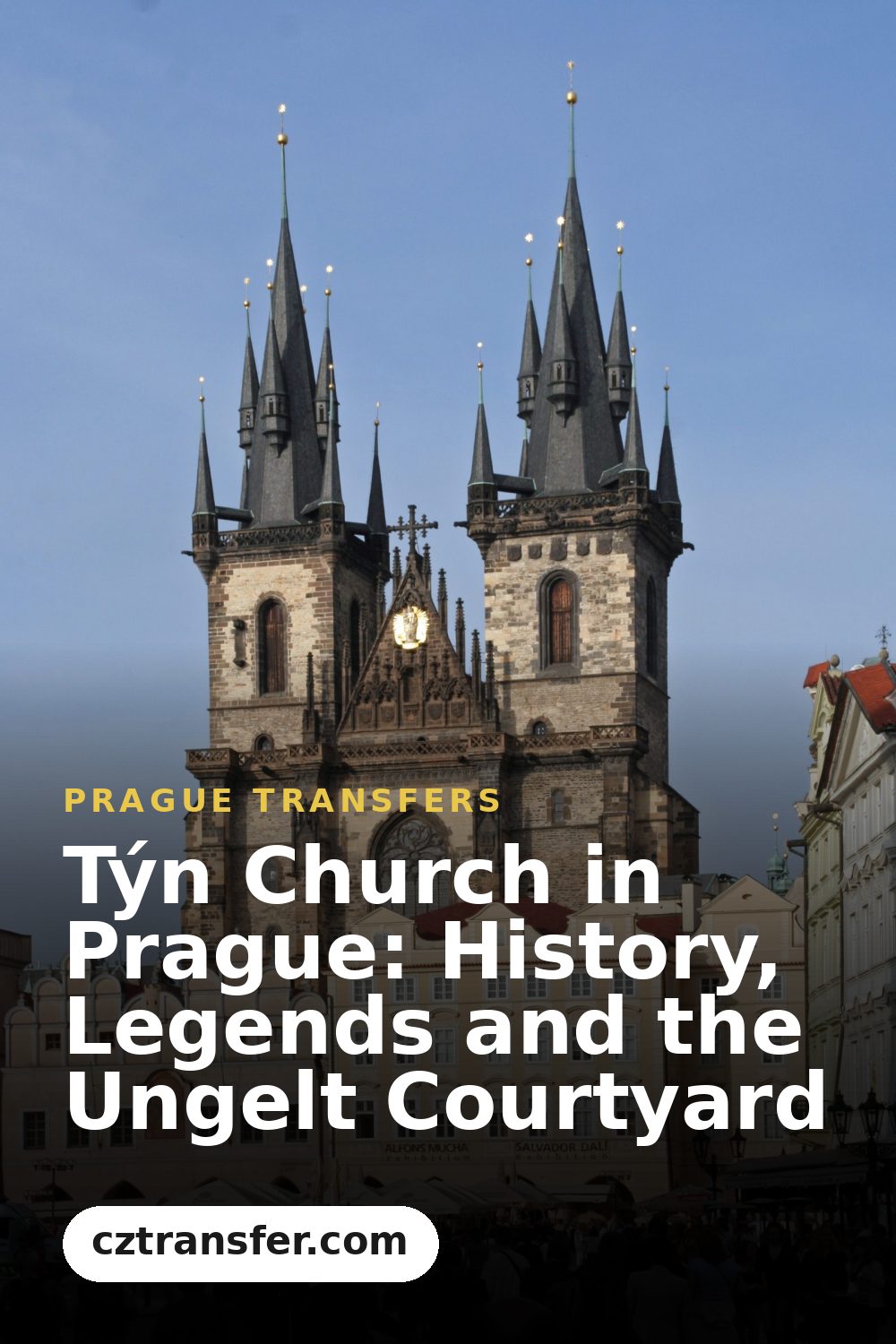
Týn Church in Prague: History, Legends and the Ungelt Courtyard
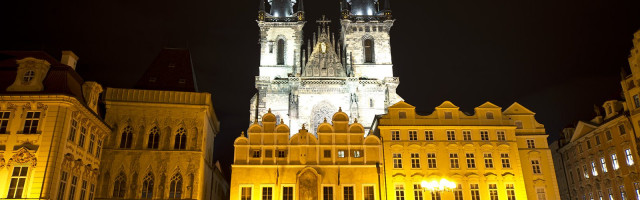
Two dark Gothic spires rising behind the pastel houses of Old Town Square are the picture most people carry home from Prague. They belong to the Church of Our Lady before Týn, the Týn Church. Its story starts not with the church but with a walled yard behind it, where foreign merchants once unloaded their wagons and paid their dues. Here is how the courtyard and the church grew up together, the legends attached to them, and how to visit both on a short walk from the square.
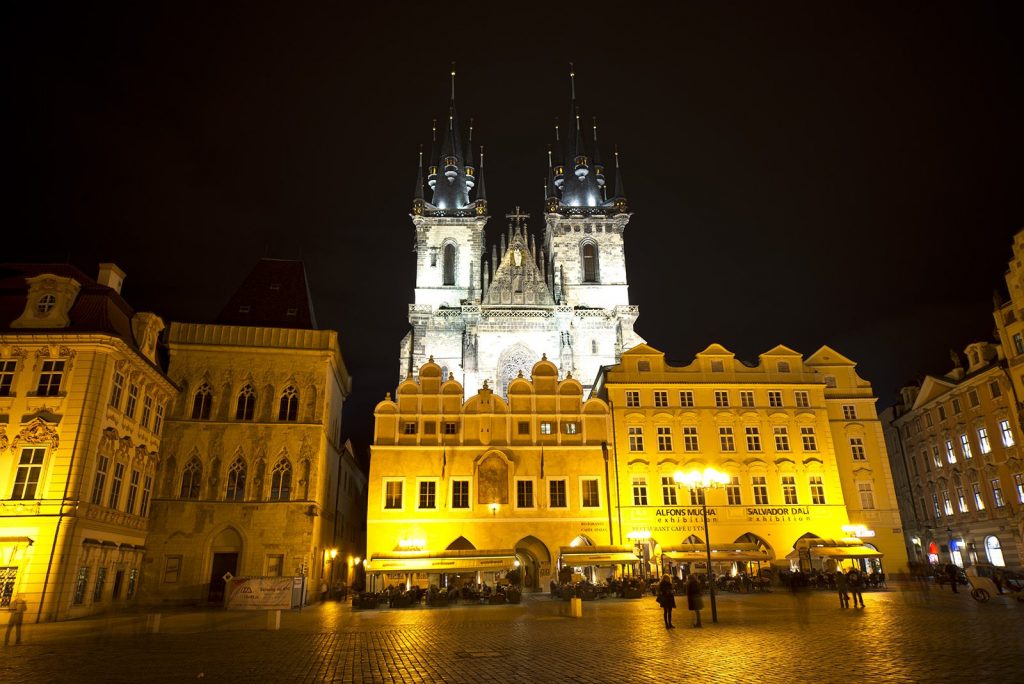
The Týn Church above Old Town Square at night. Photo: Steve Collis / CC BY 2.0
Weather in Prague
Updated 23 Nov, 08:38
Exchange rate
| 1 EUR (Euro) | 24.47 CZK |
| 1 USD (US dollar) | 22.26 CZK |
| 1 GBP (British pound) | 29.21 CZK |
ČNB rate, 20 Nov 2026
Route from Prague Airport to the Týn Church
Ungelt: the merchants’ yard that gave the church its name
In early medieval Prague, a trader arriving from Germany, Italy or the Low Countries could not simply sell his goods in the market. He first had to drive his wagons into a fortified yard just east of the market square, surrounded by a wall and a moat. There the goods were unloaded, stored, counted and taxed, and the merchant paid the duty before he could trade. Visitors are said to have handed in their weapons at the gate.
The old Czech word for an enclosed, fenced-in place is týn, and the yard became the Týn Court (Týnský dvůr). Germans called it after the duty itself, Ungelt, and that name stuck. Written records point to the early 12th century, the time of Prince Bořivoj II, and archaeologists date the yard to roughly the same period. Inside there was more than a customs house: lodgings and stables for the merchants, and a small church with a hospital to care for travellers who fell ill far from home.
The yard did its best business under Charles IV and his son Wenceslas IV, when Prague was the capital of the Holy Roman Empire. Customs were collected here until 1774. By then houses had grown up around the courtyard, and today it is one of the most pleasant corners of the Old Town: a quiet square of restored burghers’ houses, galleries, cafés and small hotels, with the Renaissance Granovský Palace and its painted arcaded loggia on one side.
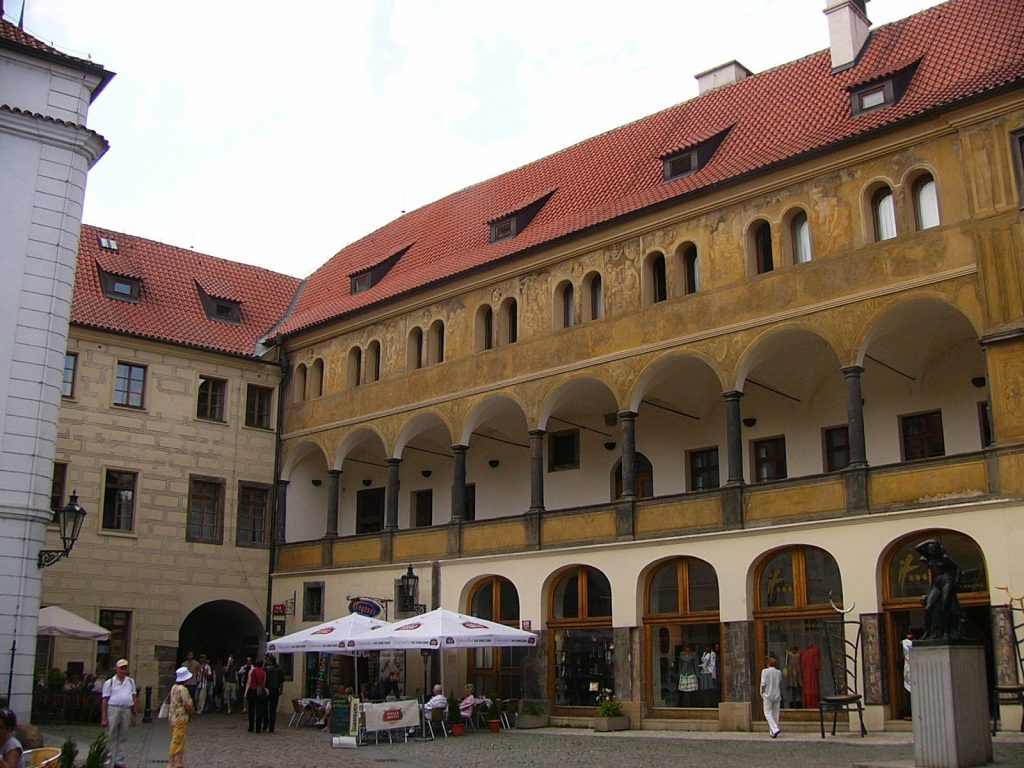
Ungelt, the old customs yard behind the Týn Church. Photo: Jklamo / CC BY-SA 2.5
The courtyard has its own ghost, a Turkish merchant said to wander here at night with a head in a box. We tell his story among the legends and ghosts of old Prague.
How the Týn Church was built
The merchants’ little church stood outside the yard, facing the market, which is why the present building is called the Church of Our Lady before Týn: the church in front of the Týn Court. It grew in three stages over almost five hundred years.
- 11th century A small Romanesque church serves the foreign merchants and the hospital of the Týn Court.
- 13th century It is replaced by an early Gothic church. In the 14th century the reform preachers Konrad Waldhauser and Jan Milíč of Kroměříž draw crowds here, a generation before Jan Hus.
- 14th century Work begins on the present three-aisled Gothic church, paid for by rich Old Town merchants and burghers. Builders from the circle of Charles IV’s cathedral architects, the Parler workshop, work on it.
- 1419–1430s The Hussite wars stop the building. The aisles stand, but the main nave has no vault, and the towers and the gable are unfinished.
- 15th century The Týn Church becomes the main church of the Hussites (Utraquists) in Prague; their elected archbishop Jan Rokycana preaches here. The roof is finished, and the gable between the towers receives a large gilded chalice, the Hussite symbol, in the time of King George of Poděbrady.
- 1511 The south tower is completed, some fifty years after the north one.
- 1620s After the Battle of White Mountain the church returns to the Catholics. The chalice is taken down and melted; in 1626 a statue of the Virgin Mary by Kašpar Bechteler takes its place, with the gold of the chalice in her halo.
- 1679 A great fire ruins the nave. It is rebuilt with a lower Baroque vault, and the interior is refurnished in the Baroque style.
- 1819 Fire strikes again, gutting the north tower and damaging the west gable; the repairs are finished in the second half of the 19th century.
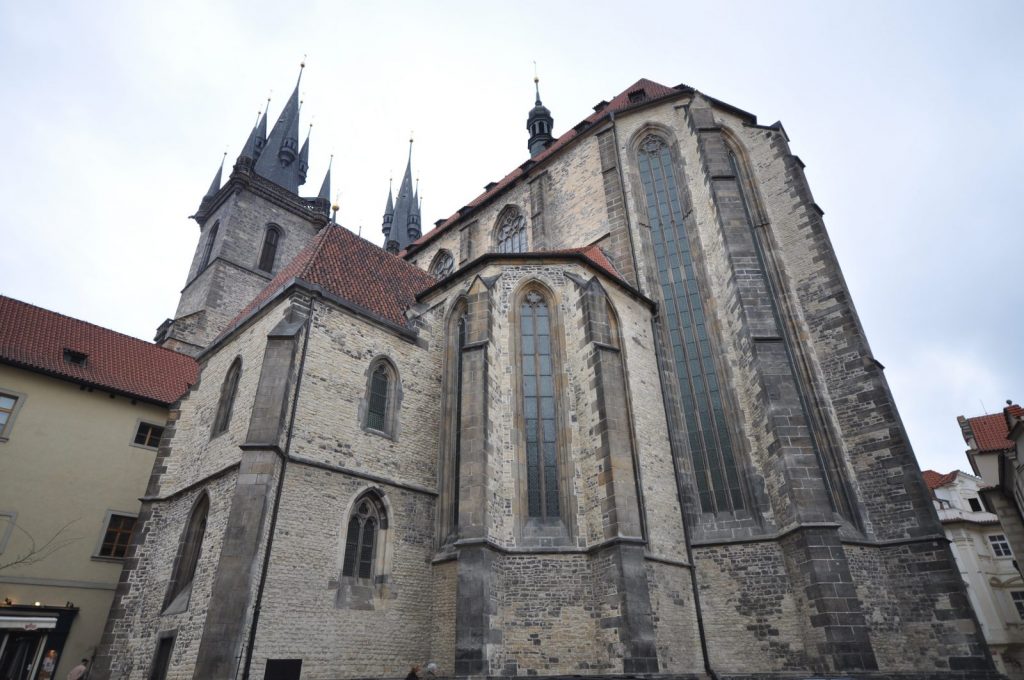
The Gothic body of the church, seen from Týnská Street. Photo: Jorge Láscar / CC BY 2.0
The church is 52 metres long and its nave rises 44 metres. On the north side, in narrow Týnská Street, look for the Gothic portal with a carved scene of Christ’s Passion, made by the Parler workshop around 1390. The one in the street is a copy; the original is in the National Gallery.
Adam and Eve: the two towers
From the square the towers look like twins, both about 80 metres high with a crown of little spires. They are not identical. The south tower, the one on the right as you face the church, is a little broader and about a metre taller, and it is called Adam. The slimmer north tower is Eve. Prague guides like to say that Adam stands on the sunny side to shield Eve; the real reason for the difference is simpler, since the towers were built half a century apart. Gothic builders also liked slightly unequal pairs, and Prague has given them the names of the first man and woman.
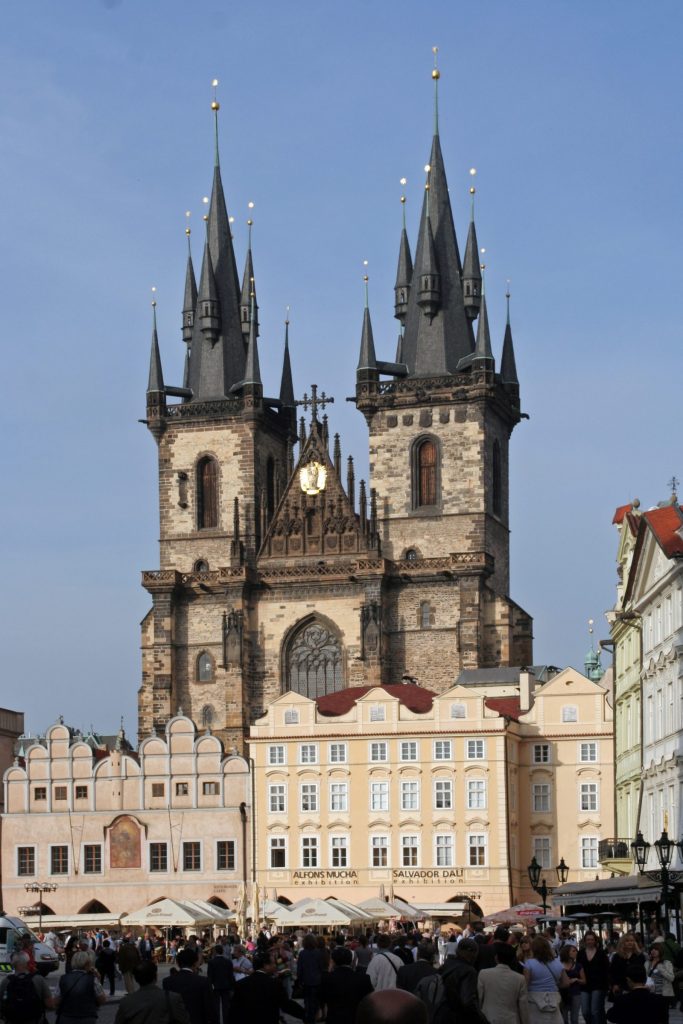
Eve on the left, Adam on the right, with the gable and the Virgin Mary between them. Photo: Tony Hisgett / CC BY 2.0
Notice too that the church has no front door on the square. Its west front is hidden behind a row of houses, the most famous of them the arcaded Týn School. You enter through a narrow passage under the arcades, which is why the church seems to rise straight out of the rooftops.
Legends of the Týn Church
The storks in the chalice
Czech storytellers say that when the great gilded chalice still stood on the gable, a pair of storks built their nest inside it. The birds filled the cup with worms, frogs and snakes, which fell onto the people walking below. The Hussites could not take down their sacred symbol, and the Catholics laughed at them, so once the storks had flown south for the winter the chalice was simply covered with a large board. It is a legend, not a record, but it is a good one to remember when you look up at the Virgin Mary who stands there today.
The timber that went to the gallows
Another story explains why the roof took so long. The timber prepared for vaulting and roofing the nave was used instead to build the gallows for the Hussite captain Jan Roháč of Dubá, executed in 1437. The roof was finished only about twenty years later.
Tycho Brahe’s toothache cure
The Danish astronomer Tycho Brahe worked for Emperor Rudolf II in Prague and died here in 1601. He is buried in the Týn Church, and his red marble tombstone with his armoured figure is on a pillar near the main altar. Locals used to say that touching the stone face on his right cheek would cure toothache.
The heart of a king
King George of Poděbrady, the only Hussite king of Bohemia, is buried with the other kings at Prague Castle. A legend says that his heart was laid to rest in the Týn Church, the church of his faith.
The Jewish boy buried in the Týn Church
One of the graves in the church tells a darker story. Šimon Abeles was a twelve-year-old boy from Prague’s Jewish Town who died in February 1694. A Jesuit account published soon afterwards claimed that he had wanted to become a Christian and that his father, Lazar Abeles, had killed him for it; the father was arrested and died in prison. Although the boy had never been baptised, he was given a lavish funeral and buried as a martyr in the Týn Church on 31 March 1694, with a procession through the Old Town.
Historians treat the Jesuit version as one-sided: other accounts describe a beating and a fall, and the case was used against Prague’s Jewish community for years. His tomb is still in the church. The Jewish Museum in Prague tells the story from the other side, and it is a short walk away.
The Jewish Quarter, five minutes away
From the north side of Old Town Square, the elegant Pařížská Street leads in five minutes to Josefov, the former Jewish Town. Its houses were rebuilt around 1900, but six synagogues, the Jewish Town Hall and the Old Jewish Cemetery survive. The Old-New Synagogue, built in the 13th century, is the oldest synagogue in Europe still used for worship, and the home of the legend of the Golem. Most of the sites belong to the Jewish Museum and share one ticket; they are closed on Saturdays and Jewish holidays.
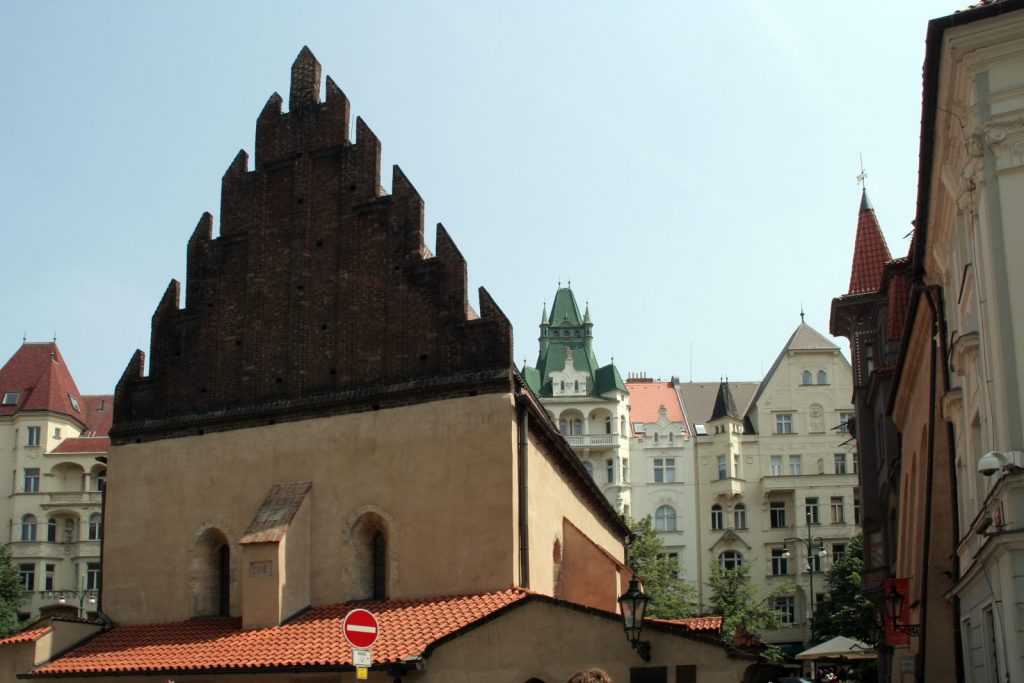
The Old-New Synagogue in Josefov. Photo: Tony Hisgett / CC BY 2.0
What else to see on and around Old Town Square
- The astronomical clock. Built in 1410 on the Old Town Hall, it is the oldest astronomical clock in the world still working. Every hour during the day the twelve apostles appear in its windows.
- The Old Town Hall tower. The lift takes you up to a gallery with the best view of the Týn towers and the square below.
- The Jan Hus memorial. Unveiled in 1915, five hundred years after the reformer was burned at the stake in Constance.
- St Nicholas Church. The white Baroque church on the corner of the square, designed by Kilián Ignác Dientzenhofer and often used for concerts.
- The 27 crosses. Set into the pavement by the Old Town Hall, they mark the execution of 27 leaders of the Bohemian uprising in 1621. Heads of twelve of them were displayed on the Old Town Bridge Tower for ten years.
- Kinsky Palace and the House at the Stone Bell. A Rococo palace and a rare Gothic town house, both used by the Prague City Gallery and the National Gallery for exhibitions.
- The Marian Column. Pulled down in 1918 and put back up in 2020, it stands between the Hus memorial and the Old Town Hall.
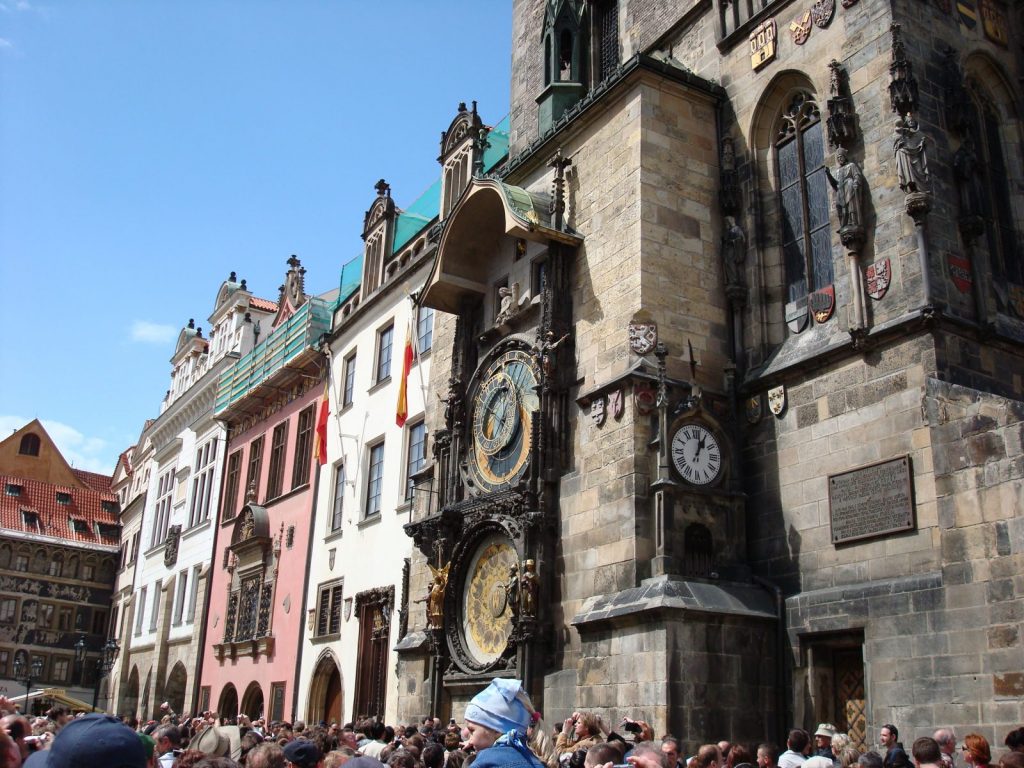
The astronomical clock on the Old Town Hall. Photo: Everythingandrobots / public domain
From late November to early January the square fills with Prague’s best-known Christmas market, with the Týn towers lit up behind the tree: see Christmas in Prague. To walk the whole Old Town with a free audio guide, follow our Prague walking tour in 14 stops.
Visiting the Týn Church
- Entrance: from Old Town Square, through the passage under the arcades of the Týn School, between the restaurants.
- Opening hours: usually Tuesday to Saturday 10:00–13:00 and 15:00–17:00, Sunday 10:30–12:00, closed on Mondays. Hours change in winter and on holidays, and visits stop during services, so check tyn.cz before you go.
- Admission: free, with a voluntary donation at the door.
- Inside: look for the pewter baptismal font from 1414, the oldest in Prague; Karel Škréta’s paintings on the main altar; the tombstone of Tycho Brahe; and the organ, the oldest in Prague, restored in 2000. Photography is usually not allowed.
- Concerts: the church often hosts evening concerts of organ and choral music, the easiest way to hear the organ.
Flying in? Old Town Square is about 30 minutes from Václav Havel Airport. A pre-booked taxi from Prague Airport to any hotel in the centre costs €30 for the whole car, fixed before you fly. The driver meets you in the arrivals hall with a name board and tracks your flight. The square itself is closed to cars, so we stop at the nearest street a car may enter and help with your bags.
Book your Prague Airport taxi →
Want to see the city on the way? Our airport transfer through the historic centre drives past Prague Castle and the river and ends on Old Town Square, in front of the Týn towers.
On the way home, the same car and the same €30 take you from your hotel to the right terminal: book Prague → Prague Airport →
Frequently asked questions
Why is it called the Church of Our Lady before Týn?
Because it stands in front of the Týn Court, the walled merchants’ yard behind it, also called Ungelt. Týn is an old Czech word for an enclosed, fenced-in place.
What are the Adam and Eve towers?
They are the two 80-metre towers of the Týn Church. The broader south tower, about a metre taller, is called Adam; the slimmer north tower is Eve.
Is Tycho Brahe really buried in the Týn Church?
Yes. The Danish astronomer died in Prague in 1601 and is buried in the church. His tombstone with a carved figure in armour is on a pillar near the main altar.
How do I get into the Týn Church?
From Old Town Square, through the narrow passage under the arcades of the Týn School, the house that stands in front of the church. Entry is free, with a voluntary donation.
What is Ungelt in Prague?
Ungelt is the medieval courtyard behind the Týn Church where foreign merchants stored their goods and paid customs duty. Today it is a quiet square with shops, galleries and cafés.
How do I get from Prague Airport to the Týn Church?
By taxi it takes about 30 minutes. A pre-booked car from Prague Airport to the Old Town costs €30 for the whole car, and the driver drops you at the nearest street open to cars, a few minutes’ walk from the church.