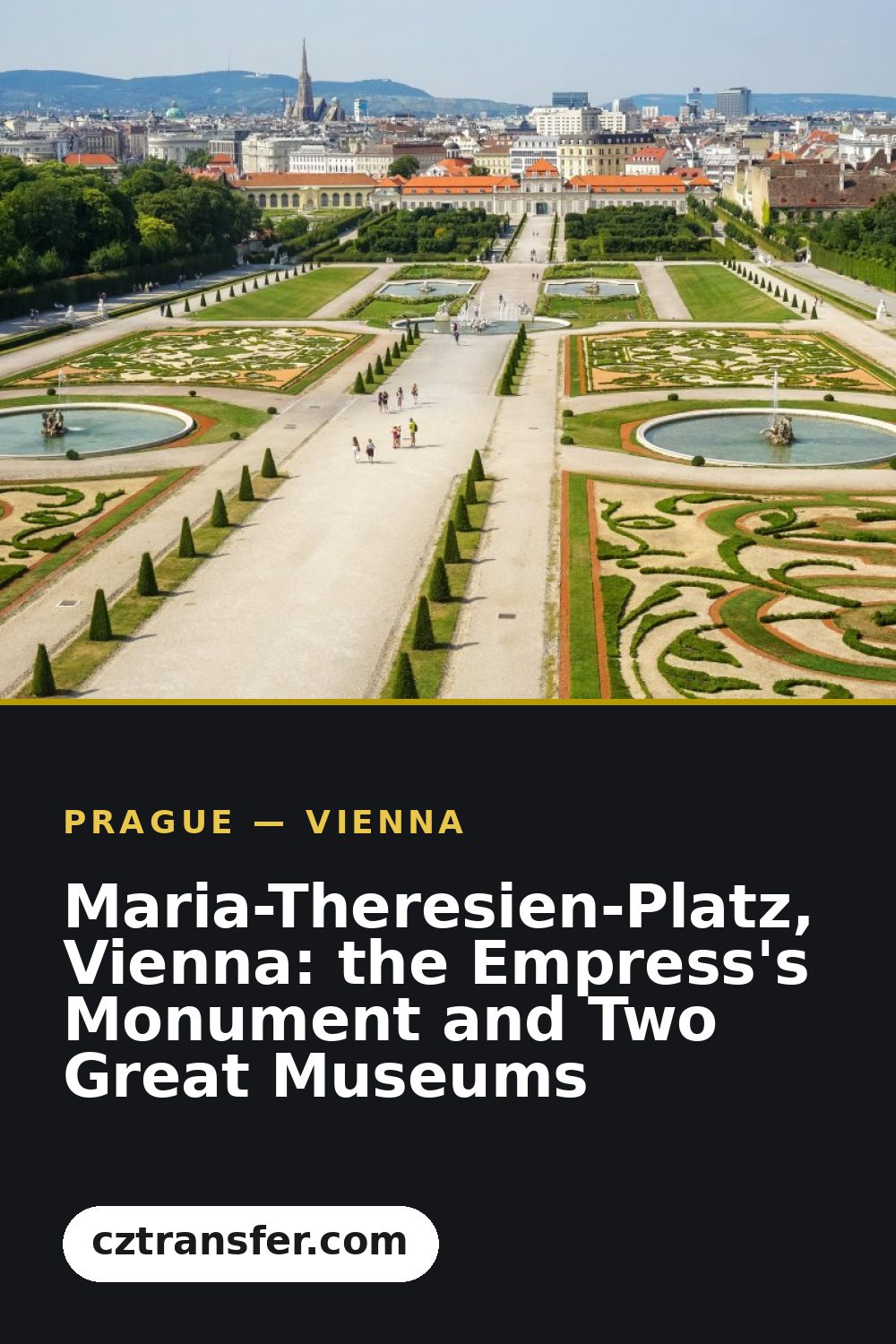
Maria-Theresien-Platz, Vienna: the Empress's Monument and Two Great Museums
How you can pay
- Cash to the driver — euros, Czech crowns, US dollars or pounds sterling
- Card to the driver, contactless — Visa, Mastercard, Maestro, American Express, or pay by phone
- Card or PayPal online, before the trip — Visa, Mastercard, American Express; the payment processor adds a 6% fee
- Crypto, before the trip — USDT (TRC-20) or Bitcoin
Payment details · no deposit, pay at the end of the trip if you like
If you have just arrived in Vienna by transfer from Prague, or you have come for a single day, there is one square where the imperial capital fits into a few hundred metres. Maria-Theresien-Platz sits on the Ringstrasse, right in the centre: the great monument to Empress Maria Theresa stands in the middle, and on either side of it rise two palaces built as twins — the Kunsthistorisches Museum, with one of the finest collections of paintings in the world, and the Natural History Museum. Across the Ring is the Hofburg; behind the square is the MuseumsQuartier. You can see all of it without a single tram ride.
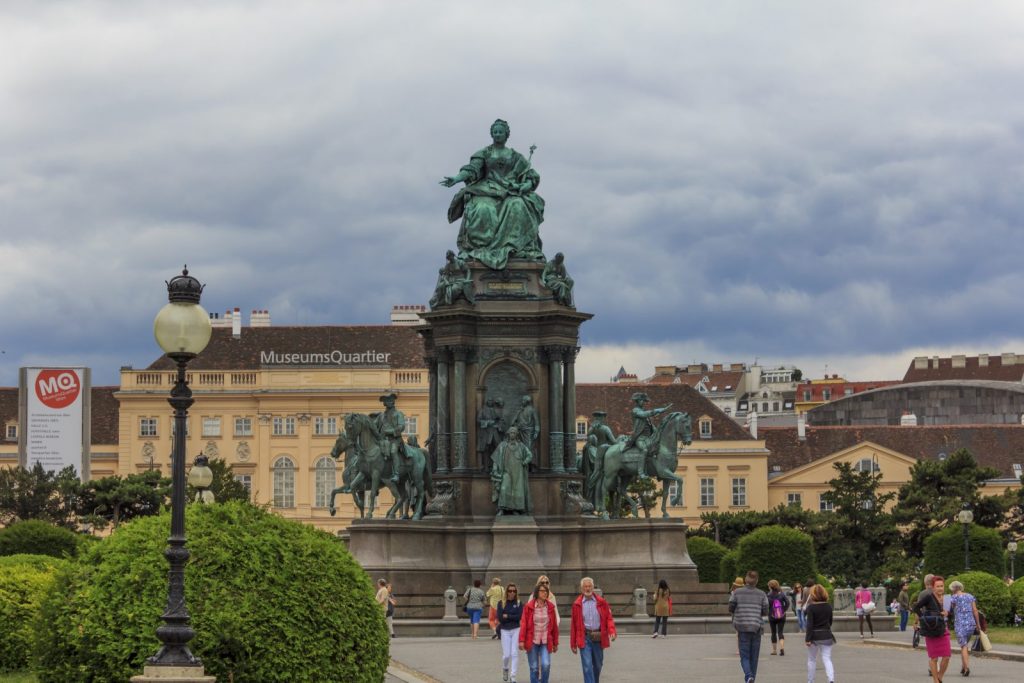
The Maria Theresa Monument, with the MuseumsQuartier behind it. Photo: Perituss, CC0
Maria Theresa: the woman on the pedestal
Maria Theresa (1717–1780) was never meant to rule. She inherited the Habsburg lands at 23 because her father, Emperor Charles VI, had no surviving son, and he spent years persuading Europe to accept a document called the Pragmatic Sanction, which let a daughter succeed him. When he died in 1740, most of Europe ignored it. Prussia seized Silesia within weeks, and Bavaria, France and Saxony joined in. A young woman with no training in government and a treasury that was nearly empty was expected to lose everything.
She lost Silesia and kept the rest. Over eight years of war she won over the Hungarian nobility, rebuilt the army and had herself crowned Queen of Hungary in Pressburg and Queen of Bohemia in St Vitus Cathedral in Prague, in 1743. Her husband, Francis Stephen of Lorraine, was elected Holy Roman Emperor in 1745, but nobody at the time doubted who was running the empire.
What makes her remarkable is what she did once the fighting stopped. She turned a patchwork of crowns into a state that could actually be governed:
- Administration. With Count Haugwitz she centralised taxation and the civil service, so that the nobility paid tax and the army was paid regularly.
- Schools. Her General School Ordinance of 1774 made primary education compulsory for boys and girls — one of the first such laws in Europe.
- Law. She codified criminal law and, in 1776, abolished judicial torture in her hereditary lands.
- Medicine. After smallpox killed and scarred members of her own family, she had her children inoculated and promoted inoculation across the empire. Her physician Gerard van Swieten reformed the medical faculty of the University of Vienna.
She also had sixteen children, among them two emperors, Joseph II and Leopold II, and Marie Antoinette, Queen of France. She reigned for forty years, and Schönbrunn as it looks today is largely her doing. Austrians still call her simply «the Empress», although strictly she was empress only by marriage; her own crowns were those of Hungary and Bohemia.
The monument
Emperor Franz Joseph unveiled the monument on 13 May 1888, the 171st anniversary of her birth. Designed by the architect Carl von Hasenauer, with every bronze by the sculptor Caspar von Zumbusch, it took about thirteen years to make and stands 19.36 metres high. The Empress alone is six metres tall.
She sits enthroned at the top, holding the sceptre and the Pragmatic Sanction in her left hand and greeting her people with her right. Below her the monument is a portrait of her whole reign, 24 named figures in all:
- Four field marshals on horseback at the corners: Daun, Laudon, Khevenhüller and Traun.
- Four standing statues for the pillars of her state: Chancellor Kaunitz for diplomacy, Haugwitz for administration, Prince Joseph Wenzel of Liechtenstein for the army and Gerard van Swieten for science and the arts.
- Reliefs of her advisers, officials and generals, and of the composers Gluck and Haydn — with Mozart beside them as a child. Look for him: it is the detail most visitors miss.
Four allegorical figures at her feet stand for Justice, Strength, Mercy and Wisdom.
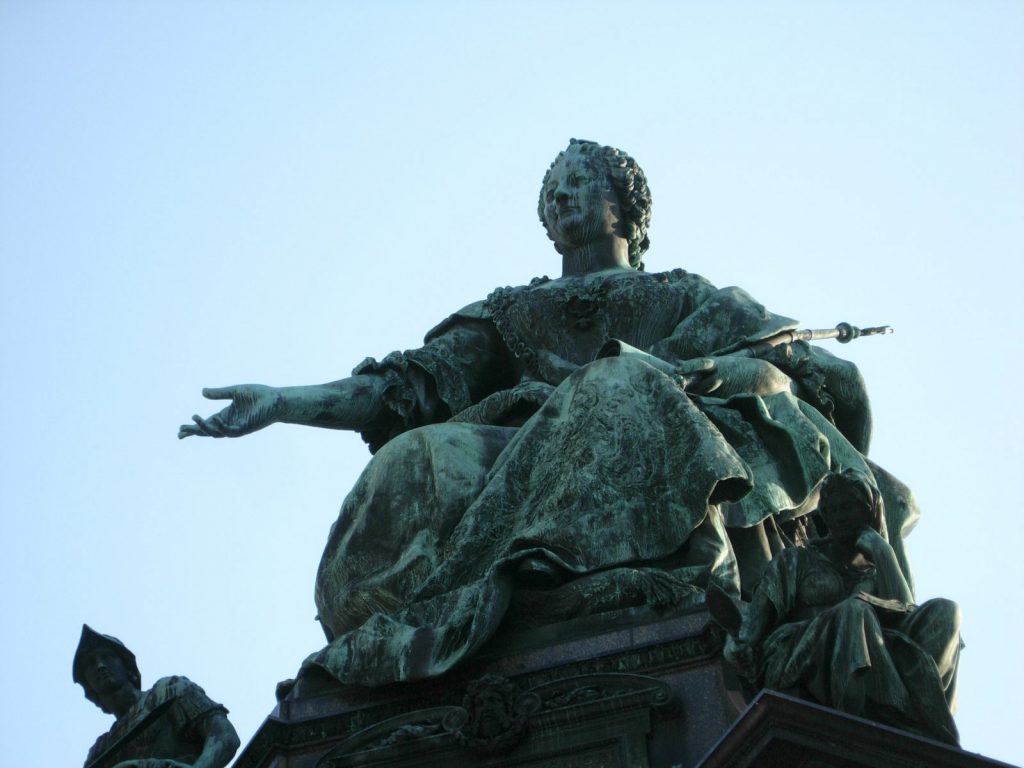
The Empress greets the square with her right hand. Photo: Acediscovery, CC BY 4.0
The Kunsthistorisches Museum (Museum of Fine Arts)
The building on your right as you look from the MuseumsQuartier towards the Ring is the Kunsthistorisches Museum, designed by Gottfried Semper and Carl von Hasenauer and opened in 1891 to house the collections the Habsburgs had gathered over four centuries. The building itself is part of the visit: the grand staircase, the marble and the octagonal cupola hall, where there is a café under the dome.
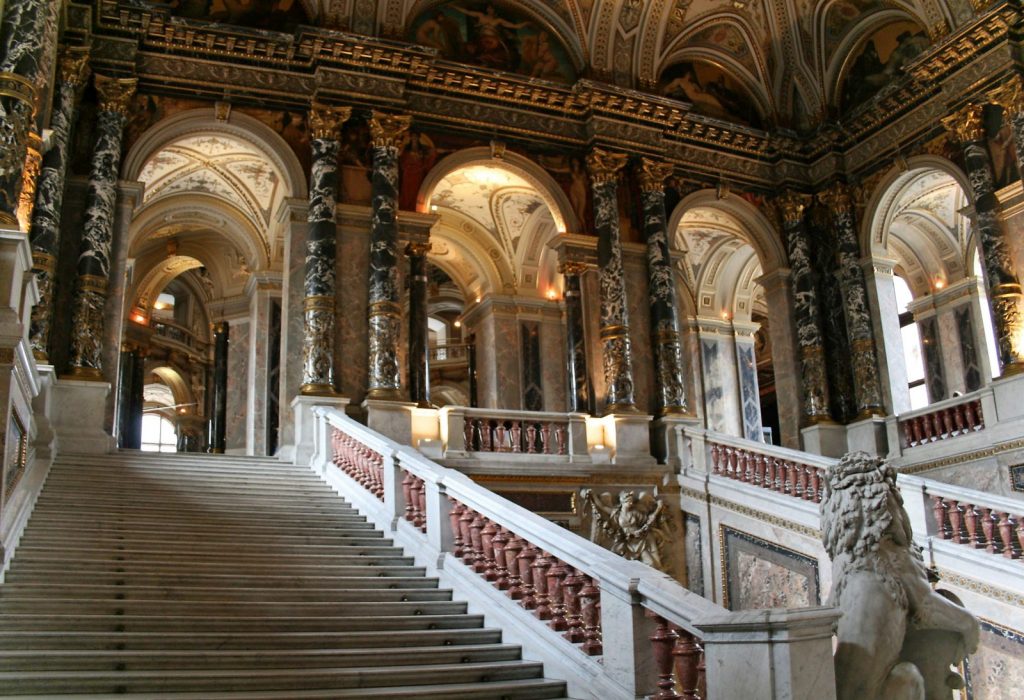
The grand staircase of the Kunsthistorisches Museum. Photo: Pe-sa, public domain
The Picture Gallery is the reason most people come. It holds twelve paintings by Pieter Bruegel the Elder — the largest group of his work anywhere — including Hunters in the Snow, The Tower of Babel and Peasant Wedding. Near them hang Vermeer’s The Art of Painting, Raphael’s Madonna of the Meadow, Velázquez’s portraits of the Infanta Margarita, Arcimboldo’s Summer, and rooms of Titian, Rubens and Rembrandt.
The Kunstkammer is the Habsburg cabinet of curiosities: clocks, automata, carved ivory, rock crystal and Benvenuto Cellini’s gold salt cellar, the Saliera.
The Egyptian and Near Eastern Collection, the Greek and Roman antiquities and the Coin Cabinet fill the rest of the building.
On the way up the staircase, look at the walls between the arches. The paintings there are by Hans Makart and by the young Gustav Klimt, his brother Ernst and Franz Matsch — Klimt’s work from before he became Klimt.
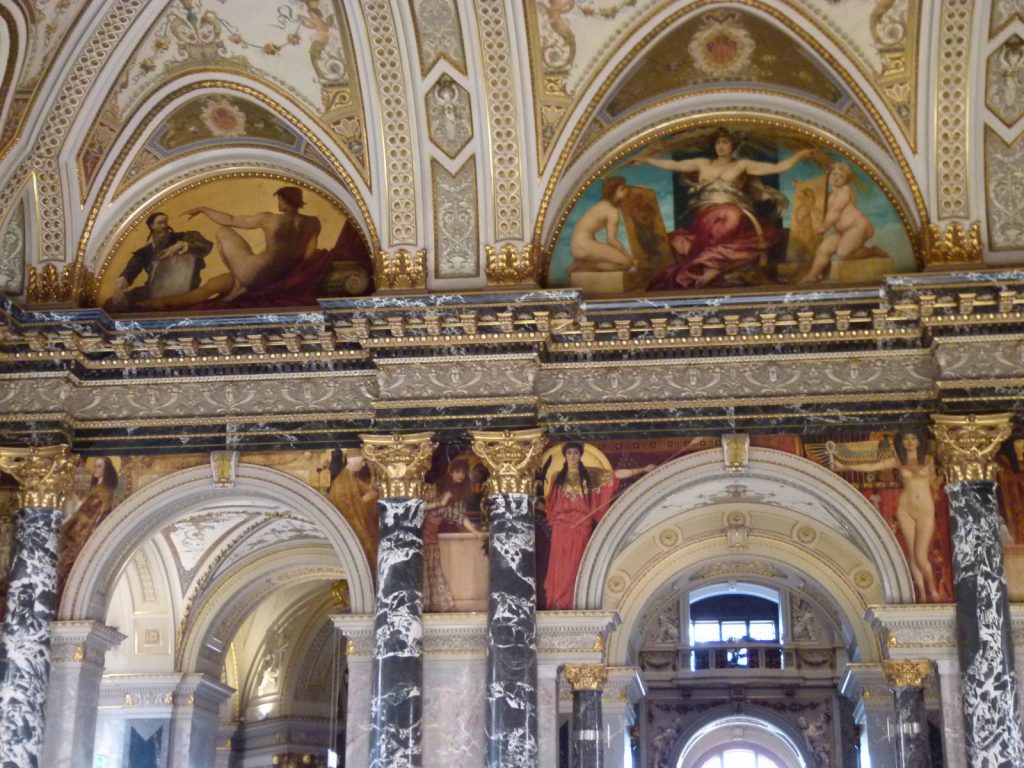
Staircase paintings by Hans Makart and the young Gustav Klimt. Photo: Wikimedia Commons, CC0
The Natural History Museum
Its twin across the square opened two years earlier, in 1889, and is just as grand inside: an imperial palace built for minerals, fossils and stuffed animals, many of them still in their original nineteenth-century cases.
- The Venus of Willendorf. A limestone figure eleven centimetres tall, about 29,500 years old, found in the Wachau valley in 1908. She has a small dark room of her own.
- The meteorite hall. The oldest meteorite collection in the world and the largest on public display.
- The dinosaur hall, with skeletons and a life-size moving Allosaurus.
- Minerals and gems, including the jewel bouquet that Maria Theresa gave to her husband, made of more than two thousand precious stones — a good link back to the woman outside.
It is the better choice of the two with children, and visitors under 19 get in free at both.
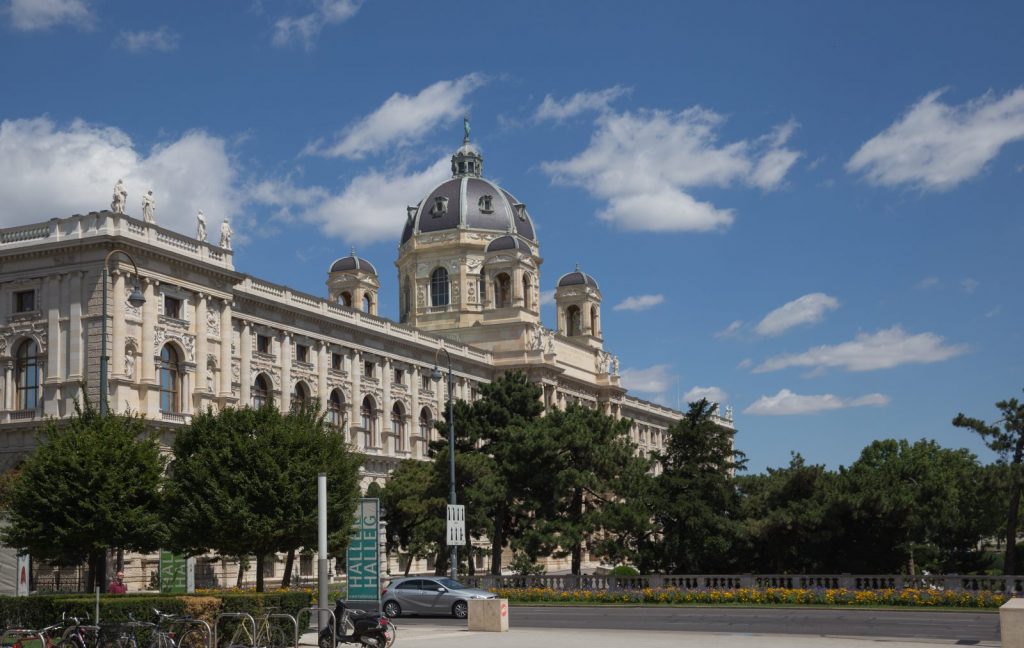
The Natural History Museum, seen from the MuseumsQuartier. Photo: Hubertl, public domain
Opening hours and tickets
| Kunsthistorisches Museum | Natural History Museum | |
|---|---|---|
| Open | Daily 10:00–18:00, Thursday until 21:00 | 9:00–18:00, Wednesday until 20:00; closed Tuesday |
| Adult ticket | €22 online, €24 at the desk | €18 |
| Under 19 | Free | Free |
| Good to know | Since September 2026 entry is by timed slot: book online before you go | Last entry 30 minutes before closing |
Prices and hours as published by the museums in November 2026. The monument and the square are free and open at all hours.
How to fit it into your day
Everything here is a few minutes’ walk apart, so the question is only how much time you give the museums.
- Half a day: twenty minutes at the monument, then two to three hours in one museum — the Picture Gallery if you love painting, the Natural History Museum if you have children with you.
- A full day: one museum in the morning, lunch in the MuseumsQuartier, the other museum in the afternoon. On Thursday the Kunsthistorisches Museum stays open until nine, which makes an evening visit easy.
- On a day trip from Prague: you have about six hours in Vienna, so choose one museum and spend the rest of the time at the Hofburg and St Stephen’s Cathedral, both within fifteen minutes on foot. Avoid Tuesday if the Natural History Museum is on your list.
From mid-November until Christmas a Christmas village is usually set up on the square between the two museums.
Getting there from Prague
The square is on the Burgring, on tram lines 1, 2 and D (stop Burgring) and a short walk from the U3 station Volkstheater. Coming by car from Prague, the drive is about four hours, and the driver can set you down by the museums.
Taxi and private transfer from Prague to Vienna — €350 per car, to any address in Vienna, vignettes included, one stop on the way free. See the transfer
Day trip from Prague to Vienna — from €370 per car: the driver brings you to Vienna in the morning and takes you back to Prague in the evening. See the day trip
Flying into Prague first? Taxi from Prague Airport to your hotel, €30 · Going home from Vienna: Vienna to Prague, €350
Frequently asked questions
Where exactly is the Maria Theresa Monument?
In the middle of Maria-Theresien-Platz in Vienna’s first district, on the Ringstrasse opposite the Hofburg, between the Kunsthistorisches Museum and the Natural History Museum.
Who are the figures around Maria Theresa?
Her field marshals Daun, Laudon, Khevenhüller and Traun on horseback, her ministers Kaunitz and Haugwitz, Prince Liechtenstein and her physician van Swieten standing, and in the reliefs her officials and generals together with Gluck, Haydn and the child Mozart.
Can I see both museums in one day?
Yes, if you are staying in Vienna: give each two to three hours with a break in between. On a day trip from Prague there is realistically time for one museum, plus a walk to the Hofburg and St Stephen’s Cathedral.
Do I need to book museum tickets in advance?
For the Kunsthistorisches Museum, yes: since September 2026 entry is by timed slot, and booking online is also cheaper. The Natural History Museum sells tickets at the door.
How far is it from Prague, and how do I get there?
Prague to Vienna is about 330 km, roughly four hours by car with one stop. A private transfer costs €350 per car and drops you at your hotel or right by the museums; a day trip with the return journey costs from €370.