Munich Free Audio Guide and Walking Tour in 9 Stops
Munich, the capital of Bavaria, is about four hours from Prague, so a day trip leaves you a few hours in the city — just enough for its old centre, if you use them well. Luckily, that centre is compact. This page is a free audio guide to it in English, written out and read aloud: nine stops from the Karlstor to the Odeonsplatz, about 2.5 km and two and a half to three and a half hours with a beer-hall lunch. Keep the page open on your phone and play or read each stop as you reach it. The walk costs nothing; you pay only for what you go into.
Listen to the audio guide — each stop below has its own track, about a minute long. Start with the introduction:
Or download the whole tour as one MP3 (7 minutes, 3 MB) and listen to it in the car on the way, or offline in Munich.
€370 car, up to 4 · €380 minivan, up to 8
Private day trip from your Prague hotel to Munich and back
- Pick-up at your hotel or apartment in Prague, at the time you choose — the earlier, the more time in Munich
- About four hours to Munich; the driver drops you at the Karlstor, the start of this walk
- The driver waits while you walk, visit and have lunch
- The driver collects you at the Odeonsplatz, the end of the walk, and takes you back to your hotel in Prague the same night
- Price for the whole car and a twelve-hour day, not per person: fuel, tolls, motorway vignettes, parking, waiting and child seats included. A longer day is priced when you book
Tell us the date, your hotel in Prague, when you would like to leave and how many of you there are — we confirm the car and the price in writing. +420 773 477 799 (WhatsApp, Viber, Telegram) · cz@cztransfer.com · more about the day trip
Order
How you can pay
- Cash to the driver — euros, Czech crowns, US dollars or pounds sterling
- Card to the driver, contactless — Visa, Mastercard, Maestro, American Express, or pay by phone
- Card or PayPal online, before the trip — Visa, Mastercard, American Express; the payment processor adds a 6% fee
- Crypto, before the trip — USDT (TRC-20) or Bitcoin
Payment details · no deposit, pay at the end of the trip if you like
Before you set off
- The day: twelve hours with eight of them in the car leaves about four hours in Munich. Leave Prague at five or six in the morning for a longer, fourteen-hour day
- Distance: about 2.5 km, flat, all inside the old town and largely pedestrian
- Passports: Munich is in Germany. Both countries are in Schengen, but Germany runs checks at its land borders, so every passenger needs a passport or national ID card
- Timing: the Glockenspiel on the New Town Hall plays at 11 am and noon, and from March to October also at 5 pm. Plan to be on the Marienplatz for one of them
- Free: all the squares, the Frauenkirche, St Michael’s and the Theatine Church, the Viktualienmarkt and the Hofbräuhaus, unless you order something
- Paid: the tower of St Peter’s, the Residenz and its Treasury, and the royal crypt in St Michael’s
- Not today: Neuschwanstein is two hours beyond Munich, and Nymphenburg Palace and the big museums are a day of their own
- In Advent: from the end of November until Christmas Eve, the walk passes the Christkindlmarkt on the Marienplatz, with the city’s Christmas tree, and smaller markets in the Residenz courtyard and on the Wittelsbacherplatz by the Odeonsplatz
- Map: open the route in Google Maps
Munich was badly damaged in the Second World War, but unlike many German cities it chose to rebuild its old centre as it had been. Most of what you see on this walk is a careful reconstruction of the city of the Bavarian dukes and kings.
Route map
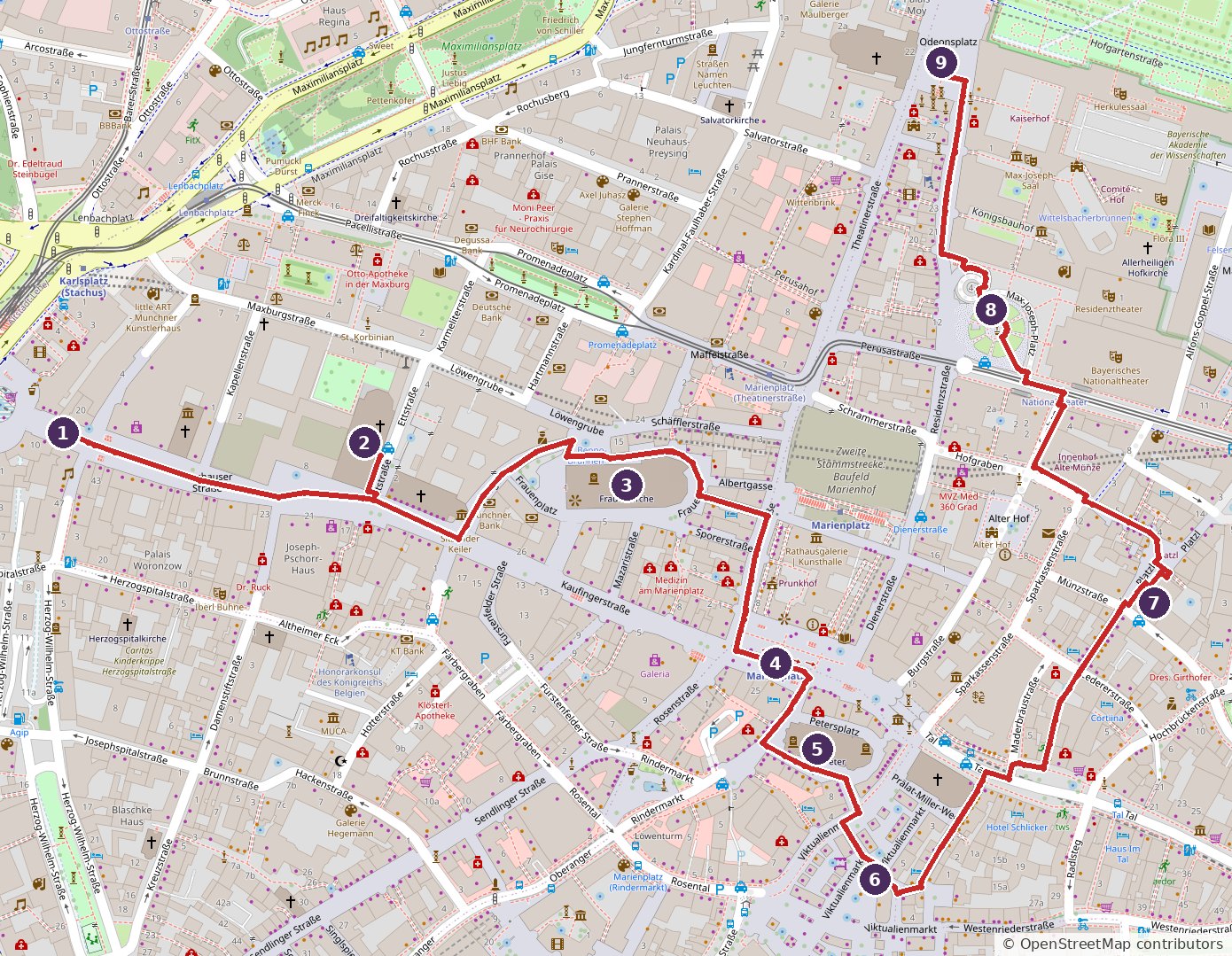
1 the Karlstor · 2 St Michael’s Church · 3 the Frauenkirche · 4 the Marienplatz and the New Town Hall · 5 St Peter’s Church · 6 the Viktualienmarkt · 7 the Hofbräuhaus · 8 Max-Joseph-Platz and the Residenz · 9 the Odeonsplatz and the Feldherrnhalle. Tap the map to open it full size. Map data © OpenStreetMap contributors.
1. The Karlstor
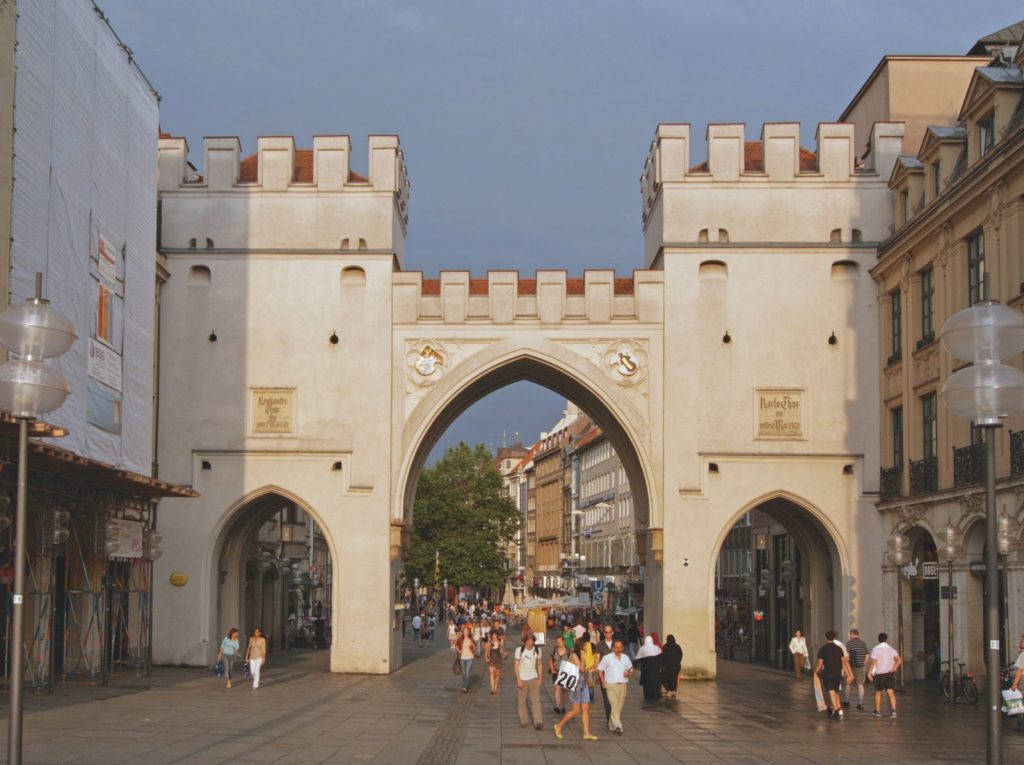
The Karlstor, the old city gate at the start of the pedestrian zone. Photo: Jensens / public domain
Welcome to Munich. You are at the Karlstor, one of the old gates of the medieval city wall. Behind you is Karlsplatz, which every local calls the Stachus, after an inn that once stood here. In front of you, through the gate, the old town begins.
Walk through the gate into Neuhauser Straße. This long pedestrian street, which becomes Kaufingerstraße further on, was the main road from the west into the city for centuries. Today it is Munich’s busiest shopping street.
2. St Michael’s Church
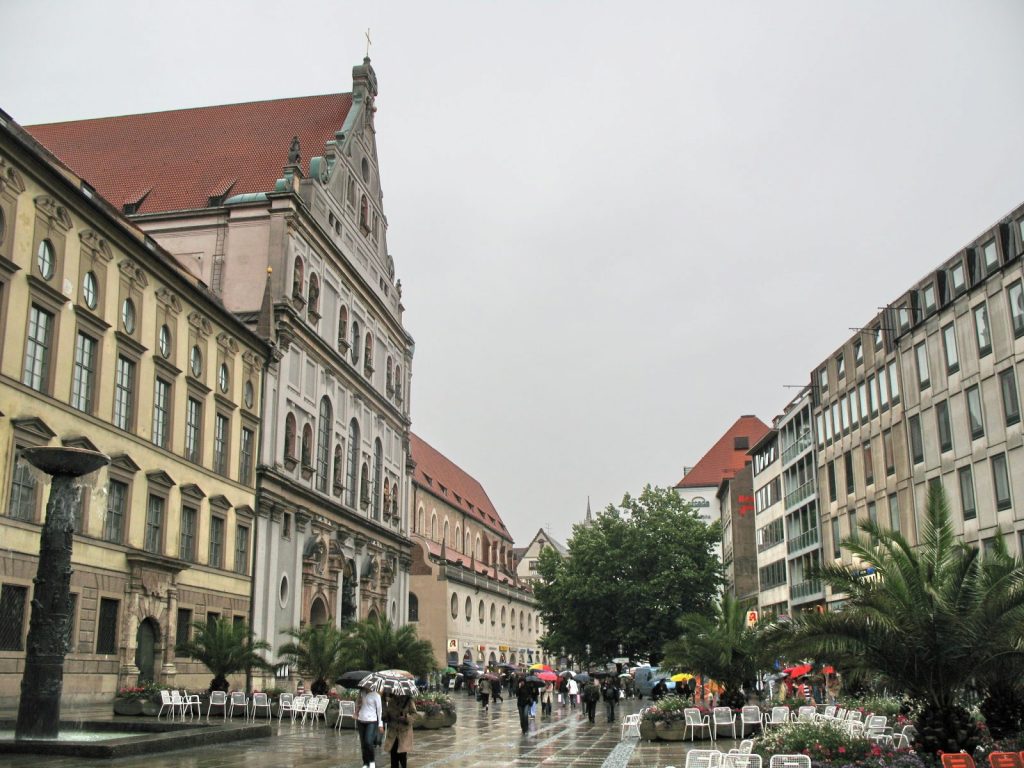
St Michael’s Church, its Renaissance front on Neuhauser Straße. Photo: Andrew Bossi / CC BY-SA 2.5
On your left, with a white front full of statues of rulers, is St Michael’s Church. It was built by the Jesuits from 1583, under Duke Wilhelm the Fifth, and it is the largest Renaissance church north of the Alps. Look for the bronze statue of St Michael fighting the devil between the two doors.
Inside, the huge barrel vault was one of the largest in the world when it was built. In the crypt below lie members of the Wittelsbach family, the dukes and kings of Bavaria, among them King Ludwig the Second, the «fairy-tale king» who built Neuschwanstein. Entry to the church is free; the crypt has a small charge.
3. The Frauenkirche
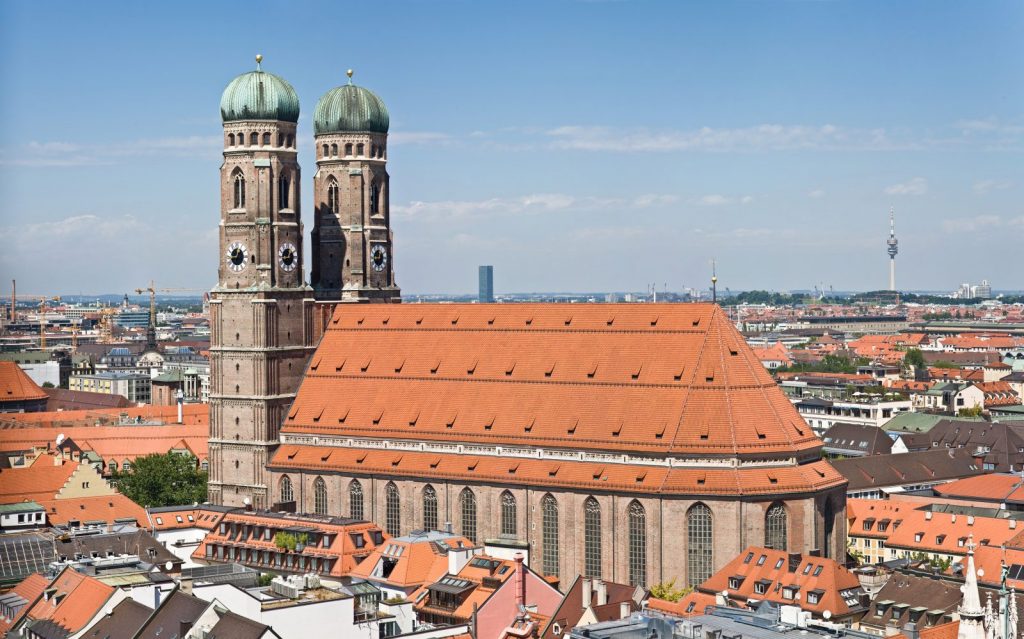
Turn left and walk up to the Frauenkirche, the Cathedral of Our Lady, with its two brick towers and their green onion domes — the symbol of Munich. The church was built in just twenty years, from 1468 to 1488; the domes were added a few decades later.
The towers are almost 100 metres high, and Munich takes them seriously. In 2004 the people of the city voted that new high-rise buildings in the city should stay lower than them.
Go inside and look for a black footprint in the floor of the entrance hall: the Devil’s Footprint. Legend says the devil stood here, saw a church with no windows, and laughed — because from this spot the pillars hide all the windows. Entry is free.
4. The Marienplatz and the New Town Hall
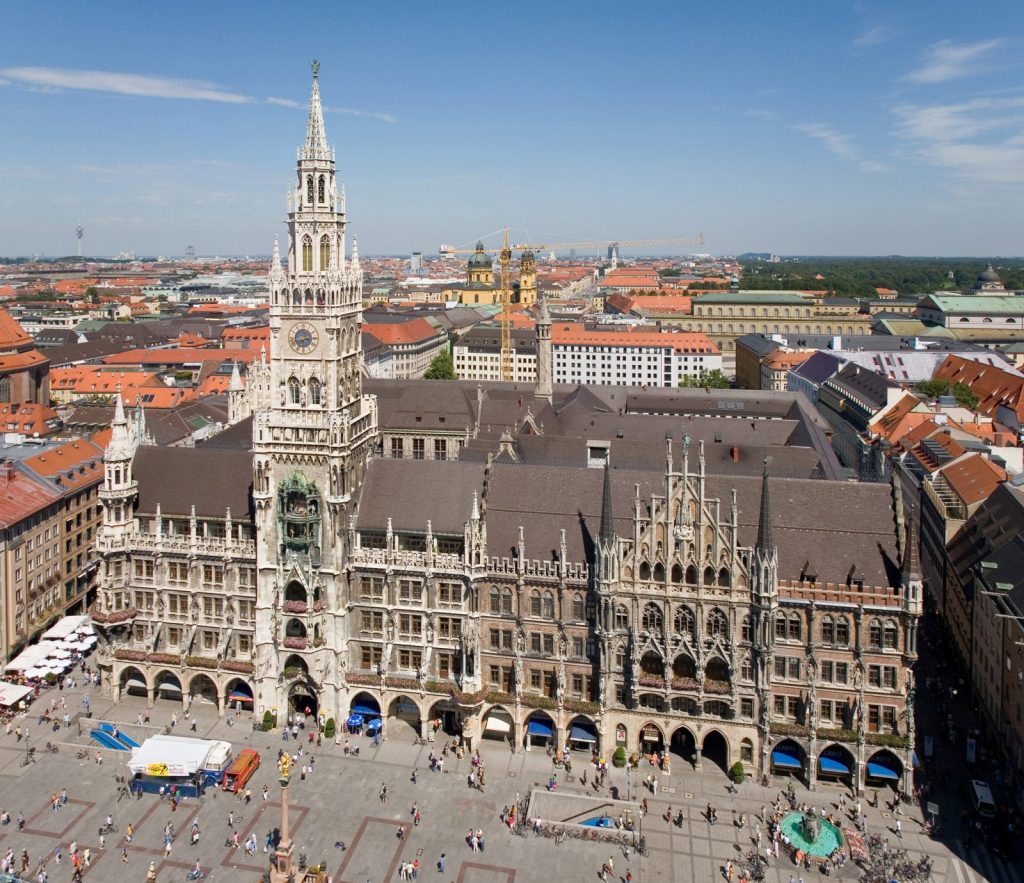
The New Town Hall and its Glockenspiel above Marienplatz. Photo: Diliff / CC BY-SA 3.0
Walk on to the Marienplatz, the main square of Munich since the city was founded. The Column of Mary in the middle was set up in 1638, in thanks that the city had survived the Swedish occupation in the Thirty Years’ War.
The whole north side is filled by the New Town Hall, a neo-Gothic building finished at the start of the 20th century. Its tower holds the famous Glockenspiel, with dozens of bells and life-size figures. At 11 am and at noon, and from March to October also at 5 pm, it plays two scenes: a knights’ tournament for a ducal wedding in 1568, and below it the coopers’ dance, which, legend says, brought the people back onto the streets after a plague.
The smaller white building at the eastern end of the square is the Old Town Hall. In Advent, the square is the centre of Munich’s Christmas market, the Christkindlmarkt, with the city’s great Christmas tree in front of the town hall.
5. St Peter’s Church
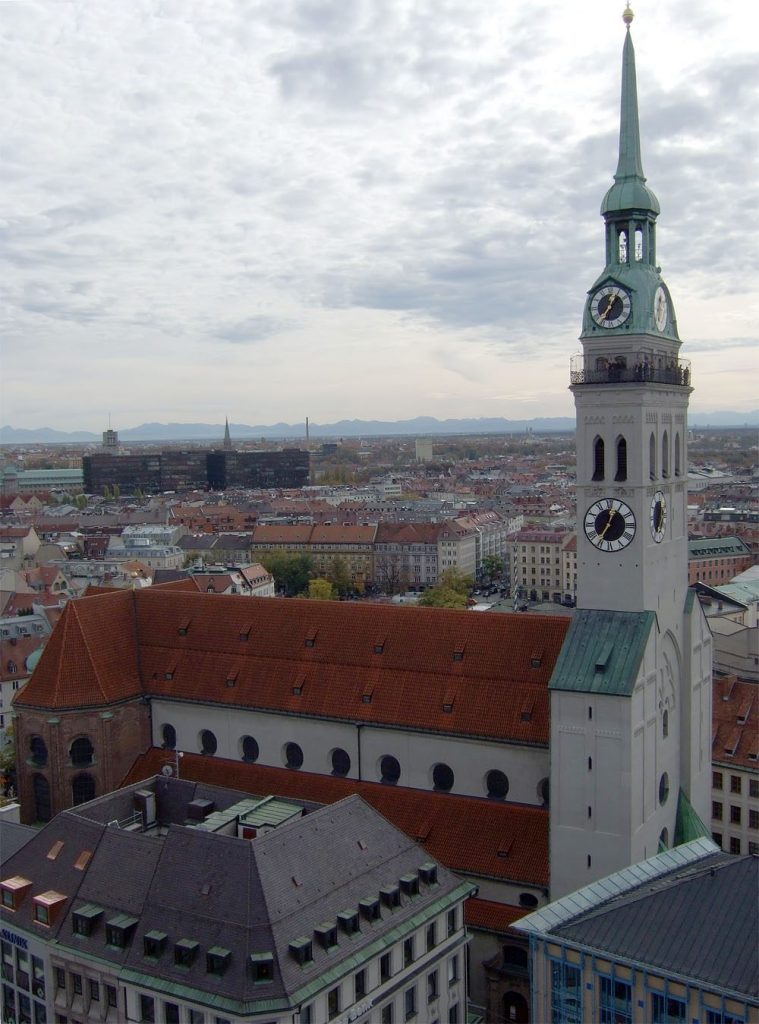
Just south of the square stands St Peter’s, the oldest parish church in Munich. People call it Alter Peter, Old Peter. Its church goes back to the beginnings of the city in the 12th century.
If you have the legs, climb the tower — about three hundred steps. From the top you look straight down onto the Marienplatz and the town hall tower, and on a clear day, especially when the warm Föhn wind blows, you can see the Alps on the horizon.
6. The Viktualienmarkt
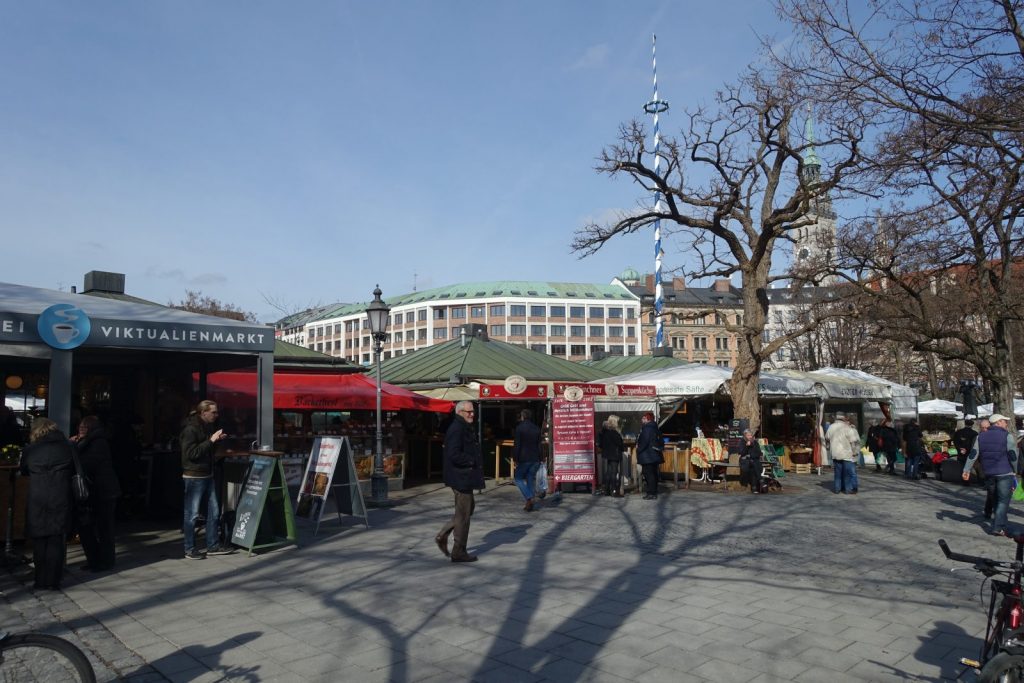
The Viktualienmarkt, with its maypole and food stalls. Photo: Wikiolo / CC BY-SA 3.0
Walk on past the back of St Peter’s to the Viktualienmarkt, Munich’s food market, held here since 1807. Its stalls sell fruit, vegetables, cheese, sausages, flowers and Bavarian specialities, and there is a beer garden in the middle under the chestnut trees.
Look for the tall maypole, painted in Bavarian blue and white, with figures of the city’s trades, and for the little fountains with statues of Munich’s favourite folk singers and comedians. This is a good place for a quick lunch: a Weisswurst, the white veal sausage, is traditionally eaten before noon.
7. The Hofbräuhaus
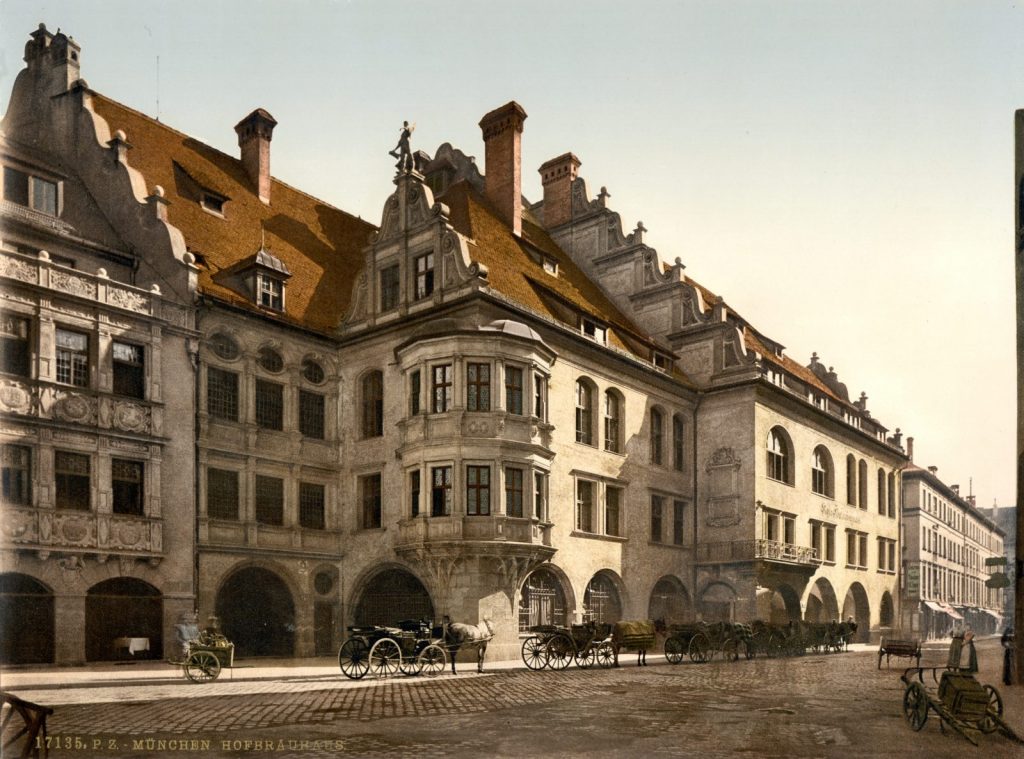
The Hofbräuhaus around 1900: the building on Platzl looks the same today. Photo: unknown author / public domain
Walk north-east through the lanes to the Platzl and the Hofbräuhaus, the most famous beer hall in the world. The brewery was founded in 1589 by Duke Wilhelm the Fifth for his court; the present building, with its great vaulted hall, dates from the 1890s.
Inside, beer comes by the litre, in a stone or glass mug called a Mass, with a brass band playing and long wooden tables shared with strangers. Regulars keep their own mugs locked in the hall. In 1920, the Nazi party held its first big meeting in the hall upstairs — one of the darker pages in the building’s history.
8. Max-Joseph-Platz and the Residenz
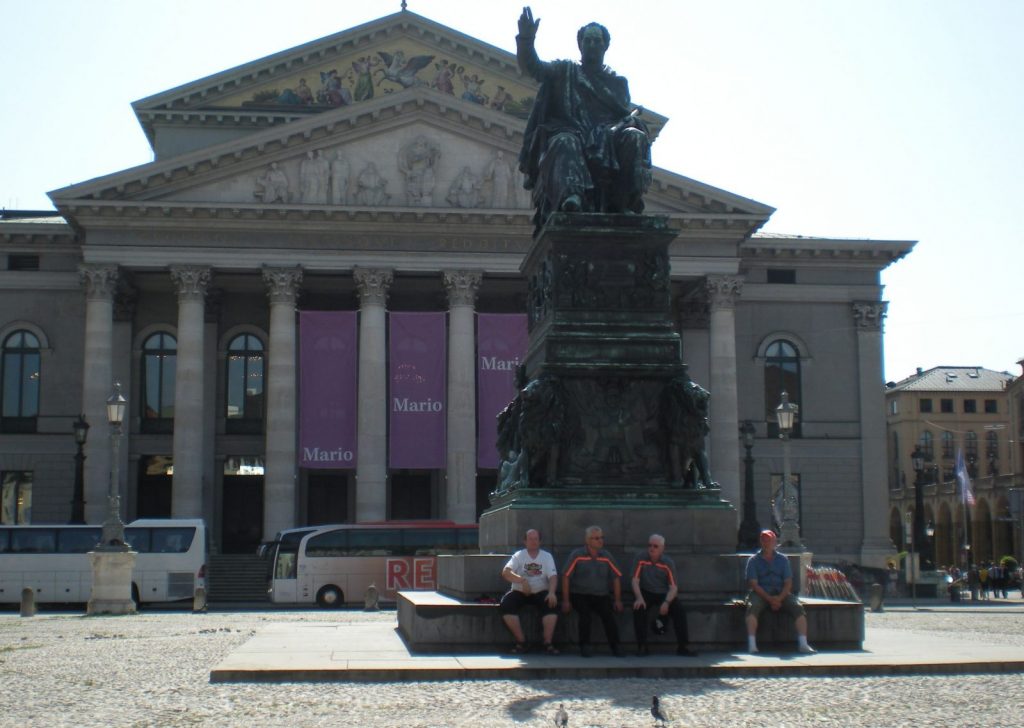
Max-Joseph-Platz: the National Theatre behind the statue of King Max I Joseph. Photo: Tony Castle / CC BY-SA 4.0
Continue north to Max-Joseph-Platz. In front of you stands the National Theatre, home of the Bavarian State Opera, with its columned front. The long building beside it is the Residenz, the city palace of the Wittelsbach dukes, electors and kings, and the largest city palace in Germany.
Its museum shows more than a hundred rooms, including the Antiquarium, a vast Renaissance hall, and the Treasury, with crowns and jewels of the Bavarian rulers. In Advent, one of the palace courtyards holds a small Christmas village.
As you walk on along Residenzstraße, look at the four bronze lions in front of the palace. Munich people touch their shields as they pass, for luck.
9. The Odeonsplatz and the Feldherrnhalle
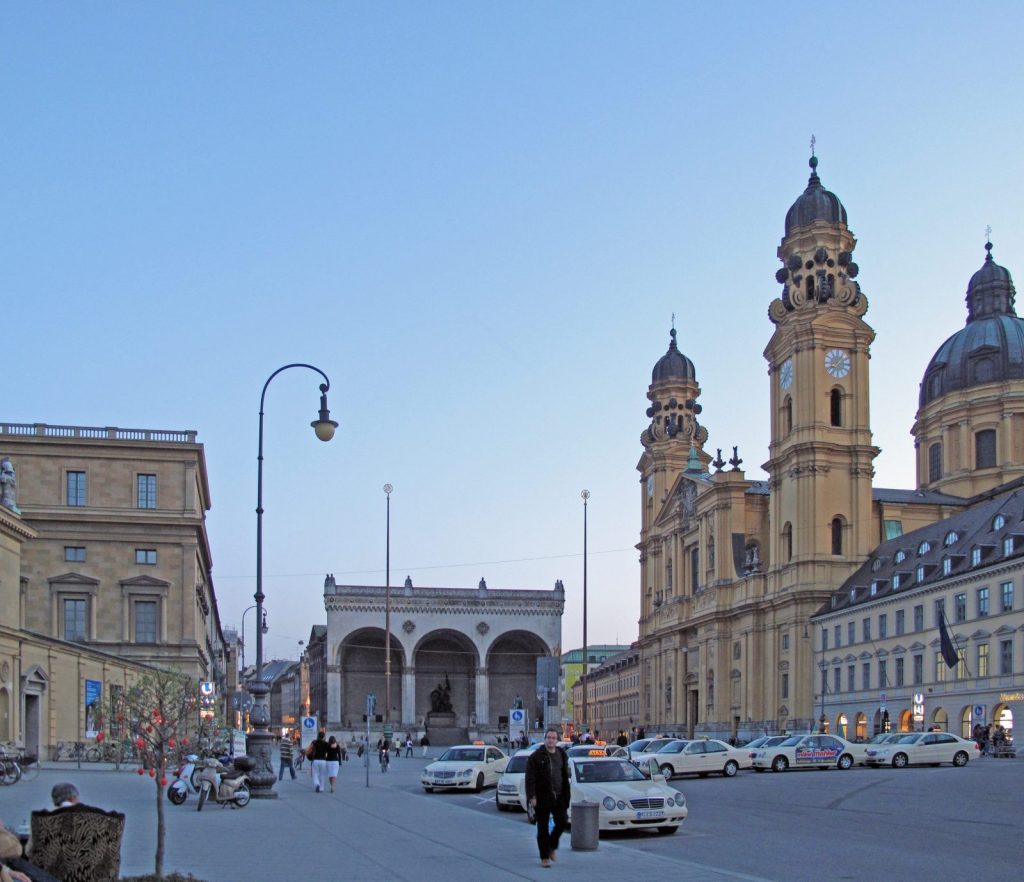
Odeonsplatz, with the Feldherrnhalle and the yellow Theatine Church. Photo: Schlaier / public domain
The walk ends at the Odeonsplatz. The open loggia in front of you is the Feldherrnhalle, the Field Marshals’ Hall, built in the 1840s for King Ludwig the First and modelled on the Loggia dei Lanzi in Florence. On 9 November 1923, Hitler’s failed Beer Hall Putsch ended here, when the police opened fire on the marchers.
Beside it rises the yellow Theatine Church, a piece of Italian Baroque built after the long-awaited birth of an heir to the Bavarian throne; entry is free. Across the square are the gates of the Hofgarten, the palace garden, and just beyond the square is the Wittelsbacherplatz, where a medieval Christmas market is held in Advent.
This is the end of the walk. If you came on the day trip, this is where your driver picks you up for the drive home.
Getting to Munich from Prague
Munich is about 380 km and four hours by car from Prague. A day trip is long, but with a driver you can rest on the way, and the day trip above drops you at the start of this walk. If you are staying in Munich, see our one-way taxi from Prague to Munich. Trains and buses are compared on our how to get there page.
Frequently asked questions
Is there a free audio guide to Munich in English?
Yes — this page. Every stop has its own English audio track that plays in your phone’s browser, and the whole tour is also one MP3 you can download before you go. No app or account is needed.
Can you see Munich in a day trip from Prague?
The old centre, yes. It is about four hours each way, so a twelve-hour day leaves about four hours in Munich — enough for this walk and a beer-hall lunch. Leave earlier for more time; Neuschwanstein and the big museums need an overnight stay.
Do I need a passport to go from Prague to Munich?
Yes, take a passport or national ID card. Both countries are in Schengen, but Germany runs checks at its land borders, including the Czech one.
When does the Glockenspiel play on the Marienplatz?
Every day at 11 am and noon, and from March to October also at 5 pm. Each show lasts about ten to fifteen minutes.
Is the Frauenkirche free to visit?
Yes. So are St Michael’s Church and the Theatine Church. The crypt of St Michael’s with King Ludwig the Second’s tomb and the tower of St Peter’s are paid.
Where are the Christmas markets in central Munich?
The main Christkindlmarkt is on the Marienplatz, stop 4, with the city’s Christmas tree, and it spreads along the shopping street towards the Karlstor. There is also a Christmas village in the Residenz, stop 8, and a medieval market on the Wittelsbacherplatz by the Odeonsplatz, stop 9.